

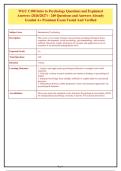
WGU C180 Intro to Psychology Questions and Explained
Answers (2026/2027) - 240 Questions and Answers Already
Graded A+ Premium Exam Tested And Verified
Subject Area Introductory Psychology
Description This exam covers major domains of psychology including biological bases,
cognition, development, social psychology, psychopathology, and research
methods. Questions require integration of concepts and application to novel
scenarios at an advanced undergraduate level.
Expected Grade A+
Total Questions 240
Duration 3 hours
Learning Outcomes 1. Analyze and apply major psychological theories to complex real-world
situations
2. Critically evaluate research methods and statistical findings in psychological
studies
3. Integrate knowledge from multiple subfields to explain behavior and mental
processes
4. Differentiate between subtle diagnostic criteria and treatment approaches for
psychological disorders
Accreditation This exam meets the standards of the American Psychological Association (APA)
for undergraduate psychology curricula at top-tier US research universities.
Page 1
,1. A researcher uses fMRI to measure brain activity while participants perform a
working memory task. She finds that the dorsolateral prefrontal cortex (DLPFC) is
more active during high-load trials. Which conclusion is most justified?
A. The DLPFC is uniquely necessary for working memory.
B. The DLPFC is correlated with working memory load but causality cannot be inferred
from fMRI alone.
C. Working memory is localized exclusively to the DLPFC.
D. The DLPFC activation is an artifact of the fMRI BOLD signal, not neural activity.
Answer: B. The DLPFC is correlated with working memory load but causality
cannot be inferred from fMRI alone.
fMRI measures blood flow changes (BOLD signal) correlated with neural activity, but
correlation does not imply causation. Option B correctly notes that fMRI data show
association, not causation. Option A and C overstate localization, and D is incorrect
because BOLD signal reliably reflects neural activity.
2. In a classic conditioning paradigm, a tone is paired with a mild shock until the
tone alone elicits a fear response. Then, the tone is presented repeatedly without the
shock. Which of the following best describes the neural mechanism underlying the
reduction of the fear response?
A. Long-term potentiation in the amygdala strengthens inhibitory connections.
B. Extinction involves new learning in the prefrontal cortex that suppresses the conditioned
response.
C. The conditioned stimulus becomes associated with the unconditioned stimulus again.
D. The amygdala's fear circuit undergoes apoptosis, permanently erasing the memory.
Answer: B. Extinction involves new learning in the prefrontal cortex that
suppresses the conditioned response.
Extinction does not erase the original fear memory but involves new inhibitory learning
mediated by the ventromedial prefrontal cortex (vmPFC) that suppresses the
amygdala's fear response. Option A is incorrect because LTP typically strengthens
excitatory connections. Option C describes reacquisition, not extinction. Option D is
false; the memory persists.
Page 2
,3. A researcher conducts a study on the effect of sleep on memory consolidation.
Participants learn a list of words and are randomly assigned to either sleep or stay
awake. The next day, they recall the words. Which statistical test should be used to
analyze the difference in recall between the two groups?
A. Chi-square test of independence
B. Pearson correlation
C. Independent samples t-test
D. One-sample t-test
Answer: C. Independent samples t-test
The independent samples t-test compares means between two independent groups (sleep
vs. awake) on a continuous dependent variable (number of words recalled). Chi-square
is for categorical data; correlation assesses association between two continuous
variables; one-sample t-test compares a sample mean to a known value.
4. Which of the following best illustrates the 'actor-observer asymmetry' in
attribution theory?
A. A student attributes their own poor exam performance to the difficulty of the test, but
attributes another student's poor performance to lack of effort.
B. A teacher attributes a student's success to hard work, but the student attributes it to luck.
C. A person attributes their own success to ability, but others' success to external factors.
D. A manager attributes a team's failure to external market conditions, but the team attributes
it to poor leadership.
Answer: A. A student attributes their own poor exam performance to the difficulty
of the test, but attributes another student's poor performance to lack of effort.
Actor-observer asymmetry refers to the tendency to attribute our own behavior to
situational factors (actor) and others' behavior to dispositional factors (observer).
Option A perfectly captures this: the student (actor) uses situational attribution for self,
but dispositional for the other student. The other options do not reflect the
actor-observer distinction.
Page 3
, 5. A child raised in an orphanage with minimal social interaction shows delayed
language development and difficulty forming attachments. According to Bowlby's
theory, which critical period is most likely disrupted?
A. The sensorimotor stage of cognitive development
B. The critical period for attachment formation in the first few years of life
C. The latency stage of psychosexual development
D. The concrete operational stage of moral reasoning
Answer: B. The critical period for attachment formation in the first few years of
life
Bowlby's attachment theory posits a critical period (sensitive period) in the first 2-3
years for forming secure attachments. Disruption during this period leads to long-term
social and emotional difficulties. Option A refers to Piaget's sensorimotor stage, which
focuses on cognitive, not attachment, development. Options C and D are from Freud
and Piaget, respectively, and are not relevant.
6. A patient with a history of depression is prescribed a selective serotonin reuptake
inhibitor (SSRI). After two weeks, the patient reports no improvement and is
considering stopping the medication. What is the most appropriate response based
on pharmacological principles?
A. SSRIs typically require 4-6 weeks to achieve full therapeutic effect due to downstream
adaptive changes.
B. The patient is a non-responder and should switch to a different class immediately.
C. The dose should be doubled to accelerate the onset of action.
D. SSRIs are ineffective for depression and should be discontinued.
Answer: A. SSRIs typically require 4-6 weeks to achieve full therapeutic effect due
to downstream adaptive changes.
SSRIs increase serotonin availability quickly, but therapeutic response takes weeks
because of neuroadaptive changes like receptor downregulation and increased
neurogenesis. Option A accurately reflects this. Option B is premature; option C
increases side effects without speeding response; option D is false.
Page 4
Answers (2026/2027) - 240 Questions and Answers Already
Graded A+ Premium Exam Tested And Verified
Subject Area Introductory Psychology
Description This exam covers major domains of psychology including biological bases,
cognition, development, social psychology, psychopathology, and research
methods. Questions require integration of concepts and application to novel
scenarios at an advanced undergraduate level.
Expected Grade A+
Total Questions 240
Duration 3 hours
Learning Outcomes 1. Analyze and apply major psychological theories to complex real-world
situations
2. Critically evaluate research methods and statistical findings in psychological
studies
3. Integrate knowledge from multiple subfields to explain behavior and mental
processes
4. Differentiate between subtle diagnostic criteria and treatment approaches for
psychological disorders
Accreditation This exam meets the standards of the American Psychological Association (APA)
for undergraduate psychology curricula at top-tier US research universities.
Page 1
,1. A researcher uses fMRI to measure brain activity while participants perform a
working memory task. She finds that the dorsolateral prefrontal cortex (DLPFC) is
more active during high-load trials. Which conclusion is most justified?
A. The DLPFC is uniquely necessary for working memory.
B. The DLPFC is correlated with working memory load but causality cannot be inferred
from fMRI alone.
C. Working memory is localized exclusively to the DLPFC.
D. The DLPFC activation is an artifact of the fMRI BOLD signal, not neural activity.
Answer: B. The DLPFC is correlated with working memory load but causality
cannot be inferred from fMRI alone.
fMRI measures blood flow changes (BOLD signal) correlated with neural activity, but
correlation does not imply causation. Option B correctly notes that fMRI data show
association, not causation. Option A and C overstate localization, and D is incorrect
because BOLD signal reliably reflects neural activity.
2. In a classic conditioning paradigm, a tone is paired with a mild shock until the
tone alone elicits a fear response. Then, the tone is presented repeatedly without the
shock. Which of the following best describes the neural mechanism underlying the
reduction of the fear response?
A. Long-term potentiation in the amygdala strengthens inhibitory connections.
B. Extinction involves new learning in the prefrontal cortex that suppresses the conditioned
response.
C. The conditioned stimulus becomes associated with the unconditioned stimulus again.
D. The amygdala's fear circuit undergoes apoptosis, permanently erasing the memory.
Answer: B. Extinction involves new learning in the prefrontal cortex that
suppresses the conditioned response.
Extinction does not erase the original fear memory but involves new inhibitory learning
mediated by the ventromedial prefrontal cortex (vmPFC) that suppresses the
amygdala's fear response. Option A is incorrect because LTP typically strengthens
excitatory connections. Option C describes reacquisition, not extinction. Option D is
false; the memory persists.
Page 2
,3. A researcher conducts a study on the effect of sleep on memory consolidation.
Participants learn a list of words and are randomly assigned to either sleep or stay
awake. The next day, they recall the words. Which statistical test should be used to
analyze the difference in recall between the two groups?
A. Chi-square test of independence
B. Pearson correlation
C. Independent samples t-test
D. One-sample t-test
Answer: C. Independent samples t-test
The independent samples t-test compares means between two independent groups (sleep
vs. awake) on a continuous dependent variable (number of words recalled). Chi-square
is for categorical data; correlation assesses association between two continuous
variables; one-sample t-test compares a sample mean to a known value.
4. Which of the following best illustrates the 'actor-observer asymmetry' in
attribution theory?
A. A student attributes their own poor exam performance to the difficulty of the test, but
attributes another student's poor performance to lack of effort.
B. A teacher attributes a student's success to hard work, but the student attributes it to luck.
C. A person attributes their own success to ability, but others' success to external factors.
D. A manager attributes a team's failure to external market conditions, but the team attributes
it to poor leadership.
Answer: A. A student attributes their own poor exam performance to the difficulty
of the test, but attributes another student's poor performance to lack of effort.
Actor-observer asymmetry refers to the tendency to attribute our own behavior to
situational factors (actor) and others' behavior to dispositional factors (observer).
Option A perfectly captures this: the student (actor) uses situational attribution for self,
but dispositional for the other student. The other options do not reflect the
actor-observer distinction.
Page 3
, 5. A child raised in an orphanage with minimal social interaction shows delayed
language development and difficulty forming attachments. According to Bowlby's
theory, which critical period is most likely disrupted?
A. The sensorimotor stage of cognitive development
B. The critical period for attachment formation in the first few years of life
C. The latency stage of psychosexual development
D. The concrete operational stage of moral reasoning
Answer: B. The critical period for attachment formation in the first few years of
life
Bowlby's attachment theory posits a critical period (sensitive period) in the first 2-3
years for forming secure attachments. Disruption during this period leads to long-term
social and emotional difficulties. Option A refers to Piaget's sensorimotor stage, which
focuses on cognitive, not attachment, development. Options C and D are from Freud
and Piaget, respectively, and are not relevant.
6. A patient with a history of depression is prescribed a selective serotonin reuptake
inhibitor (SSRI). After two weeks, the patient reports no improvement and is
considering stopping the medication. What is the most appropriate response based
on pharmacological principles?
A. SSRIs typically require 4-6 weeks to achieve full therapeutic effect due to downstream
adaptive changes.
B. The patient is a non-responder and should switch to a different class immediately.
C. The dose should be doubled to accelerate the onset of action.
D. SSRIs are ineffective for depression and should be discontinued.
Answer: A. SSRIs typically require 4-6 weeks to achieve full therapeutic effect due
to downstream adaptive changes.
SSRIs increase serotonin availability quickly, but therapeutic response takes weeks
because of neuroadaptive changes like receptor downregulation and increased
neurogenesis. Option A accurately reflects this. Option B is premature; option C
increases side effects without speeding response; option D is false.
Page 4


