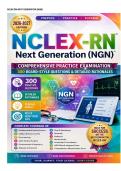
NCLEX-RN NEXT GENERATION (NGN)
,Table of Contents
NCLEX-RN Comprehensive Practice Examination (300 Questions)
Section Topic Question Range
1 Fundamentals of Nursing 1–30
2 Adult Medical-Surgical Nursing 31–100
3 Cardiovascular & Respiratory Nursing 101–128
4 Diabetes & Endocrine Disorders 129–140
5 Fluid, Electrolyte & Acid-Base Balance 141–155
6 Maternal-Newborn (Maternity Nursing) 156–180
7 Pediatric Nursing 181–195
8 Mental Health Nursing 196–210
9 Leadership, Management & Prioritization 211–225
10 Integrated NGN Clinical Judgment Case Studies 226–240
11 Comprehensive Mixed Practice Cases 241–300
Total Questions by Section
• Fundamentals of Nursing – 30 Questions
• Adult Medical-Surgical Nursing – 70 Questions
• Cardiovascular & Respiratory Nursing – 28 Questions
• Diabetes & Endocrine Disorders – 12 Questions
• Fluid, Electrolyte & Acid-Base Balance – 15 Questions
• Maternal-Newborn (Maternity Nursing) – 25 Questions
• Pediatric Nursing – 15 Questions
• Mental Health Nursing – 15 Questions
• Leadership, Management & Prioritization – 15 Questions
• Integrated NGN Clinical Judgment Case Studies – 15 Questions
• Comprehensive Mixed Practice Cases – 60 Questions
,Examination Summary
• Total Questions: 300
• Question Format: Four-option Multiple Choice (A–D)
• Difficulty Level: NCLEX-RN / NGN Board-Style
• Answer Distribution: Randomized and Unpredictable
• Each Question Includes:
o Correct Answer
o Detailed Rationale
o Why the Other Options Are Incorrect
o Clinical Pearl
o NCLEX High-Yield Tip
NCLEX-RN Next Generation (NGN)
Fundamentals & Nursing Process
1. During morning rounds, a nurse finds an older adult client suddenly confused and attempting to climb out
of bed. Which action should the nurse take first?
A. Apply soft wrist restraints.
B. Notify the healthcare provider.
C. Assess the client's airway, breathing, circulation, and blood glucose.
D. Ask the nursing assistant to stay with the client.
Answer: C
Rationale: Sudden confusion is an acute change in condition that may result from hypoxia, hypoglycemia,
infection, or other life-threatening causes. The nurse should immediately assess the client using the ABCs and
determine possible reversible causes before implementing additional interventions.
Why not the others?
• A: Restraints are a last resort after less restrictive interventions fail.
• B: Assessment must occur before notifying the provider.
• D: Observation is helpful but does not replace immediate assessment.
Clinical Pearl: Acute confusion should always be treated as a medical emergency until proven otherwise.
, NCLEX High-Yield Tip: Unexpected changes in mental status require immediate assessment before
intervention.
2. While preparing morning medications, a nurse notices that a prescribed dose appears much higher than
the usual therapeutic dose. What is the best nursing action?
A. Hold the medication and verify the prescription before administering it.
B. Administer half the prescribed dose.
C. Give the medication because it was prescribed.
D. Ask another nurse to administer the medication.
Answer: A
Rationale: Nurses are responsible for questioning medication orders that appear unsafe. The prescription
should be verified before administration to prevent medication errors.
Why not the others?
• B: Nurses should never change prescribed doses independently.
• C: Administering a questionable dose may harm the client.
• D: Delegating does not resolve the safety concern.
Clinical Pearl: Every nurse is accountable for safe medication administration.
NCLEX High-Yield Tip: When in doubt, hold the medication and clarify.
3. A postoperative client reports increasing shortness of breath and chest discomfort. Which nursing action
has the highest priority?
A. Encourage coughing and deep breathing.
B. Obtain a routine pain assessment.
C. Document the client's complaints.
D. Assess oxygen saturation, respiratory effort, and vital signs immediately.
Answer: D
Rationale: Shortness of breath with chest discomfort may indicate pulmonary embolism or another life-
threatening complication. Immediate assessment of respiratory and cardiovascular status is essential.
Why not the others?
• A: Helpful only after determining the cause.
, • B: Pain assessment alone is insufficient.
• C: Documentation follows assessment and intervention.
Clinical Pearl: Sudden dyspnea after surgery should raise concern for pulmonary embolism.
NCLEX High-Yield Tip: ABCs always take priority.
4. Which client should the nurse assess first after receiving shift report?
A. A client requesting assistance with bathing.
B. A client whose oxygen saturation decreased from 97% to 88%.
C. A client awaiting discharge teaching.
D. A client requesting a snack.
Answer: B
Rationale: A significant decrease in oxygen saturation indicates impaired oxygenation and requires immediate
assessment.
Why not the others?
• A: Hygiene needs are important but not urgent.
• C: Teaching can safely wait.
• D: A snack is not the priority.
Clinical Pearl: Respiratory deterioration often occurs before cardiovascular collapse.
NCLEX High-Yield Tip: Unstable clients are always assessed before stable clients.
5. A nurse is developing a plan of care for a client newly diagnosed with heart failure. Which nursing process
step is being performed?
A. Assessment
B. Evaluation
C. Planning
D. Implementation
Answer: C
Rationale: Planning involves establishing measurable goals and selecting nursing interventions based on
assessment findings and nursing diagnoses.
,Why not the others?
• A: Assessment involves collecting data.
• B: Evaluation measures whether outcomes were achieved.
• D: Implementation is carrying out planned interventions.
Clinical Pearl: Every intervention should be linked to a specific nursing diagnosis and desired outcome.
NCLEX High-Yield Tip: ADPIE = Assess, Diagnose, Plan, Implement, Evaluate.
6. Before assisting a client to ambulate for the first time after surgery, which nursing action is most
appropriate?
A. Encourage the client to walk independently.
B. Administer pain medication after ambulation.
C. Place the client in a wheelchair immediately.
D. Assess for dizziness by helping the client sit at the bedside first.
Answer: D
Rationale: Sitting at the bedside allows assessment for orthostatic hypotension before standing or walking.
Why not the others?
• A: The client should not ambulate independently initially.
• B: Pain should be managed before activity if needed.
• C: A wheelchair may not be necessary unless the client cannot tolerate ambulation.
Clinical Pearl: Gradual position changes reduce fall risk.
NCLEX High-Yield Tip: Dangle before standing after surgery.
7. Which assessment finding should the nurse report immediately?
A. Blood glucose of 102 mg/dL.
B. Potassium level of 2.9 mEq/L.
C. Heart rate of 82 beats/min.
D. Respiratory rate of 18 breaths/min.
Answer: B
,Rationale: Severe hypokalemia increases the risk of life-threatening cardiac dysrhythmias and requires prompt
intervention.
Why not the others?
• A: Within expected range.
• C: Normal adult heart rate.
• D: Normal respiratory rate.
Clinical Pearl: Potassium abnormalities can rapidly affect cardiac conduction.
NCLEX High-Yield Tip: Low potassium = Think dysrhythmias.
8. A nurse evaluates a client's pain 30 minutes after administering IV morphine. The client reports pain
decreased from 8/10 to 3/10. Which nursing process step is demonstrated?
A. Assessment
B. Planning
C. Evaluation
D. Diagnosis
Answer: C
Rationale: Comparing the client's response with the expected outcome is part of the evaluation phase.
Why not the others?
• A: Assessment collects baseline data.
• B: Planning establishes goals.
• D: Diagnosis identifies health problems.
Clinical Pearl: Always reassess pain after interventions.
NCLEX High-Yield Tip: Reassessment = Evaluation.
9. Which nursing action best demonstrates therapeutic communication?
A. "You shouldn't worry about your surgery."
B. "Everything will be fine."
C. "Many people have experienced this."
D. "Tell me what concerns you most about your surgery."
,Answer: D
Rationale: Open-ended questions encourage clients to express thoughts and feelings, allowing individualized
assessment.
Why not the others?
• A: Dismisses the client's feelings.
• B: Offers false reassurance.
• C: Minimizes the client's unique experience.
Clinical Pearl: Therapeutic communication focuses on the client's perspective.
NCLEX High-Yield Tip: Open-ended questions gather the most meaningful information.
10. A client refuses a scheduled blood transfusion after receiving education about its benefits and risks.
What is the nurse's best response?
A. Inform the client that refusal is not allowed.
B. Respect the client's decision and notify the healthcare provider.
C. Ask a family member to give consent.
D. Begin the transfusion because it was prescribed.
Answer: B
Rationale: Competent clients have the legal right to refuse treatment after receiving adequate information.
The nurse should respect the decision, ensure it is informed, document it, and notify the provider.
Why not the others?
• A: Clients have the right to refuse care.
• C: Family members cannot override a competent adult's decision.
• D: Administering treatment without consent is inappropriate.
Clinical Pearl: Respect for autonomy is a fundamental ethical principle.
NCLEX High-Yield Tip: Competent adults may refuse any treatment.
11. Which client should the nurse identify as the highest priority?
A. A client with sudden onset of difficulty speaking and right-sided weakness.
B. A client requesting assistance with repositioning.
,C. A client waiting for discharge prescriptions.
D. A client reporting mild nausea after breakfast.
Answer: A
Rationale: Sudden neurological deficits suggest an acute stroke, which requires immediate evaluation and
treatment.
Why not the others?
• B: Repositioning is important but not emergent.
• C: Discharge can wait.
• D: Mild nausea is less urgent.
Clinical Pearl: Time-sensitive conditions such as stroke require immediate recognition.
NCLEX High-Yield Tip: Think FAST: Face, Arm, Speech, Time.
12. A nurse delegates ambulation of a stable postoperative client to an experienced unlicensed assistive
personnel (UAP). Which responsibility remains with the nurse?
A. Performing the initial assessment before delegation.
B. Recording the client's intake and output.
C. Delivering meal trays.
D. Changing the client's bed linens.
Answer: A
Rationale: Assessment, clinical judgment, and evaluation cannot be delegated.
Why not the others?
• B: May be delegated if appropriate.
• C: Appropriate for UAP.
• D: Appropriate for UAP.
Clinical Pearl: Nurses delegate tasks—not nursing judgment.
NCLEX High-Yield Tip: Assess, teach, evaluate, and judge—these remain the nurse's responsibility.
13. Which finding indicates that a client's care goals have been achieved?
A. The nursing diagnosis has been documented.
, B. The provider has written discharge orders.
C. The client's oxygen saturation improved from 86% to 95% on room air.
D. The client received prescribed medications.
Answer: C
Rationale: Improved oxygen saturation demonstrates that the expected outcome has been achieved.
Why not the others?
• A: Documentation alone does not demonstrate improvement.
• B: Discharge orders do not confirm outcomes.
• D: Receiving medication does not necessarily indicate effectiveness.
Clinical Pearl: Outcomes should be measurable and client-centered.
NCLEX High-Yield Tip: Evaluation asks, "Did the client improve?"
14. A nurse receives a prescription that is difficult to read and appears incomplete. What should the nurse
do first?
A. Ask another nurse to interpret the prescription.
B. Administer the medication based on previous doses.
C. Clarify the prescription with the prescribing healthcare provider.
D. Delay the medication until the next scheduled dose.
Answer: C
Rationale: Unclear or incomplete prescriptions must be clarified before medications are administered.
Why not the others?
• A: Colleagues should not interpret ambiguous prescriptions.
• B: Guessing jeopardizes client safety.
• D: Delaying without clarification may also harm the client.
Clinical Pearl: Safe practice requires complete and accurate medication orders.
NCLEX High-Yield Tip: Never guess what a prescription means.
15. Which action by the nurse best reflects patient-centered care?
A. Following the same care plan for every client with the same diagnosis.
,Table of Contents
NCLEX-RN Comprehensive Practice Examination (300 Questions)
Section Topic Question Range
1 Fundamentals of Nursing 1–30
2 Adult Medical-Surgical Nursing 31–100
3 Cardiovascular & Respiratory Nursing 101–128
4 Diabetes & Endocrine Disorders 129–140
5 Fluid, Electrolyte & Acid-Base Balance 141–155
6 Maternal-Newborn (Maternity Nursing) 156–180
7 Pediatric Nursing 181–195
8 Mental Health Nursing 196–210
9 Leadership, Management & Prioritization 211–225
10 Integrated NGN Clinical Judgment Case Studies 226–240
11 Comprehensive Mixed Practice Cases 241–300
Total Questions by Section
• Fundamentals of Nursing – 30 Questions
• Adult Medical-Surgical Nursing – 70 Questions
• Cardiovascular & Respiratory Nursing – 28 Questions
• Diabetes & Endocrine Disorders – 12 Questions
• Fluid, Electrolyte & Acid-Base Balance – 15 Questions
• Maternal-Newborn (Maternity Nursing) – 25 Questions
• Pediatric Nursing – 15 Questions
• Mental Health Nursing – 15 Questions
• Leadership, Management & Prioritization – 15 Questions
• Integrated NGN Clinical Judgment Case Studies – 15 Questions
• Comprehensive Mixed Practice Cases – 60 Questions
,Examination Summary
• Total Questions: 300
• Question Format: Four-option Multiple Choice (A–D)
• Difficulty Level: NCLEX-RN / NGN Board-Style
• Answer Distribution: Randomized and Unpredictable
• Each Question Includes:
o Correct Answer
o Detailed Rationale
o Why the Other Options Are Incorrect
o Clinical Pearl
o NCLEX High-Yield Tip
NCLEX-RN Next Generation (NGN)
Fundamentals & Nursing Process
1. During morning rounds, a nurse finds an older adult client suddenly confused and attempting to climb out
of bed. Which action should the nurse take first?
A. Apply soft wrist restraints.
B. Notify the healthcare provider.
C. Assess the client's airway, breathing, circulation, and blood glucose.
D. Ask the nursing assistant to stay with the client.
Answer: C
Rationale: Sudden confusion is an acute change in condition that may result from hypoxia, hypoglycemia,
infection, or other life-threatening causes. The nurse should immediately assess the client using the ABCs and
determine possible reversible causes before implementing additional interventions.
Why not the others?
• A: Restraints are a last resort after less restrictive interventions fail.
• B: Assessment must occur before notifying the provider.
• D: Observation is helpful but does not replace immediate assessment.
Clinical Pearl: Acute confusion should always be treated as a medical emergency until proven otherwise.
, NCLEX High-Yield Tip: Unexpected changes in mental status require immediate assessment before
intervention.
2. While preparing morning medications, a nurse notices that a prescribed dose appears much higher than
the usual therapeutic dose. What is the best nursing action?
A. Hold the medication and verify the prescription before administering it.
B. Administer half the prescribed dose.
C. Give the medication because it was prescribed.
D. Ask another nurse to administer the medication.
Answer: A
Rationale: Nurses are responsible for questioning medication orders that appear unsafe. The prescription
should be verified before administration to prevent medication errors.
Why not the others?
• B: Nurses should never change prescribed doses independently.
• C: Administering a questionable dose may harm the client.
• D: Delegating does not resolve the safety concern.
Clinical Pearl: Every nurse is accountable for safe medication administration.
NCLEX High-Yield Tip: When in doubt, hold the medication and clarify.
3. A postoperative client reports increasing shortness of breath and chest discomfort. Which nursing action
has the highest priority?
A. Encourage coughing and deep breathing.
B. Obtain a routine pain assessment.
C. Document the client's complaints.
D. Assess oxygen saturation, respiratory effort, and vital signs immediately.
Answer: D
Rationale: Shortness of breath with chest discomfort may indicate pulmonary embolism or another life-
threatening complication. Immediate assessment of respiratory and cardiovascular status is essential.
Why not the others?
• A: Helpful only after determining the cause.
, • B: Pain assessment alone is insufficient.
• C: Documentation follows assessment and intervention.
Clinical Pearl: Sudden dyspnea after surgery should raise concern for pulmonary embolism.
NCLEX High-Yield Tip: ABCs always take priority.
4. Which client should the nurse assess first after receiving shift report?
A. A client requesting assistance with bathing.
B. A client whose oxygen saturation decreased from 97% to 88%.
C. A client awaiting discharge teaching.
D. A client requesting a snack.
Answer: B
Rationale: A significant decrease in oxygen saturation indicates impaired oxygenation and requires immediate
assessment.
Why not the others?
• A: Hygiene needs are important but not urgent.
• C: Teaching can safely wait.
• D: A snack is not the priority.
Clinical Pearl: Respiratory deterioration often occurs before cardiovascular collapse.
NCLEX High-Yield Tip: Unstable clients are always assessed before stable clients.
5. A nurse is developing a plan of care for a client newly diagnosed with heart failure. Which nursing process
step is being performed?
A. Assessment
B. Evaluation
C. Planning
D. Implementation
Answer: C
Rationale: Planning involves establishing measurable goals and selecting nursing interventions based on
assessment findings and nursing diagnoses.
,Why not the others?
• A: Assessment involves collecting data.
• B: Evaluation measures whether outcomes were achieved.
• D: Implementation is carrying out planned interventions.
Clinical Pearl: Every intervention should be linked to a specific nursing diagnosis and desired outcome.
NCLEX High-Yield Tip: ADPIE = Assess, Diagnose, Plan, Implement, Evaluate.
6. Before assisting a client to ambulate for the first time after surgery, which nursing action is most
appropriate?
A. Encourage the client to walk independently.
B. Administer pain medication after ambulation.
C. Place the client in a wheelchair immediately.
D. Assess for dizziness by helping the client sit at the bedside first.
Answer: D
Rationale: Sitting at the bedside allows assessment for orthostatic hypotension before standing or walking.
Why not the others?
• A: The client should not ambulate independently initially.
• B: Pain should be managed before activity if needed.
• C: A wheelchair may not be necessary unless the client cannot tolerate ambulation.
Clinical Pearl: Gradual position changes reduce fall risk.
NCLEX High-Yield Tip: Dangle before standing after surgery.
7. Which assessment finding should the nurse report immediately?
A. Blood glucose of 102 mg/dL.
B. Potassium level of 2.9 mEq/L.
C. Heart rate of 82 beats/min.
D. Respiratory rate of 18 breaths/min.
Answer: B
,Rationale: Severe hypokalemia increases the risk of life-threatening cardiac dysrhythmias and requires prompt
intervention.
Why not the others?
• A: Within expected range.
• C: Normal adult heart rate.
• D: Normal respiratory rate.
Clinical Pearl: Potassium abnormalities can rapidly affect cardiac conduction.
NCLEX High-Yield Tip: Low potassium = Think dysrhythmias.
8. A nurse evaluates a client's pain 30 minutes after administering IV morphine. The client reports pain
decreased from 8/10 to 3/10. Which nursing process step is demonstrated?
A. Assessment
B. Planning
C. Evaluation
D. Diagnosis
Answer: C
Rationale: Comparing the client's response with the expected outcome is part of the evaluation phase.
Why not the others?
• A: Assessment collects baseline data.
• B: Planning establishes goals.
• D: Diagnosis identifies health problems.
Clinical Pearl: Always reassess pain after interventions.
NCLEX High-Yield Tip: Reassessment = Evaluation.
9. Which nursing action best demonstrates therapeutic communication?
A. "You shouldn't worry about your surgery."
B. "Everything will be fine."
C. "Many people have experienced this."
D. "Tell me what concerns you most about your surgery."
,Answer: D
Rationale: Open-ended questions encourage clients to express thoughts and feelings, allowing individualized
assessment.
Why not the others?
• A: Dismisses the client's feelings.
• B: Offers false reassurance.
• C: Minimizes the client's unique experience.
Clinical Pearl: Therapeutic communication focuses on the client's perspective.
NCLEX High-Yield Tip: Open-ended questions gather the most meaningful information.
10. A client refuses a scheduled blood transfusion after receiving education about its benefits and risks.
What is the nurse's best response?
A. Inform the client that refusal is not allowed.
B. Respect the client's decision and notify the healthcare provider.
C. Ask a family member to give consent.
D. Begin the transfusion because it was prescribed.
Answer: B
Rationale: Competent clients have the legal right to refuse treatment after receiving adequate information.
The nurse should respect the decision, ensure it is informed, document it, and notify the provider.
Why not the others?
• A: Clients have the right to refuse care.
• C: Family members cannot override a competent adult's decision.
• D: Administering treatment without consent is inappropriate.
Clinical Pearl: Respect for autonomy is a fundamental ethical principle.
NCLEX High-Yield Tip: Competent adults may refuse any treatment.
11. Which client should the nurse identify as the highest priority?
A. A client with sudden onset of difficulty speaking and right-sided weakness.
B. A client requesting assistance with repositioning.
,C. A client waiting for discharge prescriptions.
D. A client reporting mild nausea after breakfast.
Answer: A
Rationale: Sudden neurological deficits suggest an acute stroke, which requires immediate evaluation and
treatment.
Why not the others?
• B: Repositioning is important but not emergent.
• C: Discharge can wait.
• D: Mild nausea is less urgent.
Clinical Pearl: Time-sensitive conditions such as stroke require immediate recognition.
NCLEX High-Yield Tip: Think FAST: Face, Arm, Speech, Time.
12. A nurse delegates ambulation of a stable postoperative client to an experienced unlicensed assistive
personnel (UAP). Which responsibility remains with the nurse?
A. Performing the initial assessment before delegation.
B. Recording the client's intake and output.
C. Delivering meal trays.
D. Changing the client's bed linens.
Answer: A
Rationale: Assessment, clinical judgment, and evaluation cannot be delegated.
Why not the others?
• B: May be delegated if appropriate.
• C: Appropriate for UAP.
• D: Appropriate for UAP.
Clinical Pearl: Nurses delegate tasks—not nursing judgment.
NCLEX High-Yield Tip: Assess, teach, evaluate, and judge—these remain the nurse's responsibility.
13. Which finding indicates that a client's care goals have been achieved?
A. The nursing diagnosis has been documented.
, B. The provider has written discharge orders.
C. The client's oxygen saturation improved from 86% to 95% on room air.
D. The client received prescribed medications.
Answer: C
Rationale: Improved oxygen saturation demonstrates that the expected outcome has been achieved.
Why not the others?
• A: Documentation alone does not demonstrate improvement.
• B: Discharge orders do not confirm outcomes.
• D: Receiving medication does not necessarily indicate effectiveness.
Clinical Pearl: Outcomes should be measurable and client-centered.
NCLEX High-Yield Tip: Evaluation asks, "Did the client improve?"
14. A nurse receives a prescription that is difficult to read and appears incomplete. What should the nurse
do first?
A. Ask another nurse to interpret the prescription.
B. Administer the medication based on previous doses.
C. Clarify the prescription with the prescribing healthcare provider.
D. Delay the medication until the next scheduled dose.
Answer: C
Rationale: Unclear or incomplete prescriptions must be clarified before medications are administered.
Why not the others?
• A: Colleagues should not interpret ambiguous prescriptions.
• B: Guessing jeopardizes client safety.
• D: Delaying without clarification may also harm the client.
Clinical Pearl: Safe practice requires complete and accurate medication orders.
NCLEX High-Yield Tip: Never guess what a prescription means.
15. Which action by the nurse best reflects patient-centered care?
A. Following the same care plan for every client with the same diagnosis.