

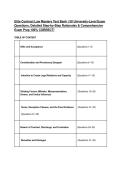
Elite Contract Law Mastery Test Bank | 50 University-Level Exam
Questions, Detailed Step-by-Step Rationales & Comprehensive
Exam Prep 100% CORRECT!
TABLE OF CONTENT
Offer and Acceptance (Questions 1–5)
Consideration and Promissory Estoppel (Questions 6–10)
Intention to Create Legal Relations and Capacity (Questions 11–15)
Vitiating Factors (Mistake, Misrepresentation, (Questions 16–20)
Duress, and Undue Influence)
Terms, Exemption Clauses, and the Parol Evidence (Questions 21–25)
(Questions 21–25)
Breach of Contract, Discharge, and Frustration (Questions 26–30)
Remedies and Damages (Questions 31–35)
, Additional Advanced Contract Scenarios (Questions 36–50)
1. Offer and Acceptance
Question 1
On Tuesday morning, Builder sends a letter to Supplier offering to purchase 500 bags of cement
for $10,000, stating: "If I do not hear from you by Thursday at noon, I will assume you have
accepted this offer." Supplier receives the letter on Wednesday but does not reply. By Thursday
afternoon, no cement has been delivered. Which of the following statements is legally correct
regarding this scenario?
● A. A binding contract was formed on Thursday at 12:01 PM because Supplier failed to
reject the offer.
● B. No contract was formed because silence cannot constitute acceptance, even if the
offeror stipulates it.
● C. A valid contract was formed as soon as Supplier received the letter on Wednesday.
● D. Supplier's silence acts as an effective counter-offer under modern commercial
standards.
Correct Answer: B. No contract was formed because silence cannot constitute acceptance,
even if the offeror stipulates it.
Rationale: As a general rule of contract law, an offeror cannot impose a contractual obligation
upon an offeree by stating that silence will be treated as consent. The offeree must manifest
assent through words or conduct unless a prior course of dealing or established custom dictates
otherwise.
Question 2
A local hardware store displays a specialized power tool on its shelf with a price tag of $45
displayed underneath it. A customer walks into the store, brings the tool to the cash register,
and places $45 on the counter, stating, "I accept your offer." The cashier refuses to sell the tool,
claiming the price tag was an error and the true price is $95. Does a binding contract exist?
● A. Yes, because displaying goods with a price tag on a shelf constitutes a binding offer
to the general public.
● B. Yes, because placing the money on the counter completes a valid bilateral contract
under common law.
, ● C. No, because the display of goods on a shelf is merely an invitation to treat, and the
customer's presentation of cash constitutes the offer.
● D. No, because retail store owners are legally exempt from pricing errors under uniform
commercial regulations.
Correct Answer: C. No, because the display of goods on a shelf is merely an invitation to treat,
and the customer's presentation of cash constitutes the offer.
Rationale: Under foundational contract principles (exemplified by cases such as
Pharmaceutical Society of Great Britain v Boots Cash Chemists), displaying items on shelves or
in windows is an invitation to deal or treat, not an offer. The customer makes the offer when
presenting the item to purchase, which the store is free to accept or reject.
Question 3
Seller offers to sell his vintage motorcycle to Buyer for $5,000, stating that the offer will remain
open for ten days. On day four, without communicating any revocation to Buyer, Seller sells the
motorcycle to a third party. On day six, Buyer learns of the sale from a mutual friend and
immediately attempts to accept Seller's original offer. What is the legal status of Buyer's
attempted acceptance?
● A. Effective, because the promise to keep the offer open for ten days created a binding
option contract.
● B. Effective, because revocation is only valid if sent via certified mail.
● C. Ineffective, because Seller's offer was successfully revoked when Buyer learned of
the sale to a third party through a reliable source.
● D. Ineffective, because offers terminate automatically after 48 hours under common law
rules.
Correct Answer: C. Ineffective, because Seller's offer was successfully revoked when Buyer
learned of the sale to a third party through a reliable source.
Rationale: An offer can be revoked at any time prior to acceptance, provided the revocation is
communicated to the offeree. Communication does not need to come directly from the offeror; if
the offeree receives reliable information from a third party that the offeror has taken action
inconsistent with continuing the offer (such as selling the item elsewhere), the offer is effectively
revoked. Furthermore, a bare promise to keep an offer open is unsupported by consideration
and is legally non-binding.
Question 4
Company A mails an offer to Company B on January 1 to sell specific machinery. Company B
mails a letter of rejection on January 2. On January 3, before receiving the rejection letter,
Company B changes its mind, sends an acceptance via expedited courier, and Company A
Questions, Detailed Step-by-Step Rationales & Comprehensive
Exam Prep 100% CORRECT!
TABLE OF CONTENT
Offer and Acceptance (Questions 1–5)
Consideration and Promissory Estoppel (Questions 6–10)
Intention to Create Legal Relations and Capacity (Questions 11–15)
Vitiating Factors (Mistake, Misrepresentation, (Questions 16–20)
Duress, and Undue Influence)
Terms, Exemption Clauses, and the Parol Evidence (Questions 21–25)
(Questions 21–25)
Breach of Contract, Discharge, and Frustration (Questions 26–30)
Remedies and Damages (Questions 31–35)
, Additional Advanced Contract Scenarios (Questions 36–50)
1. Offer and Acceptance
Question 1
On Tuesday morning, Builder sends a letter to Supplier offering to purchase 500 bags of cement
for $10,000, stating: "If I do not hear from you by Thursday at noon, I will assume you have
accepted this offer." Supplier receives the letter on Wednesday but does not reply. By Thursday
afternoon, no cement has been delivered. Which of the following statements is legally correct
regarding this scenario?
● A. A binding contract was formed on Thursday at 12:01 PM because Supplier failed to
reject the offer.
● B. No contract was formed because silence cannot constitute acceptance, even if the
offeror stipulates it.
● C. A valid contract was formed as soon as Supplier received the letter on Wednesday.
● D. Supplier's silence acts as an effective counter-offer under modern commercial
standards.
Correct Answer: B. No contract was formed because silence cannot constitute acceptance,
even if the offeror stipulates it.
Rationale: As a general rule of contract law, an offeror cannot impose a contractual obligation
upon an offeree by stating that silence will be treated as consent. The offeree must manifest
assent through words or conduct unless a prior course of dealing or established custom dictates
otherwise.
Question 2
A local hardware store displays a specialized power tool on its shelf with a price tag of $45
displayed underneath it. A customer walks into the store, brings the tool to the cash register,
and places $45 on the counter, stating, "I accept your offer." The cashier refuses to sell the tool,
claiming the price tag was an error and the true price is $95. Does a binding contract exist?
● A. Yes, because displaying goods with a price tag on a shelf constitutes a binding offer
to the general public.
● B. Yes, because placing the money on the counter completes a valid bilateral contract
under common law.
, ● C. No, because the display of goods on a shelf is merely an invitation to treat, and the
customer's presentation of cash constitutes the offer.
● D. No, because retail store owners are legally exempt from pricing errors under uniform
commercial regulations.
Correct Answer: C. No, because the display of goods on a shelf is merely an invitation to treat,
and the customer's presentation of cash constitutes the offer.
Rationale: Under foundational contract principles (exemplified by cases such as
Pharmaceutical Society of Great Britain v Boots Cash Chemists), displaying items on shelves or
in windows is an invitation to deal or treat, not an offer. The customer makes the offer when
presenting the item to purchase, which the store is free to accept or reject.
Question 3
Seller offers to sell his vintage motorcycle to Buyer for $5,000, stating that the offer will remain
open for ten days. On day four, without communicating any revocation to Buyer, Seller sells the
motorcycle to a third party. On day six, Buyer learns of the sale from a mutual friend and
immediately attempts to accept Seller's original offer. What is the legal status of Buyer's
attempted acceptance?
● A. Effective, because the promise to keep the offer open for ten days created a binding
option contract.
● B. Effective, because revocation is only valid if sent via certified mail.
● C. Ineffective, because Seller's offer was successfully revoked when Buyer learned of
the sale to a third party through a reliable source.
● D. Ineffective, because offers terminate automatically after 48 hours under common law
rules.
Correct Answer: C. Ineffective, because Seller's offer was successfully revoked when Buyer
learned of the sale to a third party through a reliable source.
Rationale: An offer can be revoked at any time prior to acceptance, provided the revocation is
communicated to the offeree. Communication does not need to come directly from the offeror; if
the offeree receives reliable information from a third party that the offeror has taken action
inconsistent with continuing the offer (such as selling the item elsewhere), the offer is effectively
revoked. Furthermore, a bare promise to keep an offer open is unsupported by consideration
and is legally non-binding.
Question 4
Company A mails an offer to Company B on January 1 to sell specific machinery. Company B
mails a letter of rejection on January 2. On January 3, before receiving the rejection letter,
Company B changes its mind, sends an acceptance via expedited courier, and Company A


