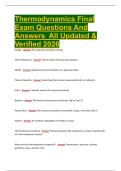
Thermodynamics Final
Exam Questions And
Answers All Updated &
Verified 2026
Energy - Answer The capacity to produce change
Thermodynamics - Answer Therme (heat, fire) dynamis (power)
Model - Answer Approximate representation of a physical reality
Physical Quantity - Answer Something that can be measured directly or indirectly
Units - Answer A specific amount of a physical quantity
Newton - Answer The amount necessary to accelerate 1kg to 1m/s^2
Pound-force - Answer The amount necessary to accelerate 1slug or 1lb-mass 1ft/s^2
System - Answer An arbitrary segregation of matter in space
Thermodynamic Property - Answer Physical quantity that represents a unique characteristic
of a thermodynamic system
What are the thermodynamic properties? - Answer Temperature, pressure, volume,
geometry, mass, density, color
, Macroscopic Property - Answer A measurable property of sufficient volume and density
such that the existence of individual molecules cannot be detected
Energy Transfers - Answer Mechanisms for transferring energy across system boundaries
Work - Answer Energy ransomer resulting from a force acting through a displacement
Heat Transfer - Answer Macroscopic mechanism by which energy is transferred to or from a
thermodynamic system as a result of a temperature difference
Homogeneous - Answer Same throughout, not reacting, pure substance
State of a System - Answer A description of its condition, by a list of values of its properties
Extensive Thermodynamic Property - Answer Property that depends on the extent (size,
mass) of the system (substance)
Intensive Thermodynamic Property - Answer Property that does not depend on the extent
of the system
Steady State - Answer No properties of the system change with time
State the second law in terms of entropy behavior - Answer All natural energy conversion
and transport processes proceed in a direction such that there will be an increase in the
entropy of the universe
Third Law of Thermodynamics - Answer A perfect crystalline solid at T=0 (Rankine - absolute
zero) has zero entropy, s
Exam Questions And
Answers All Updated &
Verified 2026
Energy - Answer The capacity to produce change
Thermodynamics - Answer Therme (heat, fire) dynamis (power)
Model - Answer Approximate representation of a physical reality
Physical Quantity - Answer Something that can be measured directly or indirectly
Units - Answer A specific amount of a physical quantity
Newton - Answer The amount necessary to accelerate 1kg to 1m/s^2
Pound-force - Answer The amount necessary to accelerate 1slug or 1lb-mass 1ft/s^2
System - Answer An arbitrary segregation of matter in space
Thermodynamic Property - Answer Physical quantity that represents a unique characteristic
of a thermodynamic system
What are the thermodynamic properties? - Answer Temperature, pressure, volume,
geometry, mass, density, color
, Macroscopic Property - Answer A measurable property of sufficient volume and density
such that the existence of individual molecules cannot be detected
Energy Transfers - Answer Mechanisms for transferring energy across system boundaries
Work - Answer Energy ransomer resulting from a force acting through a displacement
Heat Transfer - Answer Macroscopic mechanism by which energy is transferred to or from a
thermodynamic system as a result of a temperature difference
Homogeneous - Answer Same throughout, not reacting, pure substance
State of a System - Answer A description of its condition, by a list of values of its properties
Extensive Thermodynamic Property - Answer Property that depends on the extent (size,
mass) of the system (substance)
Intensive Thermodynamic Property - Answer Property that does not depend on the extent
of the system
Steady State - Answer No properties of the system change with time
State the second law in terms of entropy behavior - Answer All natural energy conversion
and transport processes proceed in a direction such that there will be an increase in the
entropy of the universe
Third Law of Thermodynamics - Answer A perfect crystalline solid at T=0 (Rankine - absolute
zero) has zero entropy, s