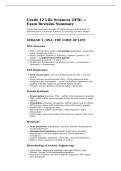
Grade 12 Life Sciences (IEB) —
Exam Revision Summary
Covers the three main strands: (1) DNA, Genetics & Evolution, (2)
Reproduction & Endocrine Systems, (3) Ecology & Human Impact
STRAND 1: DNA, THE CODE OF LIFE
DNA Structure
DNA = double helix, made of nucleotides (phosphate, deoxyribose
sugar, nitrogenous base)
Bases: Adenine–Thymine (2 H-bonds), Guanine–Cytosine (3 H-
bonds) — complementary base pairing
Antiparallel strands (5’→3’ and 3’→5’)
Packed into chromosomes via histone proteins → nucleosomes →
chromatin → chromosome
DNA Replication
Semi-conservative: each new molecule has one old + one new
strand
Steps: helicase unwinds/unzips DNA → DNA polymerase adds
complementary nucleotides → occurs on leading (continuous) and
lagging (Okazaki fragments, joined by ligase) strands
Purpose: ensures genetic continuity before cell division
Protein Synthesis
Transcription (nucleus): DNA → mRNA. RNA polymerase unwinds
DNA, builds mRNA using template strand; introns removed, exons
spliced.
Translation (ribosome, cytoplasm): mRNA codons read in triplets;
tRNA brings amino acids (anticodon pairs with codon); peptide
bonds form → polypeptide chain
Key molecules: mRNA (messenger), tRNA (transfer), rRNA
(ribosomal)
Codon table: know start codon (AUG) and stop codons (UAA, UAG,
UGA)
Mutations
Gene mutations: substitution, insertion, deletion (frameshift for
insertion/deletion)
Chromosomal mutations: deletion, duplication, inversion,
translocation; also non-disjunction (e.g. Down Syndrome =
Trisomy 21)
Causes: mutagens (radiation, chemicals), errors in replication
Effects: silent, beneficial, harmful, or neutral
Biotechnology & Genetic Engineering
Applications: genetically modified organisms (GMOs), gene
therapy, cloning, DNA profiling/fingerprinting
Restriction enzymes cut DNA at specific sequences; DNA ligase
joins fragments
, Ethical, social, and economic considerations often examined (AIM
3)
Exam tip: Diagram questions on replication/transcription/translation
are common — practice labelling and explaining direction (5’→3’) and
complementary pairing.
STRAND 2: MEIOSIS & GENETICS
Meiosis
Produces gametes, halves chromosome number (diploid →
haploid), introduces genetic variation
Two divisions: Meiosis I (homologous chromosomes separate) and
Meiosis II (sister chromatids separate, like mitosis)
Sources of variation: crossing over (prophase I, chiasmata) and
independent assortment (metaphase I)
Compare with mitosis: mitosis = 1 division, 2 identical diploid
cells; meiosis = 2 divisions, 4 genetically different haploid cells
Mendelian Genetics
Terms: gene, allele, dominant, recessive, homozygous,
heterozygous, genotype, phenotype
Monohybrid crosses (one gene) and dihybrid crosses (two genes)
— use Punnett squares
Ratios: monohybrid 3:1, dihybrid 9:3:3:1
Test cross: cross unknown genotype with homozygous recessive
to determine genotype
Patterns of Inheritance
Codominance (e.g. AB blood group) vs incomplete dominance
(e.g. flower colour blending)
Multiple alleles (ABO blood groups: IᴬIᴮ, IᴬIᴼ, IᴮIᴼ, IᴼIᴼ)
Sex-linked inheritance: genes on X chromosome
(e.g. haemophilia, red-green colour blindness) — know how to
interpret/draw pedigrees
Polygenic inheritance: multiple genes control one trait (e.g. skin
colour, height) → continuous variation
Genetic Disorders & Pedigrees
Autosomal dominant/recessive vs X-linked patterns — practice
reading pedigree diagrams to determine mode of inheritance
Examples: cystic fibrosis (autosomal recessive), Huntington’s
disease (autosomal dominant), haemophilia (X-linked recessive)
Genetic counselling and karyotyping (e.g. detecting Down
Syndrome)
Exam tip: Practice constructing genetic diagrams/Punnett squares
AND interpreting pedigrees — both come up almost every year.
STRAND 3: REPRODUCTION
Reproductive Strategies in Vertebrates
r-strategists: many offspring, little parental care, early maturity
Exam Revision Summary
Covers the three main strands: (1) DNA, Genetics & Evolution, (2)
Reproduction & Endocrine Systems, (3) Ecology & Human Impact
STRAND 1: DNA, THE CODE OF LIFE
DNA Structure
DNA = double helix, made of nucleotides (phosphate, deoxyribose
sugar, nitrogenous base)
Bases: Adenine–Thymine (2 H-bonds), Guanine–Cytosine (3 H-
bonds) — complementary base pairing
Antiparallel strands (5’→3’ and 3’→5’)
Packed into chromosomes via histone proteins → nucleosomes →
chromatin → chromosome
DNA Replication
Semi-conservative: each new molecule has one old + one new
strand
Steps: helicase unwinds/unzips DNA → DNA polymerase adds
complementary nucleotides → occurs on leading (continuous) and
lagging (Okazaki fragments, joined by ligase) strands
Purpose: ensures genetic continuity before cell division
Protein Synthesis
Transcription (nucleus): DNA → mRNA. RNA polymerase unwinds
DNA, builds mRNA using template strand; introns removed, exons
spliced.
Translation (ribosome, cytoplasm): mRNA codons read in triplets;
tRNA brings amino acids (anticodon pairs with codon); peptide
bonds form → polypeptide chain
Key molecules: mRNA (messenger), tRNA (transfer), rRNA
(ribosomal)
Codon table: know start codon (AUG) and stop codons (UAA, UAG,
UGA)
Mutations
Gene mutations: substitution, insertion, deletion (frameshift for
insertion/deletion)
Chromosomal mutations: deletion, duplication, inversion,
translocation; also non-disjunction (e.g. Down Syndrome =
Trisomy 21)
Causes: mutagens (radiation, chemicals), errors in replication
Effects: silent, beneficial, harmful, or neutral
Biotechnology & Genetic Engineering
Applications: genetically modified organisms (GMOs), gene
therapy, cloning, DNA profiling/fingerprinting
Restriction enzymes cut DNA at specific sequences; DNA ligase
joins fragments
, Ethical, social, and economic considerations often examined (AIM
3)
Exam tip: Diagram questions on replication/transcription/translation
are common — practice labelling and explaining direction (5’→3’) and
complementary pairing.
STRAND 2: MEIOSIS & GENETICS
Meiosis
Produces gametes, halves chromosome number (diploid →
haploid), introduces genetic variation
Two divisions: Meiosis I (homologous chromosomes separate) and
Meiosis II (sister chromatids separate, like mitosis)
Sources of variation: crossing over (prophase I, chiasmata) and
independent assortment (metaphase I)
Compare with mitosis: mitosis = 1 division, 2 identical diploid
cells; meiosis = 2 divisions, 4 genetically different haploid cells
Mendelian Genetics
Terms: gene, allele, dominant, recessive, homozygous,
heterozygous, genotype, phenotype
Monohybrid crosses (one gene) and dihybrid crosses (two genes)
— use Punnett squares
Ratios: monohybrid 3:1, dihybrid 9:3:3:1
Test cross: cross unknown genotype with homozygous recessive
to determine genotype
Patterns of Inheritance
Codominance (e.g. AB blood group) vs incomplete dominance
(e.g. flower colour blending)
Multiple alleles (ABO blood groups: IᴬIᴮ, IᴬIᴼ, IᴮIᴼ, IᴼIᴼ)
Sex-linked inheritance: genes on X chromosome
(e.g. haemophilia, red-green colour blindness) — know how to
interpret/draw pedigrees
Polygenic inheritance: multiple genes control one trait (e.g. skin
colour, height) → continuous variation
Genetic Disorders & Pedigrees
Autosomal dominant/recessive vs X-linked patterns — practice
reading pedigree diagrams to determine mode of inheritance
Examples: cystic fibrosis (autosomal recessive), Huntington’s
disease (autosomal dominant), haemophilia (X-linked recessive)
Genetic counselling and karyotyping (e.g. detecting Down
Syndrome)
Exam tip: Practice constructing genetic diagrams/Punnett squares
AND interpreting pedigrees — both come up almost every year.
STRAND 3: REPRODUCTION
Reproductive Strategies in Vertebrates
r-strategists: many offspring, little parental care, early maturity