THE AMERICAN
YAWP
4. Colonial Society
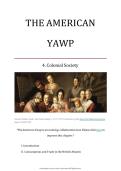
Charles Willson Peale, The Peale Family, c. 1771–1773. Collection of the New-York Historical Society,
object #1867.298.
*The American Yawp is an evolving, collaborative text. Please click here to
improve this chapter.*
I. Introduction
II. Consumption and Trade in the British Atlantic
Downloaded by harun mburu ()
, III. Slavery, Anti-Slavery and Atlantic Exchange
IV. Pursuing Political, Religious and Individual Freedom
V. Seven Years’ War
VI. Pontiac’s War
VII. Conclusion
VIII. Primary Sources
IX. Reference Material
I. Introduction
Eighteenth-century American culture moved in competing directions.
Commercial, military, and cultural ties between Great Britain and the
North American colonies tightened while a new distinctly American
culture began to form and bind together colonists from New Hampshire
to Georgia. Immigrants from other European nations meanwhile
combined with Native Americans and enslaved Africans to create an
increasingly diverse colonial population. All—men and women,
European, Native American, and African—led distinct lives and wrought
new distinct societies. While life in the thirteen colonies was shaped in
part by English practices and participation in the larger Atlantic World,
emerging cultural patterns increasingly transformed North America
into something wholly different.
Downloaded by harun mburu ()
, II. Consumption and Trade in the
British Atlantic
Transatlantic trade greatly enriched Britain, but it also created high
standards of living for many North American colonists. This two-way
relationship reinforced the colonial feeling of commonality with British
culture. It was not until trade relations, disturbed by political changes
and the demands of warfare, became strained in the 1760s that colonists
began to question these ties.
During the seventeenth and eighteenth centuries, improvements in
manufacturing, transportation, and the availability of credit increased
the opportunity for colonists to purchase consumer goods. Instead of
making their own tools, clothes, and utensils, colonists increasingly
purchased luxury items made by specialized artisans and
manufacturers. As the incomes of Americans rose and the prices of
these commodities fell, these items shifted from luxuries to common
goods. The average person’s ability to spend money on consumer goods
became a sign of their respectability. Historians have called this process
the “consumer revolution.”1
Downloaded by harun mburu ()
, Joseph Highmore, The Harlowe Family, from Samuel Richardson’s “Clarissa,” 1745–1747. Wikimedia.
Britain relied on the colonies as a source of raw materials, such as
lumber and tobacco. Americans engaged with new forms of trade and
financing that increased their ability to buy British-made goods. But the
ways in which colonists paid for these goods varied sharply from those
in Britain. When settlers first arrived in North America, they typically
carried very little hard or metallic British money with them.
Discovering no precious metals (and lacking the Crown’s authority to
mint coins), colonists relied on barter and nontraditional forms of
Downloaded by harun mburu ()
YAWP
4. Colonial Society
Charles Willson Peale, The Peale Family, c. 1771–1773. Collection of the New-York Historical Society,
object #1867.298.
*The American Yawp is an evolving, collaborative text. Please click here to
improve this chapter.*
I. Introduction
II. Consumption and Trade in the British Atlantic
Downloaded by harun mburu ()
, III. Slavery, Anti-Slavery and Atlantic Exchange
IV. Pursuing Political, Religious and Individual Freedom
V. Seven Years’ War
VI. Pontiac’s War
VII. Conclusion
VIII. Primary Sources
IX. Reference Material
I. Introduction
Eighteenth-century American culture moved in competing directions.
Commercial, military, and cultural ties between Great Britain and the
North American colonies tightened while a new distinctly American
culture began to form and bind together colonists from New Hampshire
to Georgia. Immigrants from other European nations meanwhile
combined with Native Americans and enslaved Africans to create an
increasingly diverse colonial population. All—men and women,
European, Native American, and African—led distinct lives and wrought
new distinct societies. While life in the thirteen colonies was shaped in
part by English practices and participation in the larger Atlantic World,
emerging cultural patterns increasingly transformed North America
into something wholly different.
Downloaded by harun mburu ()
, II. Consumption and Trade in the
British Atlantic
Transatlantic trade greatly enriched Britain, but it also created high
standards of living for many North American colonists. This two-way
relationship reinforced the colonial feeling of commonality with British
culture. It was not until trade relations, disturbed by political changes
and the demands of warfare, became strained in the 1760s that colonists
began to question these ties.
During the seventeenth and eighteenth centuries, improvements in
manufacturing, transportation, and the availability of credit increased
the opportunity for colonists to purchase consumer goods. Instead of
making their own tools, clothes, and utensils, colonists increasingly
purchased luxury items made by specialized artisans and
manufacturers. As the incomes of Americans rose and the prices of
these commodities fell, these items shifted from luxuries to common
goods. The average person’s ability to spend money on consumer goods
became a sign of their respectability. Historians have called this process
the “consumer revolution.”1
Downloaded by harun mburu ()
, Joseph Highmore, The Harlowe Family, from Samuel Richardson’s “Clarissa,” 1745–1747. Wikimedia.
Britain relied on the colonies as a source of raw materials, such as
lumber and tobacco. Americans engaged with new forms of trade and
financing that increased their ability to buy British-made goods. But the
ways in which colonists paid for these goods varied sharply from those
in Britain. When settlers first arrived in North America, they typically
carried very little hard or metallic British money with them.
Discovering no precious metals (and lacking the Crown’s authority to
mint coins), colonists relied on barter and nontraditional forms of
Downloaded by harun mburu ()