

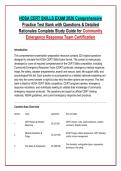
HOSA CERT SKILLS EXAM 2026 Comprehensive
Practice Test Bank with Questions & Detailed
Rationales Complete Study Guide for Community
Emergency Response Team Certification
Introduction
This comprehensive examination preparation resource contains 220 original questions
designed to simulate the HOSA CERT Skills Exam format. The content is meticulously
developed to cover all required competencies for the CERT Skills competition, including
Community Emergency Response Team (CERT) protocols, emergency medical response,
triage, fire safety, disaster preparedness, search and rescue, basic life support skills, and
psychological first aid. Each question is accompanied by a detailed rationale explaining not
only why the correct answer is right but also why the other options are incorrect. This test
bank is ideal for HOSA CERT Skills competitors, CERT program trainees, emergency
response volunteers, and individuals seeking to validate their knowledge of community
emergency response protocols. The questions are based on official CERT training
materials, FEMA guidelines, and current emergency response best practices.
Content Area Overview
Section Topic Questions Key Concepts
CERT Basics & Disaster CERT mission, roles, legal protections, incident
1 30 (Q1-30)
Response command, disaster phases
Medical Operations & START triage, patient assessment, CPR, bleeding
2 35 (Q31-65)
Triage control, shock management
Fire chemistry, extinguisher types, suppression
3 Fire Safety & Suppression 25 (Q66-90)
techniques, fire safety
,Section Topic Questions Key Concepts
25 (Q91- Family preparedness, supplies, planning,
4 Disaster Preparedness
115) mitigation, community resilience
25 (Q116- Search techniques, rescue methods, victim
5 Search & Rescue
140) extrication, safety protocols
Basic Life Support & First 25 (Q141- CPR, AED, airway management, first aid, medical
6
Aid 165) emergencies
Psychology & Team 20 (Q166- Psychological first aid, stress management, team
7
Organization 185) dynamics, communication
Terrorism & Special 20 (Q186- CBRNE, active shooter, hazardous materials, WMD
8
Situations 205) awareness
15 (Q206-
9 Comprehensive Review Integrated scenarios, cross-domain applications
220)
Section 1: CERT Basics & Disaster Response
Question 1: What does CERT stand for?
A) Community Emergency Response Team
B) Critical Emergency Response Training
C) Civilian Emergency Rescue Team
D) Coordinated Emergency Response Team
Correct Answer: A
Rationale: CERT stands for Community Emergency Response Team, a program that trains
volunteers to assist emergency services during disasters. Options B, C, and D are incorrect
acronyms.
,Question 2: What is a CERT member's #1 priority?
A) Assisting victims
B) Personal safety
C) Property protection
D) Communications
Correct Answer: B
Rationale: Personal safety is always the top priority for CERT members. You cannot help
others if you become a victim yourself. Options A, C, and D are secondary priorities.
Question 3: CERT skills can do which of the following? (Select all that apply)
A) Assist emergency services
B) Assume some of the same functions as emergency services personnel following a
disaster
C) Prepare families and communities prior to a disaster
D) All of the above
Correct Answer: D
Rationale: CERT skills can (1) assist emergency services, (2) assume some of the same
functions as emergency services personnel following a disaster, and (3) prepare families
and communities prior to a disaster. All options are correct.
Question 4: What is the key priority of CERT members?
A) Property protection
B) Traffic control
C) Lessening the impact of disasters and ensuring the safety of individuals
D) Media communications
Correct Answer: C
Rationale: The key priority of CERT members is lessening the impact of disasters and
ensuring the safety of individuals. Options A, B, and D are secondary priorities.
Question 5: CERT members respond in which period after a disaster?
, A) During the disaster
B) The period immediately after a disaster when response resources are
overwhelmed or delayed
C) After professional responders arrive
D) During the recovery phase
Correct Answer: B
Rationale: CERTs respond in the immediate aftermath of a disaster when professional
emergency services resources are overwhelmed or delayed. Options A, C, and D are
incorrect timing.
Question 6: CERT members are protected by which laws?
A) The Good Samaritan law only
B) The Volunteer Protection Act of 1997 and relevant state statutes
C) No legal protection
D) The Federal Tort Claims Act
Correct Answer: B
Rationale: CERT members are protected by the Good Samaritan law, the Volunteer
Protection Act of 1997, and relevant state statutes. Option A is incomplete; option C is false;
option D applies to federal employees.
Question 7: What is the purpose of the Incident Command System (ICS)?
A) To provide a standardized organizational structure for emergency response
B) To eliminate the need for volunteers
C) To replace all other emergency systems
D) To provide legal protection
Correct Answer: A
Rationale: The Incident Command System provides a standardized organizational structure
for emergency response. Options B, C, and D are incorrect.
Question 8: What is the first step in the CERT size-up process?
Practice Test Bank with Questions & Detailed
Rationales Complete Study Guide for Community
Emergency Response Team Certification
Introduction
This comprehensive examination preparation resource contains 220 original questions
designed to simulate the HOSA CERT Skills Exam format. The content is meticulously
developed to cover all required competencies for the CERT Skills competition, including
Community Emergency Response Team (CERT) protocols, emergency medical response,
triage, fire safety, disaster preparedness, search and rescue, basic life support skills, and
psychological first aid. Each question is accompanied by a detailed rationale explaining not
only why the correct answer is right but also why the other options are incorrect. This test
bank is ideal for HOSA CERT Skills competitors, CERT program trainees, emergency
response volunteers, and individuals seeking to validate their knowledge of community
emergency response protocols. The questions are based on official CERT training
materials, FEMA guidelines, and current emergency response best practices.
Content Area Overview
Section Topic Questions Key Concepts
CERT Basics & Disaster CERT mission, roles, legal protections, incident
1 30 (Q1-30)
Response command, disaster phases
Medical Operations & START triage, patient assessment, CPR, bleeding
2 35 (Q31-65)
Triage control, shock management
Fire chemistry, extinguisher types, suppression
3 Fire Safety & Suppression 25 (Q66-90)
techniques, fire safety
,Section Topic Questions Key Concepts
25 (Q91- Family preparedness, supplies, planning,
4 Disaster Preparedness
115) mitigation, community resilience
25 (Q116- Search techniques, rescue methods, victim
5 Search & Rescue
140) extrication, safety protocols
Basic Life Support & First 25 (Q141- CPR, AED, airway management, first aid, medical
6
Aid 165) emergencies
Psychology & Team 20 (Q166- Psychological first aid, stress management, team
7
Organization 185) dynamics, communication
Terrorism & Special 20 (Q186- CBRNE, active shooter, hazardous materials, WMD
8
Situations 205) awareness
15 (Q206-
9 Comprehensive Review Integrated scenarios, cross-domain applications
220)
Section 1: CERT Basics & Disaster Response
Question 1: What does CERT stand for?
A) Community Emergency Response Team
B) Critical Emergency Response Training
C) Civilian Emergency Rescue Team
D) Coordinated Emergency Response Team
Correct Answer: A
Rationale: CERT stands for Community Emergency Response Team, a program that trains
volunteers to assist emergency services during disasters. Options B, C, and D are incorrect
acronyms.
,Question 2: What is a CERT member's #1 priority?
A) Assisting victims
B) Personal safety
C) Property protection
D) Communications
Correct Answer: B
Rationale: Personal safety is always the top priority for CERT members. You cannot help
others if you become a victim yourself. Options A, C, and D are secondary priorities.
Question 3: CERT skills can do which of the following? (Select all that apply)
A) Assist emergency services
B) Assume some of the same functions as emergency services personnel following a
disaster
C) Prepare families and communities prior to a disaster
D) All of the above
Correct Answer: D
Rationale: CERT skills can (1) assist emergency services, (2) assume some of the same
functions as emergency services personnel following a disaster, and (3) prepare families
and communities prior to a disaster. All options are correct.
Question 4: What is the key priority of CERT members?
A) Property protection
B) Traffic control
C) Lessening the impact of disasters and ensuring the safety of individuals
D) Media communications
Correct Answer: C
Rationale: The key priority of CERT members is lessening the impact of disasters and
ensuring the safety of individuals. Options A, B, and D are secondary priorities.
Question 5: CERT members respond in which period after a disaster?
, A) During the disaster
B) The period immediately after a disaster when response resources are
overwhelmed or delayed
C) After professional responders arrive
D) During the recovery phase
Correct Answer: B
Rationale: CERTs respond in the immediate aftermath of a disaster when professional
emergency services resources are overwhelmed or delayed. Options A, C, and D are
incorrect timing.
Question 6: CERT members are protected by which laws?
A) The Good Samaritan law only
B) The Volunteer Protection Act of 1997 and relevant state statutes
C) No legal protection
D) The Federal Tort Claims Act
Correct Answer: B
Rationale: CERT members are protected by the Good Samaritan law, the Volunteer
Protection Act of 1997, and relevant state statutes. Option A is incomplete; option C is false;
option D applies to federal employees.
Question 7: What is the purpose of the Incident Command System (ICS)?
A) To provide a standardized organizational structure for emergency response
B) To eliminate the need for volunteers
C) To replace all other emergency systems
D) To provide legal protection
Correct Answer: A
Rationale: The Incident Command System provides a standardized organizational structure
for emergency response. Options B, C, and D are incorrect.
Question 8: What is the first step in the CERT size-up process?


