

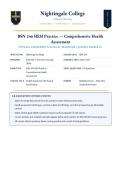
Nightingale College
ISEH · 642 NSB
★ ★
N School of Nursing
EST. 2010
CONFIDENCE · COMPETENCE · COMPASSION
BSN 246 HESI Practice — Comprehensive Health
Assessment
P H YS I C A L A SS E SS M E N T & C L I N I C A L R E A S O N I N G | A L R E A DY G RA D E D A +
INSTITUTION Nightingale College COURSE CODE BSN 246
PROGRAM Bachelor of Science in Nursing ACADEMIC YEAR
(BSN)
EXAM TITLE BSN 246 HESI Practice — TOTAL QUESTIONS 136 Questions
Comprehensive Health
Assessment
COURSE TITLE Health Assessment & Physical FORMAT Multiple Choice — Select the
Examination Single Best Answer
EXAMINATION INSTRUCTIONS
▸ Select the single best answer for each question unless otherwise instructed.
▸ Health assessment techniques, normal vs abnormal findings, and clinical reasoning are all testable
content.
▸ Select all that apply (SATA) questions require careful evaluation of each option.
▸ Correct answers and detailed rationales appear below each question for NCLEX/HESI review purposes.
▸ All content reflects evidence-based nursing practice and current clinical guidelines.
, SECTION I — HEALTH ASSESSMENT & PHYSICAL
Questions 1 – 136
EXAMINATION
1. The primary nurse asks another nurse to assist in checking a client for an apical-radial
pulse deficit. One nurse counts an apical pulse of 72 beats/minute while the other nurse
counts a radial pulse of 88 beats/minute. Which action should the primary nurse take?
A. Check the reading after the other nurse leaves the room
B. Document a pulse deficit of 16 beats per minute
C. Report the results of the deficit to the healthcare provider
D. Repeat the assessment to obtain another reading
CORRECT ANSWER D — Repeat the assessment to obtain another reading
RATIONALE A pulse deficit is the difference between apical and radial pulses. Normally, these
should be equal. A radial pulse of 88 and apical of 72 indicates a deficit of 16 beats
per minute, which suggests poor cardiac output or dysrhythmia. However, the
nurse should repeat the assessment to ensure accuracy before documenting or
reporting. The apical pulse should normally be equal to or greater than the radial
pulse. A radial pulse higher than apical is physiologically impossible and suggests
a counting error.
2. While entering a client's room, the nurse observes that the client is using pursed-lip
breathing. It is most important for the nurse to monitor the client for which problem?
A. Syncope
B. Acute pain
C. Tetany
D. Dyspnea
CORRECT ANSWER D — Dyspnea
RATIONALE Pursed-lip breathing is a compensatory mechanism used by clients with
respiratory distress to keep airways open and improve gas exchange. It indicates
the client is experiencing dyspnea. The nurse should monitor for worsening
respiratory status, including increased work of breathing, decreased oxygen
saturation, and changes in mental status.
,3. The nurse continues a neurologic assessment of the cranial nerve XI (Spinal accessory) for
a client. Which instruction should the nurse give the client to complete this assessment?
A. Shrug shoulders against resistance
B. Stand up slowly with eyes closed
C. Turn head from side to side
D. Raise both arms overhead
CORRECT ANSWER A — Shrug shoulders against resistance
RATIONALE Cranial nerve XI (spinal accessory nerve) innervates the sternocleidomastoid and
trapezius muscles. To assess CN XI, the nurse should ask the client to shrug
shoulders against resistance (trapezius) and turn the head against resistance
(sternocleidomastoid). Shrugging shoulders against resistance is the classic test
for this cranial nerve.
4. The nurse observes that a client is experiencing melena. Which serum laboratory test
should the nurse monitor in response to this finding?
A. White blood cell count (WBC)
B. Glucose
C. Blood urea nitrogen (BUN)
D. Hematocrit
CORRECT ANSWER D — Hematocrit
RATIONALE Melena (black, tarry stools) indicates upper gastrointestinal bleeding. The
hematocrit (HCT) should be monitored as it will decrease with significant blood
loss. HCT measures the proportion of blood volume occupied by red blood cells
and is a key indicator of anemia from blood loss. Other labs like potassium, WBC,
and albumin are not specific indicators of GI bleeding.
, 5. The nurse is performing an admission assessment for a client with pyelonephritis who has
urgency and burning while urinating. Which finding indicates an expected response when
the nurse percusses the costovertebral angle?
A. Audible thud without pain
B. Rigidity and firmness
C. Rebound tenderness
D. Sharp, severe pain
CORRECT ANSWER D — Sharp, severe pain
RATIONALE In pyelonephritis, percussion of the costovertebral angle (CVA) elicits sharp,
severe pain (CVA tenderness). This indicates inflammation of the renal
parenchyma. The pain is caused by stretching of the renal capsule and
inflammation of the kidney tissues. This is a classic finding in acute
pyelonephritis.
6. In assessing a client's level of consciousness, what should the nurse assess first?
A. Motor response
B. Eye opening
C. Verbal response
D. Level of alertness
CORRECT ANSWER D — Level of alertness
RATIONALE The first step in assessing level of consciousness is determining the client's level
of alertness. This includes observing whether the client is awake, drowsy,
lethargic, stuporous, or comatose. Assessing alertness provides the foundation for
further neurologic assessment. The Glasgow Coma Scale evaluates eye opening,
verbal response, and motor response.
ISEH · 642 NSB
★ ★
N School of Nursing
EST. 2010
CONFIDENCE · COMPETENCE · COMPASSION
BSN 246 HESI Practice — Comprehensive Health
Assessment
P H YS I C A L A SS E SS M E N T & C L I N I C A L R E A S O N I N G | A L R E A DY G RA D E D A +
INSTITUTION Nightingale College COURSE CODE BSN 246
PROGRAM Bachelor of Science in Nursing ACADEMIC YEAR
(BSN)
EXAM TITLE BSN 246 HESI Practice — TOTAL QUESTIONS 136 Questions
Comprehensive Health
Assessment
COURSE TITLE Health Assessment & Physical FORMAT Multiple Choice — Select the
Examination Single Best Answer
EXAMINATION INSTRUCTIONS
▸ Select the single best answer for each question unless otherwise instructed.
▸ Health assessment techniques, normal vs abnormal findings, and clinical reasoning are all testable
content.
▸ Select all that apply (SATA) questions require careful evaluation of each option.
▸ Correct answers and detailed rationales appear below each question for NCLEX/HESI review purposes.
▸ All content reflects evidence-based nursing practice and current clinical guidelines.
, SECTION I — HEALTH ASSESSMENT & PHYSICAL
Questions 1 – 136
EXAMINATION
1. The primary nurse asks another nurse to assist in checking a client for an apical-radial
pulse deficit. One nurse counts an apical pulse of 72 beats/minute while the other nurse
counts a radial pulse of 88 beats/minute. Which action should the primary nurse take?
A. Check the reading after the other nurse leaves the room
B. Document a pulse deficit of 16 beats per minute
C. Report the results of the deficit to the healthcare provider
D. Repeat the assessment to obtain another reading
CORRECT ANSWER D — Repeat the assessment to obtain another reading
RATIONALE A pulse deficit is the difference between apical and radial pulses. Normally, these
should be equal. A radial pulse of 88 and apical of 72 indicates a deficit of 16 beats
per minute, which suggests poor cardiac output or dysrhythmia. However, the
nurse should repeat the assessment to ensure accuracy before documenting or
reporting. The apical pulse should normally be equal to or greater than the radial
pulse. A radial pulse higher than apical is physiologically impossible and suggests
a counting error.
2. While entering a client's room, the nurse observes that the client is using pursed-lip
breathing. It is most important for the nurse to monitor the client for which problem?
A. Syncope
B. Acute pain
C. Tetany
D. Dyspnea
CORRECT ANSWER D — Dyspnea
RATIONALE Pursed-lip breathing is a compensatory mechanism used by clients with
respiratory distress to keep airways open and improve gas exchange. It indicates
the client is experiencing dyspnea. The nurse should monitor for worsening
respiratory status, including increased work of breathing, decreased oxygen
saturation, and changes in mental status.
,3. The nurse continues a neurologic assessment of the cranial nerve XI (Spinal accessory) for
a client. Which instruction should the nurse give the client to complete this assessment?
A. Shrug shoulders against resistance
B. Stand up slowly with eyes closed
C. Turn head from side to side
D. Raise both arms overhead
CORRECT ANSWER A — Shrug shoulders against resistance
RATIONALE Cranial nerve XI (spinal accessory nerve) innervates the sternocleidomastoid and
trapezius muscles. To assess CN XI, the nurse should ask the client to shrug
shoulders against resistance (trapezius) and turn the head against resistance
(sternocleidomastoid). Shrugging shoulders against resistance is the classic test
for this cranial nerve.
4. The nurse observes that a client is experiencing melena. Which serum laboratory test
should the nurse monitor in response to this finding?
A. White blood cell count (WBC)
B. Glucose
C. Blood urea nitrogen (BUN)
D. Hematocrit
CORRECT ANSWER D — Hematocrit
RATIONALE Melena (black, tarry stools) indicates upper gastrointestinal bleeding. The
hematocrit (HCT) should be monitored as it will decrease with significant blood
loss. HCT measures the proportion of blood volume occupied by red blood cells
and is a key indicator of anemia from blood loss. Other labs like potassium, WBC,
and albumin are not specific indicators of GI bleeding.
, 5. The nurse is performing an admission assessment for a client with pyelonephritis who has
urgency and burning while urinating. Which finding indicates an expected response when
the nurse percusses the costovertebral angle?
A. Audible thud without pain
B. Rigidity and firmness
C. Rebound tenderness
D. Sharp, severe pain
CORRECT ANSWER D — Sharp, severe pain
RATIONALE In pyelonephritis, percussion of the costovertebral angle (CVA) elicits sharp,
severe pain (CVA tenderness). This indicates inflammation of the renal
parenchyma. The pain is caused by stretching of the renal capsule and
inflammation of the kidney tissues. This is a classic finding in acute
pyelonephritis.
6. In assessing a client's level of consciousness, what should the nurse assess first?
A. Motor response
B. Eye opening
C. Verbal response
D. Level of alertness
CORRECT ANSWER D — Level of alertness
RATIONALE The first step in assessing level of consciousness is determining the client's level
of alertness. This includes observing whether the client is awake, drowsy,
lethargic, stuporous, or comatose. Assessing alertness provides the foundation for
further neurologic assessment. The Glasgow Coma Scale evaluates eye opening,
verbal response, and motor response.


