

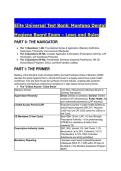
Elite Universal Test Bank: Montana Dental
Hygiene Board Exam – Laws and Rules
PART 0: THE NAVIGATOR
● Tier 1 (Questions 1–28): Foundational Syntax & Application (Statutory Definitions,
Supervision Thresholds, and Licensure Standards)
● Tier 2 (Questions 29–58): Complex Application & Simulation (Prescriptive Authority, LAP
Parameters, and Anesthesia Protocols)
● Tier 3 (Questions 59–88): Grandmaster Synthesis (Impaired Practitioners, HB 321
School-Based Programs, Ethics, and Multi-Variable Liability)
PART I: THE PRIMER
Mastery of the Montana Code Annotated (MCA) and Administrative Rules of Montana (ARM)
elevates the dental hygienist from a clinical technician to a legally autonomous public health
practitioner. This test bank forces the synthesis of board statutes, enabling elite academic
performance and flawless professional compliance in high-stakes clinical environments.
● The "Critical Axioms" Cheat Sheet:
Statutory Domain Core Rule / Requirement (Montana Board of
Dentistry Standards)
Supervision Hierarchy Direct: Dentist on-premises. General: Dentist
resides in MT (off-premises). Public Health: No
prior authorization/presence (LAP required).
Limited Access Permit (LAP) Empowers practice in public health facilities &
school-based programs (HB 321). Requires
2,400 hrs/3 yrs OR 3,000 career hrs (350/yr in
last 2 yrs).
CE Mandates (3-Year Cycle) Base RDH: 36 hrs. LAP: +12 hrs (48 total).
Prescriptive Authority: +3 hrs pharmacology.
CPR/BLS is mandatory & distinct from
academic CE.
Prescriptive Authority Limits SDF: 38%. Varnish: 5%. NaF Paste: 1.1%.
Benzocaine: up to 20%. Cetacaine: 14-2-2.
Chlorhexidine: 0.12%. DEA Controlled
Substances are strictly prohibited.
Mandatory Reporting Licensees must report impaired/fraudulent
colleagues (MCA 37-1-308) within 30 days to
the Board or the Montana Assistance Program
(MAP).
,PART II: THE ELITE TEST BANK
Tier 1: Foundational Syntax & Application
Q1: Under Montana MCA 37-4-405, a dental hygienist is authorized to provide oral hygiene
instruction in a public clinic or hospital under which level of supervision? A) General supervision
only B) Direct supervision only C) Without direct or general supervision D) Public health
supervision only
● The Answer: C (Without direct or general supervision)
● Distractor Analysis:
○ A is incorrect: General supervision is required for clinical prophylaxis, not verbal
oral instruction.
○ B is incorrect: Direct supervision mandates physical presence, which is statutorily
waived here.
○ D is incorrect: Public health supervision governs limited clinical services, requiring
an LAP, not basic instruction.
The Mentor's Analysis: The state deregulates simple oral health education to maximize public
benefit. When facing instruction-only scenarios, the immediate priority is recognizing the
exemption. By utilizing the education exemption, you bypass the common trap of over-applying
clinical supervision rules. Professional/Academic Intuition: Oral hygiene instruction in
institutional settings requires zero formal dentist supervision.
Q2: A licensed Montana dental hygienist wishes to administer a local anesthetic agent.
According to MCA 37-4-401, this specific action MUST be performed under: A) Public health
supervision B) General supervision C) Direct supervision D) Indirect supervision
● The Answer: B (General supervision)
● Distractor Analysis:
○ A is incorrect: Local anesthesia is explicitly prohibited under public health
supervision.
○ C is incorrect: The 2017 legislative update (SB 120) transitioned local anesthesia
from direct to general supervision.
○ D is incorrect: Indirect supervision is not a legally defined category in the MT Dental
Practice Act.
The Mentor's Analysis: Montana laws authorize certified RDHs to administer local anesthetics
without the dentist physically in the building. When facing anesthesia administration, the
immediate priority is confirming general supervision. By utilizing general supervision rules, you
bypass the common trap of outdated direct-supervision legacy laws. Professional/Academic
Intuition: Local anesthesia by a certified RDH requires general supervision, never public
health supervision.
Q3: A dental hygienist is renewing their license. How many continuing education (CE) hours are
required for a standard RDH license over the MT three-year reporting cycle? A) 12 hours B) 24
hours C) 36 hours D) 60 hours
● The Answer: C (36 hours)
● Distractor Analysis:
○ A is incorrect: 12 hours is an annual requirement for other jurisdictions, not the MT
cycle.
○ B is incorrect: 24 hours is a common novice miscalculation.
○ D is incorrect: 60 hours is the standard CE requirement for licensed dentists, not
, hygienists.
The Mentor's Analysis: CE validates ongoing clinical competence. When facing license renewal,
the immediate priority is baseline compliance. By utilizing the 36-hour rule, you bypass the
common trap of confusing dentist and RDH requirements. Professional/Academic Intuition: The
foundational CE metric for a Montana RDH is 36 hours every 3 years.
Q4: An RDH holding a Limited Access Permit (LAP) is calculating their CE requirements. What
is the total number of CE hours this LAP hygienist MUST complete per cycle? A) 36 hours B) 48
hours C) 60 hours D) 72 hours
● The Answer: B (48 hours)
● Distractor Analysis:
○ A is incorrect: 36 hours is the base requirement; it fails to account for the LAP
add-on.
○ C is incorrect: 60 hours applies to dentists.
○ D is incorrect: 72 hours is mathematically doubling the base requirement without
statutory backing.
The Mentor's Analysis: LAP hygienists operate with high autonomy, requiring advanced ongoing
education. When facing LAP renewals, the immediate priority is adding the 12 supplemental
hours. By utilizing the 48-hour total, you bypass the common trap of standard renewal
under-reporting. Professional/Academic Intuition: LAP licensure demands 36 base hours plus
12 LAP-specific hours, totaling 48 hours.
Q5: An RDH qualifies for limited prescriptive authority. How many of their required CE hours
MUST be specifically dedicated to pharmacology? A) 1 hour B) 3 hours C) 5 hours D) 12 hours
● The Answer: B (3 hours)
● Distractor Analysis:
○ A is incorrect: 1 hour is insufficient to meet the Board's prescriptive maintenance
standard.
○ C is incorrect: 5 hours is an arbitrary distractor.
○ D is incorrect: 12 hours applies to the LAP endorsement, not prescriptive authority.
The Mentor's Analysis: Prescribing agents requires targeted, continuous pharmacological
updating. When facing prescriptive renewals, the immediate priority is isolating pharmacology
hours. By utilizing the 3-hour mandate, you bypass the common trap of generic CE application.
Professional/Academic Intuition: Prescriptive authority mandates 3 dedicated hours of
pharmacology within the 36-hour cycle.
Q6: A dental hygienist fails to renew their license by the March 1st deadline. If they attempt to
renew on March 5th, what is the standard financial penalty assessed? A) Administrative
suspension pending a hearing B) A flat late fee of $20 C) A penalty fee equal to 100% of the
renewal fee D) Mandatory re-examination
● The Answer: C (A penalty fee equal to 100% of the renewal fee)
● Distractor Analysis:
○ A is incorrect: Suspension occurs later; a brief lapse initially incurs financial
penalties.
○ B is incorrect: $20 is an LAP renewal fee, not the statutory late penalty.
○ D is incorrect: Re-examination is reserved for excessively lapsed licenses.
The Mentor's Analysis: The Board enforces hard deadlines via strict financial punitive measures.
When facing lapsed renewals, the immediate priority is paying the double fee. By utilizing the
100% penalty rule, you bypass the common trap of assuming grace periods exist.
Professional/Academic Intuition: Missing the March 1st deadline instantly triggers a 100%
financial penalty.
Hygiene Board Exam – Laws and Rules
PART 0: THE NAVIGATOR
● Tier 1 (Questions 1–28): Foundational Syntax & Application (Statutory Definitions,
Supervision Thresholds, and Licensure Standards)
● Tier 2 (Questions 29–58): Complex Application & Simulation (Prescriptive Authority, LAP
Parameters, and Anesthesia Protocols)
● Tier 3 (Questions 59–88): Grandmaster Synthesis (Impaired Practitioners, HB 321
School-Based Programs, Ethics, and Multi-Variable Liability)
PART I: THE PRIMER
Mastery of the Montana Code Annotated (MCA) and Administrative Rules of Montana (ARM)
elevates the dental hygienist from a clinical technician to a legally autonomous public health
practitioner. This test bank forces the synthesis of board statutes, enabling elite academic
performance and flawless professional compliance in high-stakes clinical environments.
● The "Critical Axioms" Cheat Sheet:
Statutory Domain Core Rule / Requirement (Montana Board of
Dentistry Standards)
Supervision Hierarchy Direct: Dentist on-premises. General: Dentist
resides in MT (off-premises). Public Health: No
prior authorization/presence (LAP required).
Limited Access Permit (LAP) Empowers practice in public health facilities &
school-based programs (HB 321). Requires
2,400 hrs/3 yrs OR 3,000 career hrs (350/yr in
last 2 yrs).
CE Mandates (3-Year Cycle) Base RDH: 36 hrs. LAP: +12 hrs (48 total).
Prescriptive Authority: +3 hrs pharmacology.
CPR/BLS is mandatory & distinct from
academic CE.
Prescriptive Authority Limits SDF: 38%. Varnish: 5%. NaF Paste: 1.1%.
Benzocaine: up to 20%. Cetacaine: 14-2-2.
Chlorhexidine: 0.12%. DEA Controlled
Substances are strictly prohibited.
Mandatory Reporting Licensees must report impaired/fraudulent
colleagues (MCA 37-1-308) within 30 days to
the Board or the Montana Assistance Program
(MAP).
,PART II: THE ELITE TEST BANK
Tier 1: Foundational Syntax & Application
Q1: Under Montana MCA 37-4-405, a dental hygienist is authorized to provide oral hygiene
instruction in a public clinic or hospital under which level of supervision? A) General supervision
only B) Direct supervision only C) Without direct or general supervision D) Public health
supervision only
● The Answer: C (Without direct or general supervision)
● Distractor Analysis:
○ A is incorrect: General supervision is required for clinical prophylaxis, not verbal
oral instruction.
○ B is incorrect: Direct supervision mandates physical presence, which is statutorily
waived here.
○ D is incorrect: Public health supervision governs limited clinical services, requiring
an LAP, not basic instruction.
The Mentor's Analysis: The state deregulates simple oral health education to maximize public
benefit. When facing instruction-only scenarios, the immediate priority is recognizing the
exemption. By utilizing the education exemption, you bypass the common trap of over-applying
clinical supervision rules. Professional/Academic Intuition: Oral hygiene instruction in
institutional settings requires zero formal dentist supervision.
Q2: A licensed Montana dental hygienist wishes to administer a local anesthetic agent.
According to MCA 37-4-401, this specific action MUST be performed under: A) Public health
supervision B) General supervision C) Direct supervision D) Indirect supervision
● The Answer: B (General supervision)
● Distractor Analysis:
○ A is incorrect: Local anesthesia is explicitly prohibited under public health
supervision.
○ C is incorrect: The 2017 legislative update (SB 120) transitioned local anesthesia
from direct to general supervision.
○ D is incorrect: Indirect supervision is not a legally defined category in the MT Dental
Practice Act.
The Mentor's Analysis: Montana laws authorize certified RDHs to administer local anesthetics
without the dentist physically in the building. When facing anesthesia administration, the
immediate priority is confirming general supervision. By utilizing general supervision rules, you
bypass the common trap of outdated direct-supervision legacy laws. Professional/Academic
Intuition: Local anesthesia by a certified RDH requires general supervision, never public
health supervision.
Q3: A dental hygienist is renewing their license. How many continuing education (CE) hours are
required for a standard RDH license over the MT three-year reporting cycle? A) 12 hours B) 24
hours C) 36 hours D) 60 hours
● The Answer: C (36 hours)
● Distractor Analysis:
○ A is incorrect: 12 hours is an annual requirement for other jurisdictions, not the MT
cycle.
○ B is incorrect: 24 hours is a common novice miscalculation.
○ D is incorrect: 60 hours is the standard CE requirement for licensed dentists, not
, hygienists.
The Mentor's Analysis: CE validates ongoing clinical competence. When facing license renewal,
the immediate priority is baseline compliance. By utilizing the 36-hour rule, you bypass the
common trap of confusing dentist and RDH requirements. Professional/Academic Intuition: The
foundational CE metric for a Montana RDH is 36 hours every 3 years.
Q4: An RDH holding a Limited Access Permit (LAP) is calculating their CE requirements. What
is the total number of CE hours this LAP hygienist MUST complete per cycle? A) 36 hours B) 48
hours C) 60 hours D) 72 hours
● The Answer: B (48 hours)
● Distractor Analysis:
○ A is incorrect: 36 hours is the base requirement; it fails to account for the LAP
add-on.
○ C is incorrect: 60 hours applies to dentists.
○ D is incorrect: 72 hours is mathematically doubling the base requirement without
statutory backing.
The Mentor's Analysis: LAP hygienists operate with high autonomy, requiring advanced ongoing
education. When facing LAP renewals, the immediate priority is adding the 12 supplemental
hours. By utilizing the 48-hour total, you bypass the common trap of standard renewal
under-reporting. Professional/Academic Intuition: LAP licensure demands 36 base hours plus
12 LAP-specific hours, totaling 48 hours.
Q5: An RDH qualifies for limited prescriptive authority. How many of their required CE hours
MUST be specifically dedicated to pharmacology? A) 1 hour B) 3 hours C) 5 hours D) 12 hours
● The Answer: B (3 hours)
● Distractor Analysis:
○ A is incorrect: 1 hour is insufficient to meet the Board's prescriptive maintenance
standard.
○ C is incorrect: 5 hours is an arbitrary distractor.
○ D is incorrect: 12 hours applies to the LAP endorsement, not prescriptive authority.
The Mentor's Analysis: Prescribing agents requires targeted, continuous pharmacological
updating. When facing prescriptive renewals, the immediate priority is isolating pharmacology
hours. By utilizing the 3-hour mandate, you bypass the common trap of generic CE application.
Professional/Academic Intuition: Prescriptive authority mandates 3 dedicated hours of
pharmacology within the 36-hour cycle.
Q6: A dental hygienist fails to renew their license by the March 1st deadline. If they attempt to
renew on March 5th, what is the standard financial penalty assessed? A) Administrative
suspension pending a hearing B) A flat late fee of $20 C) A penalty fee equal to 100% of the
renewal fee D) Mandatory re-examination
● The Answer: C (A penalty fee equal to 100% of the renewal fee)
● Distractor Analysis:
○ A is incorrect: Suspension occurs later; a brief lapse initially incurs financial
penalties.
○ B is incorrect: $20 is an LAP renewal fee, not the statutory late penalty.
○ D is incorrect: Re-examination is reserved for excessively lapsed licenses.
The Mentor's Analysis: The Board enforces hard deadlines via strict financial punitive measures.
When facing lapsed renewals, the immediate priority is paying the double fee. By utilizing the
100% penalty rule, you bypass the common trap of assuming grace periods exist.
Professional/Academic Intuition: Missing the March 1st deadline instantly triggers a 100%
financial penalty.


