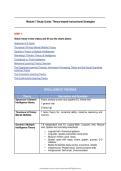
Module 7 Study Guide: Theory-based Instructional Strategies
STEP 1:
Watch these review videos and fill out the charts below:
Spearman’s G Factor
Thurstone’s Primary Mental Abilities Theory
Gardner's Theory of Multiple Intelligences
Sternberg’s Triarchic Theory of Intelligence
Crystalized vs. Fluid Intelligence
Behavioral Learning Theory Overview
The Cognitivist Learning Theories: Information Processing Theory and the Social Cognitivist
Learning Theory
The Humanistic Learning Theory
The Constructivist Learning Theory
INTELLIGENCE THEORIES
Theory Description and Examples
Spearman’s General Factor analysis scores vary together Ex: Verbal Intel
Intelligence theory 1 general intel
G factor (g)
Thurstone’s Primary 7 factor theory Ex: numerical ability, inductive reasoning and
Mental Abilities memory.
Gardner’s Multiple 7-9 independent intel Ex: Logical-Math, Linguistic intel, Musical
Intelligence Theory intel, Spatial intel and body-kinesthetic
• Logical/math- Numerical patterns
• Linguistic- spoken and written word smart
• Musical- rhythm, pitch, tones,
• Spatial- good with maps, charts, graphs, puzzles, 3-D
rotations
• Bodily-Kinesthetic-body control, movement, athletic
• Interpersonal- People smart, Communication skills
• Intrapersonal- Self-smart, Communication
Downloaded by harun mburu ()
, • Naturalist- Nature and environment
Sternberg’s Triarchic 3 types of intelligences Creative, Analytical, and Practical
Theory of Intelligence
Creative- come up with ideas
Analytical- Critical thinking
Practical- Apply knowledge and skills appropriately
List the video title of one video that you watched: Spearman’s G factor, Garner’s theory of
multiple intelligences, Thurstone’s Primary Mental Abilities Theory, Sternberg’s Triarchic Theory
of Intelligence,
Type of Intelligence Explanation and Examples
Crystallized Knowledge already known and built throughout life
Riding a bike,
Fluid Knowledge gained and can be forgotten if not used
How to fix cars,
BEAHVIORAL LEARNING THEORY
(and Instructional Strategies)
Classical Conditioning (Ivan Pavlov)
Concept Explanation and Examples
Unconditioned Stimulus A natural stimulus
Unconditioned Response A Natural response
Neutral Stimulus It can be sensed by either seeing it, tasting it, or hearing it
Conditioned Stimulus A learned stimulus
Downloaded by harun mburu ()
STEP 1:
Watch these review videos and fill out the charts below:
Spearman’s G Factor
Thurstone’s Primary Mental Abilities Theory
Gardner's Theory of Multiple Intelligences
Sternberg’s Triarchic Theory of Intelligence
Crystalized vs. Fluid Intelligence
Behavioral Learning Theory Overview
The Cognitivist Learning Theories: Information Processing Theory and the Social Cognitivist
Learning Theory
The Humanistic Learning Theory
The Constructivist Learning Theory
INTELLIGENCE THEORIES
Theory Description and Examples
Spearman’s General Factor analysis scores vary together Ex: Verbal Intel
Intelligence theory 1 general intel
G factor (g)
Thurstone’s Primary 7 factor theory Ex: numerical ability, inductive reasoning and
Mental Abilities memory.
Gardner’s Multiple 7-9 independent intel Ex: Logical-Math, Linguistic intel, Musical
Intelligence Theory intel, Spatial intel and body-kinesthetic
• Logical/math- Numerical patterns
• Linguistic- spoken and written word smart
• Musical- rhythm, pitch, tones,
• Spatial- good with maps, charts, graphs, puzzles, 3-D
rotations
• Bodily-Kinesthetic-body control, movement, athletic
• Interpersonal- People smart, Communication skills
• Intrapersonal- Self-smart, Communication
Downloaded by harun mburu ()
, • Naturalist- Nature and environment
Sternberg’s Triarchic 3 types of intelligences Creative, Analytical, and Practical
Theory of Intelligence
Creative- come up with ideas
Analytical- Critical thinking
Practical- Apply knowledge and skills appropriately
List the video title of one video that you watched: Spearman’s G factor, Garner’s theory of
multiple intelligences, Thurstone’s Primary Mental Abilities Theory, Sternberg’s Triarchic Theory
of Intelligence,
Type of Intelligence Explanation and Examples
Crystallized Knowledge already known and built throughout life
Riding a bike,
Fluid Knowledge gained and can be forgotten if not used
How to fix cars,
BEAHVIORAL LEARNING THEORY
(and Instructional Strategies)
Classical Conditioning (Ivan Pavlov)
Concept Explanation and Examples
Unconditioned Stimulus A natural stimulus
Unconditioned Response A Natural response
Neutral Stimulus It can be sensed by either seeing it, tasting it, or hearing it
Conditioned Stimulus A learned stimulus
Downloaded by harun mburu ()