

Alabama Department of
MAXE H&L
Insurance
★ ★
AL
State of Alabama
EST. 1819
PROTECTING ALABAMA CONSUMERS
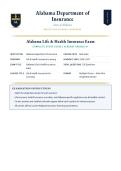
Alabama Life & Health Insurance Exam
CO M P L E T E ST U DY G U I D E | A L R E A DY G RA D E D A +
INSTITUTION Alabama Department of Insurance COURSE CODE L&H Exam
PROGRAM Life & Health Insurance Licensing ACADEMIC YEAR
EXAM TITLE Alabama Life & Health Insurance TOTAL QUESTIONS 136 Questions
Exam
COURSE TITLE Life & Health Insurance Pre- FORMAT Multiple Choice — Select the
Licensing Single Best Answer
EXAMINATION INSTRUCTIONS
▸ Select the single best answer for each question.
▸ Life insurance, health insurance, annuities, and Alabama-specific regulations are all testable content.
▸ Correct answers and detailed rationales appear below each question for review purposes.
▸ All content reflects current Alabama insurance licensing requirements.
, SECTION I — LIFE & HEALTH INSURANCE PRINCIPLES Questions 1 – 136
1. Which of the following would be considered a speculative risk?
A. The possibility the painting you bought might be a long-lost masterpiece
B. The possibility of a house fire
C. The possibility of a car accident
D. The possibility of a medical emergency
CORRECT ANSWER A — The possibility the painting you bought might be a long-lost
masterpiece
RATIONALE A speculative risk is one in which there is a chance for either loss or gain.
Examples include gambling, casinos, and lotteries. All of the other choices
describe pure risk, where there is no chance of gain, only a chance of loss exists.
2. Which is the proper term for a company owned by its policy owners?
A. A stock insurance company
B. A mutual insurance company
C. A fraternal benefit society
D. A reciprocal insurance exchange
CORRECT ANSWER B — A mutual insurance company
RATIONALE A mutual insurance company is owned by its policy owners (policyholders), who
are also the company's members. Policyholders may receive dividends based on
the company's financial performance. Stock companies are owned by
shareholders, not policyholders.
,3. A producer who is acting as an agent is representing:
A. Always the insurer
B. Always the insured
C. Both the insurer and the insured
D. Neither the insurer nor the insured
CORRECT ANSWER A — Always the insurer
RATIONALE An agent is a representative of the insurer and is authorized to act on behalf of the
insurer. The agent's actions are binding on the insurer as long as they are within
the scope of their authority. The agent represents the insurer, not the insured.
4. All of the following are elements of a contract, except:
A. Offer and acceptance
B. Consideration
C. Competent parties
D. Authority
CORRECT ANSWER D — Authority
RATIONALE All enforceable contracts must include these characteristics: offer and acceptance
(agreement), consideration, competent parties, and legal purpose. Authority is
not considered one of the elements of a legal contract. Authority relates to the
power given to an agent.
, 5. Each of the following would be an element in the definition of fraud, except:
A. Intentional material misrepresentation with the intent of causing injury to another party
B. Withholding of known material facts
C. A false statement on the application that is material to the acceptance of the risk
D. An individual warrants a fact stated on the application
CORRECT ANSWER D — An individual warrants a fact stated on the application
RATIONALE A warranted fact is one guaranteed to be true. Although no statement on an
application is regarded as warranty, no fraud is involved if a statement is
guaranteed to be true. Fraud requires intentional misrepresentation with intent to
deceive.
6. A company that is licensed to sell insurance in a particular state is:
A. An authorized Company
B. A foreign Company
C. An alien Company
D. A surplus lines Company
CORRECT ANSWER A — An authorized Company
RATIONALE An authorized company is one that is licensed to sell insurance in a particular
state. This is also referred to as an admitted company. Foreign companies are
incorporated in another state, alien companies are incorporated outside the US,
and surplus lines are non-admitted companies.
MAXE H&L
Insurance
★ ★
AL
State of Alabama
EST. 1819
PROTECTING ALABAMA CONSUMERS
Alabama Life & Health Insurance Exam
CO M P L E T E ST U DY G U I D E | A L R E A DY G RA D E D A +
INSTITUTION Alabama Department of Insurance COURSE CODE L&H Exam
PROGRAM Life & Health Insurance Licensing ACADEMIC YEAR
EXAM TITLE Alabama Life & Health Insurance TOTAL QUESTIONS 136 Questions
Exam
COURSE TITLE Life & Health Insurance Pre- FORMAT Multiple Choice — Select the
Licensing Single Best Answer
EXAMINATION INSTRUCTIONS
▸ Select the single best answer for each question.
▸ Life insurance, health insurance, annuities, and Alabama-specific regulations are all testable content.
▸ Correct answers and detailed rationales appear below each question for review purposes.
▸ All content reflects current Alabama insurance licensing requirements.
, SECTION I — LIFE & HEALTH INSURANCE PRINCIPLES Questions 1 – 136
1. Which of the following would be considered a speculative risk?
A. The possibility the painting you bought might be a long-lost masterpiece
B. The possibility of a house fire
C. The possibility of a car accident
D. The possibility of a medical emergency
CORRECT ANSWER A — The possibility the painting you bought might be a long-lost
masterpiece
RATIONALE A speculative risk is one in which there is a chance for either loss or gain.
Examples include gambling, casinos, and lotteries. All of the other choices
describe pure risk, where there is no chance of gain, only a chance of loss exists.
2. Which is the proper term for a company owned by its policy owners?
A. A stock insurance company
B. A mutual insurance company
C. A fraternal benefit society
D. A reciprocal insurance exchange
CORRECT ANSWER B — A mutual insurance company
RATIONALE A mutual insurance company is owned by its policy owners (policyholders), who
are also the company's members. Policyholders may receive dividends based on
the company's financial performance. Stock companies are owned by
shareholders, not policyholders.
,3. A producer who is acting as an agent is representing:
A. Always the insurer
B. Always the insured
C. Both the insurer and the insured
D. Neither the insurer nor the insured
CORRECT ANSWER A — Always the insurer
RATIONALE An agent is a representative of the insurer and is authorized to act on behalf of the
insurer. The agent's actions are binding on the insurer as long as they are within
the scope of their authority. The agent represents the insurer, not the insured.
4. All of the following are elements of a contract, except:
A. Offer and acceptance
B. Consideration
C. Competent parties
D. Authority
CORRECT ANSWER D — Authority
RATIONALE All enforceable contracts must include these characteristics: offer and acceptance
(agreement), consideration, competent parties, and legal purpose. Authority is
not considered one of the elements of a legal contract. Authority relates to the
power given to an agent.
, 5. Each of the following would be an element in the definition of fraud, except:
A. Intentional material misrepresentation with the intent of causing injury to another party
B. Withholding of known material facts
C. A false statement on the application that is material to the acceptance of the risk
D. An individual warrants a fact stated on the application
CORRECT ANSWER D — An individual warrants a fact stated on the application
RATIONALE A warranted fact is one guaranteed to be true. Although no statement on an
application is regarded as warranty, no fraud is involved if a statement is
guaranteed to be true. Fraud requires intentional misrepresentation with intent to
deceive.
6. A company that is licensed to sell insurance in a particular state is:
A. An authorized Company
B. A foreign Company
C. An alien Company
D. A surplus lines Company
CORRECT ANSWER A — An authorized Company
RATIONALE An authorized company is one that is licensed to sell insurance in a particular
state. This is also referred to as an admitted company. Foreign companies are
incorporated in another state, alien companies are incorporated outside the US,
and surplus lines are non-admitted companies.


