

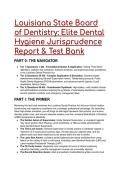
Louisiana State Board
of Dentistry: Elite Dental
Hygiene Jurisprudence
Report & Test Bank
PART 0: THE NAVIGATOR
● Tier 1 (Questions 1–28) - Foundational Syntax & Application: Testing "Hard Deck"
definitions, statutory fee schedules, licensure timelines, and explicit boundary prohibitions
in the Louisiana Dental Practice Act.
● Tier 2 (Questions 29–58) - Complex Application & Simulation: Scenario-based
assessments analyzing General Supervision metrics, Teledentistry protocols, Public
Health Dental Hygienist (PHDH) parameters, and advanced permit logistics (Local
Anesthesia, Nitrous Oxide).
● Tier 3 (Questions 59–88) - Grandmaster Synthesis: High-stakes, multi-variable clinical
and administrative scenarios requiring the synthesis of overlapping disciplinary violations,
records retention conflicts, and emergency management laws.
PART I: THE PRIMER
Mastering this test bank hardwires the Louisiana Dental Practice Act into your clinical intuition,
transforming rote regulatory compliance into a strategic professional advantage. By dissecting
these high-stakes scenarios, you will forge an elite legal framework that protects your license,
elevates patient care, and ensures absolute mastery over the Louisiana State Board of Dentistry
(LSBD) jurisprudence standards.
● The Golden Axiom of Supervision: Under General Supervision, a Louisiana hygienist
may never perform Root Planing, Local Anesthesia, or Nitrous Oxide administration;
these demand Direct Supervision.
● The Time-Lock Axiom: General Supervision in private practice is ruthlessly capped: a
maximum of 5 consecutive business days, 20 total days per calendar year, and the
patient must have been examined by the dentist within the last 9 months.
● The Laser Ban Axiom: Louisiana dental hygienists are strictly prohibited from using
lasers for the cutting of hard or soft tissue, including Laser Bacterial Reduction (LBR) and
Laser-Assisted Periodontal Therapy (LAPT).
● The CE Purity Axiom: Hygienists must complete 20 hours of clinical continuing
education biennially; practice management courses are universally rejected.
● The Record Retention Axiom: Adult and pediatric medical/dental written records must
, be held for 6 years; diagnostic images and radiographs require 3 years of retention.
Comprehensive Regulatory Framework & Analysis
The Louisiana State Board of Dentistry regulates the profession through strict adherence to Title
46, Part XXXIII of the Louisiana Administrative Code and the Louisiana Revised Statutes (R.S.
37:751 et seq.). Current regulatory trends in Louisiana reflect a dual mandate: expanding
access to care in underserved environments while aggressively policing the boundary between
dental hygiene and surgical dentistry.
Recent legislative advancements, such as the adoption of the Interstate Dental and Dental
Hygiene Licensure Compact (IDDHL) via HB 543 (Act 312), signal a shift toward borderless
practice for elite clinicians. This compact utilizes the American Board of Dental Examiners
(ADEX) as the gold standard for clinical competency, allowing practitioners who have graduated
from a CODA-accredited program and passed the ADEX to obtain multi-state privileges without
redundant examinations.
However, within state lines, supervision laws remain rigid. The General Supervision doctrine
acts as a vital bridge for patient care, but it is heavily tethered by chronological limits. In a
private practice setting, an absent dentist may only supervise a maximum of two hygienists.
Furthermore, the absentee period is strictly capped at 5 consecutive business days and 20 total
days per calendar year. Exemptions to these ratios are only granted to Public Health Dental
Hygienists (PHDH) operating in licensed nursing homes, provided they possess five years of
full-time clinical experience and have completed six hours of medical emergency continuing
education (CE).
Technological shifts have also prompted targeted rulemaking. Teledentistry is now permitted for
preventative procedures (e.g., sealants, prophylaxis) in Federally Qualified Health Centers
(FQHCs) and specific public schools, provided the dentist reviews the diagnostic data.
Asynchronous teledentistry requires the supervising dentist to review the intraoral images
before the patient is discharged. Conversely, the state has forcefully pushed back against the
delegation of laser therapy. While other jurisdictions allow hygienists to perform Laser Bacterial
Reduction (LBR), Louisiana categorically prohibits hygienists from utilizing any laser capable of
hard or soft tissue removal.
To navigate the administrative burdens of practice, professionals must master the state's
retention and fee frameworks.
Document/Credential Type Statutory Retention/Validity Source
Period
Patient Written Dental/Medical 6 years from the last date of
Chart treatment
Patient Diagnostic Images / 3 years from the last date of
X-Rays treatment
Continuing Education (CE) 3 calendar years following the
Certificates year of completion
Jurisprudence Examination 1 year from the date of
Score examination
Clinical Board Score (ADEX) 3 years from the date of
for RDH successful completion
, LSBD Administrative Action Authorized Fee Source
Dental Hygiene Biennial $220
Renewal
Licensure by Credentials $800
Application
Local Anesthesia / Nitrous $50
Oxide Renewal
Delinquency Fee (Late $100
Renewal)
Well-Being Program Annual $15
Surcharge
PART II: THE ELITE TEST BANK
Tier 1: Foundational Syntax & Application
Q1: A Louisiana dental hygienist completes 20 hours of CE, consisting of 15 hours of live
periodontal theory and 5 hours of online practice management. Based on the principles of LSBD
Continuing Education, which conclusion is the MOST ACCURATE? A) The submission is valid
as it meets the 20-hour biennial requirement. B) The submission is valid because 5 hours of
non-clinical elective CE is allowed. C) The submission is invalid because practice management
is not clinical in nature. D) The submission is invalid because online courses are capped at 4
hours.
● The Answer: C (The submission is invalid because practice management is not clinical in
nature.)
● Distractor Analysis:
○ A is incorrect: Hitting the total hour metric is irrelevant if the category is prohibited.
○ B is incorrect: Louisiana does not have a non-clinical elective allowance.
○ D is incorrect: Up to 8 hours of online/correspondence CE is permitted.
The Mentor's Analysis: The LSBD demands clinical purity. Every CE hour must directly relate to
the delivery of dental services to a patient. By utilizing only clinical courses, you bypass the
common trap of rejected renewals. Professional/Academic Intuition: Practice management
courses yield zero CE credit in Louisiana.
Q2: A hygienist submits 8 hours of correspondence CE. The course consisted of reading clinical
PDFs without a final assessment. Based on LSBD rules, which action is MOST ACCURATE? A)
The hours are accepted if a summary essay is provided. B) The hours are accepted because
correspondence is a recognized format. C) The hours are rejected because correspondence
courses must include a written examination that the licensee passes. D) The hours are rejected
because all CE must be live.
● The Answer: C (The hours are rejected because correspondence courses must include a
written examination that the licensee passes.)
● Distractor Analysis:
○ A is incorrect: The LSBD does not evaluate subjective essays.
○ B is incorrect: Format alone does not guarantee compliance.
○ D is incorrect: Live CE is required for 12 hours, but 8 hours can be remote.
The Mentor's Analysis: Passive reading is legally invisible. The Board requires an objective
metric of knowledge acquisition. By utilizing tested online courses, you bypass the common trap
of invalid distance learning. Professional/Academic Intuition: All correspondence/online CE
of Dentistry: Elite Dental
Hygiene Jurisprudence
Report & Test Bank
PART 0: THE NAVIGATOR
● Tier 1 (Questions 1–28) - Foundational Syntax & Application: Testing "Hard Deck"
definitions, statutory fee schedules, licensure timelines, and explicit boundary prohibitions
in the Louisiana Dental Practice Act.
● Tier 2 (Questions 29–58) - Complex Application & Simulation: Scenario-based
assessments analyzing General Supervision metrics, Teledentistry protocols, Public
Health Dental Hygienist (PHDH) parameters, and advanced permit logistics (Local
Anesthesia, Nitrous Oxide).
● Tier 3 (Questions 59–88) - Grandmaster Synthesis: High-stakes, multi-variable clinical
and administrative scenarios requiring the synthesis of overlapping disciplinary violations,
records retention conflicts, and emergency management laws.
PART I: THE PRIMER
Mastering this test bank hardwires the Louisiana Dental Practice Act into your clinical intuition,
transforming rote regulatory compliance into a strategic professional advantage. By dissecting
these high-stakes scenarios, you will forge an elite legal framework that protects your license,
elevates patient care, and ensures absolute mastery over the Louisiana State Board of Dentistry
(LSBD) jurisprudence standards.
● The Golden Axiom of Supervision: Under General Supervision, a Louisiana hygienist
may never perform Root Planing, Local Anesthesia, or Nitrous Oxide administration;
these demand Direct Supervision.
● The Time-Lock Axiom: General Supervision in private practice is ruthlessly capped: a
maximum of 5 consecutive business days, 20 total days per calendar year, and the
patient must have been examined by the dentist within the last 9 months.
● The Laser Ban Axiom: Louisiana dental hygienists are strictly prohibited from using
lasers for the cutting of hard or soft tissue, including Laser Bacterial Reduction (LBR) and
Laser-Assisted Periodontal Therapy (LAPT).
● The CE Purity Axiom: Hygienists must complete 20 hours of clinical continuing
education biennially; practice management courses are universally rejected.
● The Record Retention Axiom: Adult and pediatric medical/dental written records must
, be held for 6 years; diagnostic images and radiographs require 3 years of retention.
Comprehensive Regulatory Framework & Analysis
The Louisiana State Board of Dentistry regulates the profession through strict adherence to Title
46, Part XXXIII of the Louisiana Administrative Code and the Louisiana Revised Statutes (R.S.
37:751 et seq.). Current regulatory trends in Louisiana reflect a dual mandate: expanding
access to care in underserved environments while aggressively policing the boundary between
dental hygiene and surgical dentistry.
Recent legislative advancements, such as the adoption of the Interstate Dental and Dental
Hygiene Licensure Compact (IDDHL) via HB 543 (Act 312), signal a shift toward borderless
practice for elite clinicians. This compact utilizes the American Board of Dental Examiners
(ADEX) as the gold standard for clinical competency, allowing practitioners who have graduated
from a CODA-accredited program and passed the ADEX to obtain multi-state privileges without
redundant examinations.
However, within state lines, supervision laws remain rigid. The General Supervision doctrine
acts as a vital bridge for patient care, but it is heavily tethered by chronological limits. In a
private practice setting, an absent dentist may only supervise a maximum of two hygienists.
Furthermore, the absentee period is strictly capped at 5 consecutive business days and 20 total
days per calendar year. Exemptions to these ratios are only granted to Public Health Dental
Hygienists (PHDH) operating in licensed nursing homes, provided they possess five years of
full-time clinical experience and have completed six hours of medical emergency continuing
education (CE).
Technological shifts have also prompted targeted rulemaking. Teledentistry is now permitted for
preventative procedures (e.g., sealants, prophylaxis) in Federally Qualified Health Centers
(FQHCs) and specific public schools, provided the dentist reviews the diagnostic data.
Asynchronous teledentistry requires the supervising dentist to review the intraoral images
before the patient is discharged. Conversely, the state has forcefully pushed back against the
delegation of laser therapy. While other jurisdictions allow hygienists to perform Laser Bacterial
Reduction (LBR), Louisiana categorically prohibits hygienists from utilizing any laser capable of
hard or soft tissue removal.
To navigate the administrative burdens of practice, professionals must master the state's
retention and fee frameworks.
Document/Credential Type Statutory Retention/Validity Source
Period
Patient Written Dental/Medical 6 years from the last date of
Chart treatment
Patient Diagnostic Images / 3 years from the last date of
X-Rays treatment
Continuing Education (CE) 3 calendar years following the
Certificates year of completion
Jurisprudence Examination 1 year from the date of
Score examination
Clinical Board Score (ADEX) 3 years from the date of
for RDH successful completion
, LSBD Administrative Action Authorized Fee Source
Dental Hygiene Biennial $220
Renewal
Licensure by Credentials $800
Application
Local Anesthesia / Nitrous $50
Oxide Renewal
Delinquency Fee (Late $100
Renewal)
Well-Being Program Annual $15
Surcharge
PART II: THE ELITE TEST BANK
Tier 1: Foundational Syntax & Application
Q1: A Louisiana dental hygienist completes 20 hours of CE, consisting of 15 hours of live
periodontal theory and 5 hours of online practice management. Based on the principles of LSBD
Continuing Education, which conclusion is the MOST ACCURATE? A) The submission is valid
as it meets the 20-hour biennial requirement. B) The submission is valid because 5 hours of
non-clinical elective CE is allowed. C) The submission is invalid because practice management
is not clinical in nature. D) The submission is invalid because online courses are capped at 4
hours.
● The Answer: C (The submission is invalid because practice management is not clinical in
nature.)
● Distractor Analysis:
○ A is incorrect: Hitting the total hour metric is irrelevant if the category is prohibited.
○ B is incorrect: Louisiana does not have a non-clinical elective allowance.
○ D is incorrect: Up to 8 hours of online/correspondence CE is permitted.
The Mentor's Analysis: The LSBD demands clinical purity. Every CE hour must directly relate to
the delivery of dental services to a patient. By utilizing only clinical courses, you bypass the
common trap of rejected renewals. Professional/Academic Intuition: Practice management
courses yield zero CE credit in Louisiana.
Q2: A hygienist submits 8 hours of correspondence CE. The course consisted of reading clinical
PDFs without a final assessment. Based on LSBD rules, which action is MOST ACCURATE? A)
The hours are accepted if a summary essay is provided. B) The hours are accepted because
correspondence is a recognized format. C) The hours are rejected because correspondence
courses must include a written examination that the licensee passes. D) The hours are rejected
because all CE must be live.
● The Answer: C (The hours are rejected because correspondence courses must include a
written examination that the licensee passes.)
● Distractor Analysis:
○ A is incorrect: The LSBD does not evaluate subjective essays.
○ B is incorrect: Format alone does not guarantee compliance.
○ D is incorrect: Live CE is required for 12 hours, but 8 hours can be remote.
The Mentor's Analysis: Passive reading is legally invisible. The Board requires an objective
metric of knowledge acquisition. By utilizing tested online courses, you bypass the common trap
of invalid distance learning. Professional/Academic Intuition: All correspondence/online CE


