

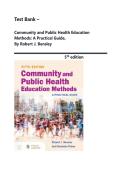
Test Bank –
Community and Public Health Education
Methods: A Practical Guide,
By Robert J. Bensley
5th edition
,TABLE OF CONTENTS
Chapter 1 Laying the Foundation for Selecting Community and Public Health Education Methods and
Strategies
Chapter 2 Becoming a Health Education Professional
Chapter 3 Promoting Health Education in a Multicultural Society
Chapter 4 Applying a Health Literacy Framework
Chapter 5 Developing and Selecting Resource Materials
Chapter 6 Developing Effective Presentation and Training Skills
Chapter 7 Applying Motivational Interviewing Techniques
Chapter 8 Exploring Social Marketing Concepts
Chapter 9 Building a Health Communication Framework
Chapter 10 Using Social Media
Chapter 11 Exploring Digital Media Strategies
Chapter 12 Working with Media Outlets
Chapter 13 Facilitating Groups
Chapter 14 Building and Sustaining Coalitions
Chapter 15 Advocating for Health Policy
,COMPREHENSIVE TEST BANK
Multiple Choice, True/False, Short Answer, and Essay Questions
CHAPTER 1: Laying the Foundation for Selecting Community and Public Health Education
Methods and Strategies
MULTIPLE CHOICE QUESTIONS
1. Which of the following BEST describes the primary goal of community and public health education?
A) To provide medical treatment to underserved populations
B) To empower individuals and communities to improve their health through education and behavior
change
C) To enforce public health laws and regulations
D) To collect epidemiological data for disease surveillance
Answer: B
Rationale: Community and public health education focuses on empowering individuals and
communities to make informed health decisions and adopt healthier behaviors.
2. When selecting health education methods and strategies, which factor should be considered FIRST?
A) Available budget and resources
B) The educator's personal preference and expertise
C) The needs, assets, and characteristics of the target population
D) The theoretical framework most commonly used in public health
Answer: C
Rationale: The target population's needs, assets, and characteristics are the primary considerations
when selecting health education methods and strategies.
3. The ecological model in health education recognizes that health behaviors are influenced by:
, A) Individual factors only
B) Multiple levels of influence, including individual, interpersonal, organizational, community, and policy
levels
C) Genetic predispositions and medical history
D) Social determinants exclusively
Answer: B
Rationale: The ecological model considers multiple levels of influence on health behavior, recognizing
that health is shaped by individual, interpersonal, community, organizational, and policy-level factors.
4. Which of the following is considered a NEEDS ASSESSMENT in health education practice?
A) A systematic process of collecting and analyzing data to determine gaps between current and desired
health outcomes
B) A budgeting process for allocating health education funds
C) A strategic plan for implementing health education programs
D) A review of existing health education literature
Answer: A
Rationale: A needs assessment is a systematic process used to identify gaps between current and
desired health outcomes, which informs the selection of appropriate methods and strategies.
5. The PRECEDE-PROCEED model is best described as:
A) A communication framework for developing public service announcements
B) A planning framework that helps health educators assess needs, set objectives, and evaluate
programs
C) A behavioral theory focusing exclusively on individual motivation
D) A policy advocacy model for legislative change
Community and Public Health Education
Methods: A Practical Guide,
By Robert J. Bensley
5th edition
,TABLE OF CONTENTS
Chapter 1 Laying the Foundation for Selecting Community and Public Health Education Methods and
Strategies
Chapter 2 Becoming a Health Education Professional
Chapter 3 Promoting Health Education in a Multicultural Society
Chapter 4 Applying a Health Literacy Framework
Chapter 5 Developing and Selecting Resource Materials
Chapter 6 Developing Effective Presentation and Training Skills
Chapter 7 Applying Motivational Interviewing Techniques
Chapter 8 Exploring Social Marketing Concepts
Chapter 9 Building a Health Communication Framework
Chapter 10 Using Social Media
Chapter 11 Exploring Digital Media Strategies
Chapter 12 Working with Media Outlets
Chapter 13 Facilitating Groups
Chapter 14 Building and Sustaining Coalitions
Chapter 15 Advocating for Health Policy
,COMPREHENSIVE TEST BANK
Multiple Choice, True/False, Short Answer, and Essay Questions
CHAPTER 1: Laying the Foundation for Selecting Community and Public Health Education
Methods and Strategies
MULTIPLE CHOICE QUESTIONS
1. Which of the following BEST describes the primary goal of community and public health education?
A) To provide medical treatment to underserved populations
B) To empower individuals and communities to improve their health through education and behavior
change
C) To enforce public health laws and regulations
D) To collect epidemiological data for disease surveillance
Answer: B
Rationale: Community and public health education focuses on empowering individuals and
communities to make informed health decisions and adopt healthier behaviors.
2. When selecting health education methods and strategies, which factor should be considered FIRST?
A) Available budget and resources
B) The educator's personal preference and expertise
C) The needs, assets, and characteristics of the target population
D) The theoretical framework most commonly used in public health
Answer: C
Rationale: The target population's needs, assets, and characteristics are the primary considerations
when selecting health education methods and strategies.
3. The ecological model in health education recognizes that health behaviors are influenced by:
, A) Individual factors only
B) Multiple levels of influence, including individual, interpersonal, organizational, community, and policy
levels
C) Genetic predispositions and medical history
D) Social determinants exclusively
Answer: B
Rationale: The ecological model considers multiple levels of influence on health behavior, recognizing
that health is shaped by individual, interpersonal, community, organizational, and policy-level factors.
4. Which of the following is considered a NEEDS ASSESSMENT in health education practice?
A) A systematic process of collecting and analyzing data to determine gaps between current and desired
health outcomes
B) A budgeting process for allocating health education funds
C) A strategic plan for implementing health education programs
D) A review of existing health education literature
Answer: A
Rationale: A needs assessment is a systematic process used to identify gaps between current and
desired health outcomes, which informs the selection of appropriate methods and strategies.
5. The PRECEDE-PROCEED model is best described as:
A) A communication framework for developing public service announcements
B) A planning framework that helps health educators assess needs, set objectives, and evaluate
programs
C) A behavioral theory focusing exclusively on individual motivation
D) A policy advocacy model for legislative change


