

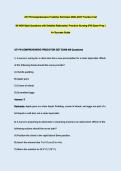
ATI PN Comprehensive Predictor Exit Exam 2026–2027 Practice Test
60 NGN-Style Questions with Detailed Rationales | Practical Nursing (PN) Exam Prep |
A+ Success Guide
ATI PN COMPREHENSIVE PREDICTOR EXIT EXAM (60 Questions)
1. A nurse is caring for a client who has a new prescription for a clear liquid diet. Which
of the following foods should the nurse provide?
A) Vanilla pudding
B) Apple juice
C) Cream of wheat
D) Scrambled eggs
Answer: B
Rationale: Apple juice is a clear liquid. Pudding, cream of wheat, and eggs are part of a
full liquid or soft diet, not a clear liquid diet.
2. A nurse is preparing to administer a cleansing enema to an adult client. Which of the
following actions should the nurse take?
A) Position the client in the right lateral Sims position.
B) Insert the enema tube 7 to 10 cm (3 to 4 in).
C) Warm the solution to 43.3° C (110° F).
,D) Administer the solution over 1 to 2 minutes.
Answer: B
Rationale: For an adult, the enema tube should be inserted 7 to 10 cm (3 to 4 in). The
client should be in the left lateral Sims position, the solution should be warmed to body
temperature (37° C or 98.6° F) to prevent cramping, and it should be administered over
5 to 10 minutes.
3. A nurse is caring for a client who is experiencing dysphagia following a stroke. Which
of the following actions should the nurse take?
A) Place the client in a supine position during meals.
B) Provide thin liquids to the client.
C) Encourage the client to tilt their head back when swallowing.
D) Place food on the unaffected side of the client's mouth.
Answer: D
Rationale: Placing food on the unaffected side promotes safe swallowing. The client
should be in a high-Fowler’s position, thickened liquids are preferred, and the client
should tuck their chin (not tilt it back) when swallowing.
4. A nurse is assessing a client who has a new prescription for a patient-controlled
analgesia (PCA) pump. Which of the following findings indicates the client is
experiencing an adverse effect of the medication?
A) Respiratory rate of 10/min
,B) Blood pressure of 130/80 mm Hg
C) Heart rate of 88/min
D) Oxygen saturation of 96%
Answer: A
Rationale: A respiratory rate of 10/min indicates respiratory depression, a life-
threatening adverse effect of opioid analgesics.
5. (NGN: Select All That Apply) A nurse is teaching a client about the proper use of a
cane. Which of the following instructions should the nurse include?
A) Hold the cane on the strong side of the body.
B) Advance the cane and the weak leg simultaneously.
C) Keep the elbow flexed at a 15- to 30-degree angle.
D) Move the cane forward 15 to 25 cm (6 to 10 in).
E) Place the cane 15 cm (6 in) lateral to the foot.
Answer: A, C, D, E
Rationale: The cane should be held on the strong side for maximum support. The elbow
should be flexed 15–30 degrees. The cane moves forward 15–25 cm and is placed 15
cm lateral to the foot. The client should advance the cane, then the weak leg, then the
strong leg (making B incorrect).
6. A nurse is caring for a client who has a new diagnosis of heart failure. Which of the
following findings should the nurse report to the provider?
, A) Weight gain of 0.5 kg (1.1 lb) in 24 hours
B) Heart rate of 92/min
C) Urine output of 25 mL/hr
D) +1 pitting edema in the lower extremities
Answer: C
Rationale: Urine output less than 30 mL/hr indicates decreased cardiac output and
renal perfusion, requiring immediate intervention.
7. A nurse is caring for a client who has a chest tube connected to a water-seal
drainage system. Which of the following findings should the nurse report to the
provider?
A) Continuous bubbling in the water-seal chamber
B) Intermittent bubbling in the water-seal chamber
C) Tidaling in the water-seal chamber
D) Drainage of 50 mL of serosanguinous fluid in the first hour
Answer: A
Rationale: Continuous bubbling in the water-seal chamber indicates an air leak in the
system and should be reported. Intermittent bubbling is expected with a pneumothorax,
tidaling is expected, and 50 mL/hr is within normal limits.
8. A nurse is assessing a client who has a new diagnosis of diabetic ketoacidosis (DKA).
Which of the following findings should the nurse expect?
60 NGN-Style Questions with Detailed Rationales | Practical Nursing (PN) Exam Prep |
A+ Success Guide
ATI PN COMPREHENSIVE PREDICTOR EXIT EXAM (60 Questions)
1. A nurse is caring for a client who has a new prescription for a clear liquid diet. Which
of the following foods should the nurse provide?
A) Vanilla pudding
B) Apple juice
C) Cream of wheat
D) Scrambled eggs
Answer: B
Rationale: Apple juice is a clear liquid. Pudding, cream of wheat, and eggs are part of a
full liquid or soft diet, not a clear liquid diet.
2. A nurse is preparing to administer a cleansing enema to an adult client. Which of the
following actions should the nurse take?
A) Position the client in the right lateral Sims position.
B) Insert the enema tube 7 to 10 cm (3 to 4 in).
C) Warm the solution to 43.3° C (110° F).
,D) Administer the solution over 1 to 2 minutes.
Answer: B
Rationale: For an adult, the enema tube should be inserted 7 to 10 cm (3 to 4 in). The
client should be in the left lateral Sims position, the solution should be warmed to body
temperature (37° C or 98.6° F) to prevent cramping, and it should be administered over
5 to 10 minutes.
3. A nurse is caring for a client who is experiencing dysphagia following a stroke. Which
of the following actions should the nurse take?
A) Place the client in a supine position during meals.
B) Provide thin liquids to the client.
C) Encourage the client to tilt their head back when swallowing.
D) Place food on the unaffected side of the client's mouth.
Answer: D
Rationale: Placing food on the unaffected side promotes safe swallowing. The client
should be in a high-Fowler’s position, thickened liquids are preferred, and the client
should tuck their chin (not tilt it back) when swallowing.
4. A nurse is assessing a client who has a new prescription for a patient-controlled
analgesia (PCA) pump. Which of the following findings indicates the client is
experiencing an adverse effect of the medication?
A) Respiratory rate of 10/min
,B) Blood pressure of 130/80 mm Hg
C) Heart rate of 88/min
D) Oxygen saturation of 96%
Answer: A
Rationale: A respiratory rate of 10/min indicates respiratory depression, a life-
threatening adverse effect of opioid analgesics.
5. (NGN: Select All That Apply) A nurse is teaching a client about the proper use of a
cane. Which of the following instructions should the nurse include?
A) Hold the cane on the strong side of the body.
B) Advance the cane and the weak leg simultaneously.
C) Keep the elbow flexed at a 15- to 30-degree angle.
D) Move the cane forward 15 to 25 cm (6 to 10 in).
E) Place the cane 15 cm (6 in) lateral to the foot.
Answer: A, C, D, E
Rationale: The cane should be held on the strong side for maximum support. The elbow
should be flexed 15–30 degrees. The cane moves forward 15–25 cm and is placed 15
cm lateral to the foot. The client should advance the cane, then the weak leg, then the
strong leg (making B incorrect).
6. A nurse is caring for a client who has a new diagnosis of heart failure. Which of the
following findings should the nurse report to the provider?
, A) Weight gain of 0.5 kg (1.1 lb) in 24 hours
B) Heart rate of 92/min
C) Urine output of 25 mL/hr
D) +1 pitting edema in the lower extremities
Answer: C
Rationale: Urine output less than 30 mL/hr indicates decreased cardiac output and
renal perfusion, requiring immediate intervention.
7. A nurse is caring for a client who has a chest tube connected to a water-seal
drainage system. Which of the following findings should the nurse report to the
provider?
A) Continuous bubbling in the water-seal chamber
B) Intermittent bubbling in the water-seal chamber
C) Tidaling in the water-seal chamber
D) Drainage of 50 mL of serosanguinous fluid in the first hour
Answer: A
Rationale: Continuous bubbling in the water-seal chamber indicates an air leak in the
system and should be reported. Intermittent bubbling is expected with a pneumothorax,
tidaling is expected, and 50 mL/hr is within normal limits.
8. A nurse is assessing a client who has a new diagnosis of diabetic ketoacidosis (DKA).
Which of the following findings should the nurse expect?


