

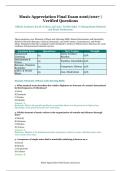
Music Appreciation Final Exam 2026/2027 |
Verified Questions
Official Academic Board of Music and Arts | Verified Q&A | Undergraduate Students
and Music Enthusiasts
These questions cover Elements of Music and Listening Skills, Musical Instruments and Ensembles,
Historical Periods (Baroque, Classical, Romantic), and 20th Century, Contemporary, and World
Music. Emphasize that this is original content designed to reinforce official course objectives for exam
readiness and guaranteed academic success.
Content Area Questions Key Topics Weight
Elements & Form, Texture,
25 25%
Listening Rhythm
Instruments &
25 Families, Ensembles 25%
Voices
Baroque, Classical,
25 Composers, History 25%
Romantic
20th C & World
25 Jazz, Modernism 25%
Music
Domain: Elements of Music and Listening Skills
1. What musical term describes the relative highness or lowness of a sound, determined
by the frequency of vibrations?
A) Pitch
B) Dynamics
C) Timbre
D) Rhythm
Answer: A
Rationale: Pitch is the specific quality of a sound that allows it to be perceived as high or low,
depending on the speed of sound wave vibrations.
2. Which element of music refers to the organization of sounds and silences through
time?
A) Melody
B) Harmony
C) Rhythm
D) Texture
Answer: C
Rationale: Rhythm is the fundamental pulse and pattern of time in music, dictating when notes
occur and for how long.
3. A sequence of single notes that is musically satisfying is known as a:
A) Chord
B) Melody
C) Progression
D) Cadence
Answer: B
Music Appreciation Final Exam 2026/2027
,Rationale: A melody consists of a series of individual pitches that the listener perceives as a single,
coherent entity.
4. Which texture involves a single melodic line without any accompaniment?
A) Monophonic
B) Homophonic
C) Polyphonic
D) Heterophonic
Answer: A
Rationale: Monophony is the simplest musical texture, consisting of one melody performed alone.
5. The term 'fortissimo' (ff) indicates that the music should be played:
A) Very soft
B) Moderately loud
C) Very loud
D) Gradually getting louder
Answer: C
Rationale: Dynamics describe volume; 'fortissimo' translates to 'very loud' in Italian musical
terminology.
6. What is the term for a combination of three or more notes played simultaneously?
A) Interval
B) Scale
C) Chord
D) Arpeggio
Answer: C
Rationale: Chords are the building blocks of harmony, created when multiple pitches sound at once.
7. The speed at which a musical piece is played is known as its:
A) Meter
B) Tempo
C) Pulse
D) Syncopation
Answer: B
Rationale: Tempo indicates the rate of the beat, ranging from very slow (adagio) to very fast
(presto).
8. Which form consists of a statement (A), followed by a contrasting section (B), and a
return to the original statement (A)?
A) Binary form
B) Ternary form
C) Theme and variations
D) Rondo
Answer: B
Rationale: Ternary form (ABA) is a common structural design that emphasizes contrast and return.
9. A 'crescendo' instructions a performer to:
A) Decrease volume
B) Increase speed
C) Increase volume
D) Decrease speed
Music Appreciation Final Exam 2026/2027
, Answer: C
Rationale: Crescendo is a dynamic instruction meaning to gradually get louder.
10. What element describes the unique sound quality or 'tone color' of a specific
instrument or voice?
A) Texture
B) Timbre
C) Harmony
D) Dynamics
Answer: B
Rationale: Timbre allows listeners to distinguish between a flute and a trumpet playing the same
pitch at the same volume.
11. In musical meter, the grouping of beats into regular patterns is called:
A) Syncopation
B) Measure
C) Duple
D) Rhythm
Answer: B
Rationale: A measure (or bar) contains a specific number of beats according to the time signature.
12. Which term describes a chord that sounds stable and restful?
A) Dissonant
B) Consonant
C) Chromatic
D) Atonal
Answer: B
Rationale: Consonance refers to harmonious intervals or chords that sound pleasing and complete.
13. A short, recurring musical idea or fragment is known as a:
A) Phrase
B) Motive
C) Cadence
D) Sequence
Answer: B
Rationale: Motives serve as the smallest structural units in a composition, often developed
throughout the work.
14. Which form involves a recurring theme alternating with several contrasting sections
(ABACA)?
A) Sonata
B) Rondo
C) Fugue
D) Variations
Answer: B
Rationale: Rondo form is characterized by a bright, recurring main theme that keeps returning
after different episodes.
15. The shift from one musical key to another within the same piece is called:
A) Transposition
B) Modulation
C) Intonation
Music Appreciation Final Exam 2026/2027
Verified Questions
Official Academic Board of Music and Arts | Verified Q&A | Undergraduate Students
and Music Enthusiasts
These questions cover Elements of Music and Listening Skills, Musical Instruments and Ensembles,
Historical Periods (Baroque, Classical, Romantic), and 20th Century, Contemporary, and World
Music. Emphasize that this is original content designed to reinforce official course objectives for exam
readiness and guaranteed academic success.
Content Area Questions Key Topics Weight
Elements & Form, Texture,
25 25%
Listening Rhythm
Instruments &
25 Families, Ensembles 25%
Voices
Baroque, Classical,
25 Composers, History 25%
Romantic
20th C & World
25 Jazz, Modernism 25%
Music
Domain: Elements of Music and Listening Skills
1. What musical term describes the relative highness or lowness of a sound, determined
by the frequency of vibrations?
A) Pitch
B) Dynamics
C) Timbre
D) Rhythm
Answer: A
Rationale: Pitch is the specific quality of a sound that allows it to be perceived as high or low,
depending on the speed of sound wave vibrations.
2. Which element of music refers to the organization of sounds and silences through
time?
A) Melody
B) Harmony
C) Rhythm
D) Texture
Answer: C
Rationale: Rhythm is the fundamental pulse and pattern of time in music, dictating when notes
occur and for how long.
3. A sequence of single notes that is musically satisfying is known as a:
A) Chord
B) Melody
C) Progression
D) Cadence
Answer: B
Music Appreciation Final Exam 2026/2027
,Rationale: A melody consists of a series of individual pitches that the listener perceives as a single,
coherent entity.
4. Which texture involves a single melodic line without any accompaniment?
A) Monophonic
B) Homophonic
C) Polyphonic
D) Heterophonic
Answer: A
Rationale: Monophony is the simplest musical texture, consisting of one melody performed alone.
5. The term 'fortissimo' (ff) indicates that the music should be played:
A) Very soft
B) Moderately loud
C) Very loud
D) Gradually getting louder
Answer: C
Rationale: Dynamics describe volume; 'fortissimo' translates to 'very loud' in Italian musical
terminology.
6. What is the term for a combination of three or more notes played simultaneously?
A) Interval
B) Scale
C) Chord
D) Arpeggio
Answer: C
Rationale: Chords are the building blocks of harmony, created when multiple pitches sound at once.
7. The speed at which a musical piece is played is known as its:
A) Meter
B) Tempo
C) Pulse
D) Syncopation
Answer: B
Rationale: Tempo indicates the rate of the beat, ranging from very slow (adagio) to very fast
(presto).
8. Which form consists of a statement (A), followed by a contrasting section (B), and a
return to the original statement (A)?
A) Binary form
B) Ternary form
C) Theme and variations
D) Rondo
Answer: B
Rationale: Ternary form (ABA) is a common structural design that emphasizes contrast and return.
9. A 'crescendo' instructions a performer to:
A) Decrease volume
B) Increase speed
C) Increase volume
D) Decrease speed
Music Appreciation Final Exam 2026/2027
, Answer: C
Rationale: Crescendo is a dynamic instruction meaning to gradually get louder.
10. What element describes the unique sound quality or 'tone color' of a specific
instrument or voice?
A) Texture
B) Timbre
C) Harmony
D) Dynamics
Answer: B
Rationale: Timbre allows listeners to distinguish between a flute and a trumpet playing the same
pitch at the same volume.
11. In musical meter, the grouping of beats into regular patterns is called:
A) Syncopation
B) Measure
C) Duple
D) Rhythm
Answer: B
Rationale: A measure (or bar) contains a specific number of beats according to the time signature.
12. Which term describes a chord that sounds stable and restful?
A) Dissonant
B) Consonant
C) Chromatic
D) Atonal
Answer: B
Rationale: Consonance refers to harmonious intervals or chords that sound pleasing and complete.
13. A short, recurring musical idea or fragment is known as a:
A) Phrase
B) Motive
C) Cadence
D) Sequence
Answer: B
Rationale: Motives serve as the smallest structural units in a composition, often developed
throughout the work.
14. Which form involves a recurring theme alternating with several contrasting sections
(ABACA)?
A) Sonata
B) Rondo
C) Fugue
D) Variations
Answer: B
Rationale: Rondo form is characterized by a bright, recurring main theme that keeps returning
after different episodes.
15. The shift from one musical key to another within the same piece is called:
A) Transposition
B) Modulation
C) Intonation
Music Appreciation Final Exam 2026/2027


