

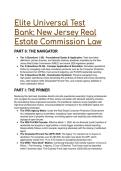
Elite Universal Test
Bank: New Jersey Real
Estate Commission Law
PART 0: THE NAVIGATOR
● Tier 1 (Questions 1–28) - Foundational Syntax & Application: Tests hard-deck
definitions, primary theories, and absolute statutory deadlines mandated by the New
Jersey Real Estate Commission (NREC) and recent 2026 legislative updates.
● Tier 2 (Questions 29–58) - Complex Application & Simulation: Simulates operational
friction by navigating multi-step compliance protocols such as the Consumer Protection
Enhancement Act (CPEA), trust account ledgering, and FinCEN residential reporting.
● Tier 3 (Questions 59–88) - Grandmaster Synthesis: Presents paragraph-long,
high-stakes operational crises demanding the synthesis of federal anti-money laundering
laws, state taxation shifts (Graduated Percent Fee), and complex agency liabilities to
avert catastrophic failure.
PART I: THE PRIMER
Mastering this test bank translates directly into elite operational superiority, forging professionals
who navigate the severe liabilities of New Jersey real estate with absolute statutory precision.
By internalizing these engineered scenarios, the practitioner replaces novice hesitation with
high-level professional intuition, ensuring bulletproof compliance in the 2026/2027 global and
local regulatory landscape.
● The CPEA Agency Matrix: Under the Real Estate Consumer Protection Enhancement
Act, designated agency is permitted, mandatory buyer representation agreements are
required prior to property showings, and listing agents must explicitly post relationship
signage at open houses.
● The 2026 FinCEN Cascade: Effective March 1, 2026, all non-financed (cash) transfers of
residential real property to legal entities or trusts trigger mandatory federal reporting.
Responsibility follows a strict cascade, beginning absolutely with the closing or settlement
agent.
● The Graduated Percent Fee (GPF) Shift: The legacy 1% mansion tax on buyers is
abolished. For properties over $1,000,000, the seller now bears the GPF, which
aggressively scales from 1% to 3.5% based on escalating transaction tiers.
● The NREC "Hard Deck" Metrics: Continuing Education (CE) strictly requires 12 hours (2
Ethics, 1 Fair Housing, 1 Agency, 2 Core, 6 Elective). Trust funds must be deposited
within 5 business days. The Guaranty Fund caps recovery at $20,000 per transaction.
,Core Metrics and Statutory Limitations
Regulatory Domain Metric / Requirement Governing Statute / Standard
CE Completion Deadline April 30 of renewal year to N.J.A.C. 11:5-12.4
avoid $200 late fee
Trust Account Deposits Within 5 business days of N.J.A.C. 11:5-5.1
receipt
Guaranty Fund Max $20,000 per transaction N.J.S.A. 45:15-34
Interstate Land Sales 7 calendar day rescission N.J.S.A. 45:15-16.27
period
Right-to-List Agreements Maximum duration of 5 years P.L.1995, c.360
FinCEN Filing Deadline Later of 30 days post-closing or 31 CFR Chapter X
last day of next month
Temporary Broker App. Within 30 days of N.J.S.A. 45:15-11.3
death/incapacity (requires 3 yrs
exp.)
PART II: THE ELITE TEST BANK
Tier 1: Foundational Syntax & Application
Q1: A licensed New Jersey salesperson is completing Continuing Education (CE) for the 2027
renewal cycle. Based on the principles of the NREC Continuing Education Requirements, which
course breakdown is the MOST ACCURATE? A) 12 total hours: 6 elective, 4 ethics, 2 fair
housing. B) 12 total hours: 6 core, 6 elective, with no specific topic mandates. C) 12 total hours:
2 ethics, 1 fair housing, 1 agency, 2 additional core, and 6 electives. D) 16 total hours: 4 ethics,
2 agency, 10 electives.
● The Answer: C (12 total hours: 2 ethics, 1 fair housing, 1 agency, 2 additional core, and 6
electives)
● Distractor Analysis:
○ A is incorrect: The breakdown lacks the mandatory 1-hour agency requirement
introduced recently.
○ B is incorrect: The regulations explicitly subdivide the 6 core hours into mandatory
micro-categories.
○ D is incorrect: New Jersey law mandates 12 hours, not 16.
The Mentor's Analysis: The state strictly monitors the composition, not just the volume, of
professional education. When renewing a license, the immediate priority is satisfying the exact
micro-requirements within the core umbrella. By utilizing the 2-1-1-2-6 formula, the practitioner
bypasses the common trap of license expiration due to misallocated credits.
Professional/Academic Intuition: CE requires a precise distribution; failure to include the
single hour of Agency or Fair Housing voids the entire renewal.
Q2: A brokerage firm utilizes the designated agency structure for an in-house transaction.
Based on the principles of the Consumer Protection Enhancement Act, which statement
regarding the Broker of Record's status is MOST ACCURATE? A) The Broker of Record
becomes a transaction broker. B) The Broker of Record operates as a seller's agent exclusively.
C) The Broker of Record acts as a disclosed dual agent. D) The Broker of Record recuses
,themselves entirely from the transaction.
● The Answer: C (The Broker of Record acts as a disclosed dual agent)
● Distractor Analysis:
○ A is incorrect: Transaction brokers do not represent either party, whereas the firm
here retains fiduciary agency.
○ B is incorrect: Operating solely for the seller violates the buyer's representation
within the firm.
○ D is incorrect: A broker cannot legally abandon supervision of their agents.
The Mentor's Analysis: Designated agency allows individual agents to advocate for opposing
sides, but the firm itself bridges the gap. When employing designated agents, the immediate
priority is securing dual agency consent for the corporate entity. By utilizing informed consent,
the practitioner bypasses the common trap of undisclosed conflict of interest.
Professional/Academic Intuition: Individual agents designate; the overarching broker acts
as a dual agent.
Q3: An individual is aggrieved by a licensed broker's embezzlement of escrow funds and
secures a court judgment. Based on the principles of the New Jersey Real Estate Guaranty
Fund, what is the maximum recovery limit the claimant can expect for this single transaction? A)
$10,000 B) $20,000 C) $50,000 D) An unlimited amount up to the total embezzled funds.
● The Answer: B ($20,000)
● Distractor Analysis:
○ A is incorrect: The limit of $10,000 is a legacy ceiling prior to statutory amendments.
○ C is incorrect: This limit applies in other jurisdictions, but not New Jersey.
○ D is incorrect: The fund is strictly capped by statute to ensure continued solvency.
The Mentor's Analysis: The Guaranty Fund serves as a consumer safety net, not a total
indemnity policy. When a consumer faces an uncollectible judgment, the immediate priority is
applying to the fund subject to statutory caps. By utilizing the $20,000 maximum constraint, the
practitioner bypasses the common trap of overpromising recovery to a defrauded client.
Professional/Academic Intuition: The Guaranty Fund shields the public but caps liability at
$20,000 per transaction.
Q4: A cash buyer purchases a $3,000,000 residential property using an LLC. The closing is
scheduled for March 15, 2026. Based on the principles of the FinCEN Residential Real Estate
Rule, who is FIRST in the cascade to bear the reporting obligation? A) The real estate broker
representing the buyer. B) The closing or settlement agent. C) The buyer's LLC managing
member. D) The title insurance underwriter.
● The Answer: B (The closing or settlement agent)
● Distractor Analysis:
○ A is incorrect: Brokers are positioned lower in the cascade and are exempt if a
closing agent is present.
○ C is incorrect: The rule explicitly targets the real estate professionals facilitating the
transfer, not the transferee directly.
○ D is incorrect: Underwriters are not primary; the individual executing the settlement
takes the first tier.
The Mentor's Analysis: Federal anti-money laundering frameworks rely on chokepoint reporting.
When a non-financed transfer occurs, the immediate priority is determining the cascade
hierarchy. By utilizing the settlement agent as the primary reporter, the practitioner bypasses the
common trap of broker liability for federal filings. Professional/Academic Intuition: The FinCEN
reporting cascade always triggers at the settlement table first.
Q5: A seller is listing their residential property. Under the RECPA 2024 guidelines, when MUST
, the seller provide a fully completed Property Condition Disclosure Statement to a potential
buyer? A) At the closing table. B) Within 3 days after the contract is signed. C) Before the buyer
is contractually obligated. D) It remains strictly optional in New Jersey.
● The Answer: C (Before the buyer is contractually obligated)
● Distractor Analysis:
○ A is incorrect: Providing it at closing defeats the purpose of informing the purchase
decision.
○ B is incorrect: Post-contract disclosure is a legacy error exposing the seller to
rescission.
○ D is incorrect: The 2024 Act transformed this from a best practice into a mandatory
statutory requirement.
The Mentor's Analysis: Transparency is now legislated at the point of decision, not the point of
transfer. When listing a property, the immediate priority is executing the disclosure statement
upfront. By utilizing preemptive disclosure, the practitioner bypasses the common trap of
contract cancellation during attorney review. Professional/Academic Intuition: Disclosure
precedes obligation; no buyer signs blind.
Q6: A salesperson receives an earnest money deposit check from a buyer on a Tuesday. Based
on the principles of N.J.A.C. 11:5-5.1, by what deadline MUST the employing broker deposit
these funds into the trust account? A) Immediately upon receipt. B) Within 48 hours. C) Within 5
business days of receipt. D) By the end of the current month.
● The Answer: C (Within 5 business days of receipt)
● Distractor Analysis:
○ A is incorrect: While prudent, the statute grants a specific grace period.
○ B is incorrect: This is a strict standard applied in other jurisdictions, not New Jersey.
○ D is incorrect: Waiting until month-end constitutes severe commingling and
regulatory negligence.
The Mentor's Analysis: Escrow mechanics require deliberate speed. When handling funds
belonging to others, the immediate priority is secure ledgering within the statutory window. By
utilizing the 5-business-day rule, the practitioner bypasses the common trap of regulatory
sanctions for delayed deposits. Professional/Academic Intuition: Five business days is the
absolute ceiling for trust account deposits.
Q7: A real estate licensee advertises a property on their personal webpage. Based on the
principles of N.J.A.C. 11:5-6.1 (Advertising Rules), what is the formatting requirement regarding
the broker's regular business name? A) It must be included in small print at the bottom of the
page. B) It must appear in larger print or be displayed in a more prominent manner than the
salesperson's name. C) It is not required if the salesperson includes their direct cell phone
number. D) It must match the exact font size of the salesperson's name.
● The Answer: B (It must appear in larger print or be displayed in a more prominent manner
than the salesperson's name)
● Distractor Analysis:
○ A is incorrect: Fine print violates the clear and conspicuous mandate.
○ C is incorrect: A broker's name is universally required to prevent blind ads.
○ D is incorrect: Equal size is insufficient; the broker's name must be definitively
larger or more prominent.
The Mentor's Analysis: The public must know exactly who holds the ultimate liability for the
transaction. When designing advertising, the immediate priority is visual hierarchy. By utilizing
prominent broker branding, the practitioner bypasses the common trap of deceptive blind
advertising. Professional/Academic Intuition: The broker's name must visually eclipse the
Bank: New Jersey Real
Estate Commission Law
PART 0: THE NAVIGATOR
● Tier 1 (Questions 1–28) - Foundational Syntax & Application: Tests hard-deck
definitions, primary theories, and absolute statutory deadlines mandated by the New
Jersey Real Estate Commission (NREC) and recent 2026 legislative updates.
● Tier 2 (Questions 29–58) - Complex Application & Simulation: Simulates operational
friction by navigating multi-step compliance protocols such as the Consumer Protection
Enhancement Act (CPEA), trust account ledgering, and FinCEN residential reporting.
● Tier 3 (Questions 59–88) - Grandmaster Synthesis: Presents paragraph-long,
high-stakes operational crises demanding the synthesis of federal anti-money laundering
laws, state taxation shifts (Graduated Percent Fee), and complex agency liabilities to
avert catastrophic failure.
PART I: THE PRIMER
Mastering this test bank translates directly into elite operational superiority, forging professionals
who navigate the severe liabilities of New Jersey real estate with absolute statutory precision.
By internalizing these engineered scenarios, the practitioner replaces novice hesitation with
high-level professional intuition, ensuring bulletproof compliance in the 2026/2027 global and
local regulatory landscape.
● The CPEA Agency Matrix: Under the Real Estate Consumer Protection Enhancement
Act, designated agency is permitted, mandatory buyer representation agreements are
required prior to property showings, and listing agents must explicitly post relationship
signage at open houses.
● The 2026 FinCEN Cascade: Effective March 1, 2026, all non-financed (cash) transfers of
residential real property to legal entities or trusts trigger mandatory federal reporting.
Responsibility follows a strict cascade, beginning absolutely with the closing or settlement
agent.
● The Graduated Percent Fee (GPF) Shift: The legacy 1% mansion tax on buyers is
abolished. For properties over $1,000,000, the seller now bears the GPF, which
aggressively scales from 1% to 3.5% based on escalating transaction tiers.
● The NREC "Hard Deck" Metrics: Continuing Education (CE) strictly requires 12 hours (2
Ethics, 1 Fair Housing, 1 Agency, 2 Core, 6 Elective). Trust funds must be deposited
within 5 business days. The Guaranty Fund caps recovery at $20,000 per transaction.
,Core Metrics and Statutory Limitations
Regulatory Domain Metric / Requirement Governing Statute / Standard
CE Completion Deadline April 30 of renewal year to N.J.A.C. 11:5-12.4
avoid $200 late fee
Trust Account Deposits Within 5 business days of N.J.A.C. 11:5-5.1
receipt
Guaranty Fund Max $20,000 per transaction N.J.S.A. 45:15-34
Interstate Land Sales 7 calendar day rescission N.J.S.A. 45:15-16.27
period
Right-to-List Agreements Maximum duration of 5 years P.L.1995, c.360
FinCEN Filing Deadline Later of 30 days post-closing or 31 CFR Chapter X
last day of next month
Temporary Broker App. Within 30 days of N.J.S.A. 45:15-11.3
death/incapacity (requires 3 yrs
exp.)
PART II: THE ELITE TEST BANK
Tier 1: Foundational Syntax & Application
Q1: A licensed New Jersey salesperson is completing Continuing Education (CE) for the 2027
renewal cycle. Based on the principles of the NREC Continuing Education Requirements, which
course breakdown is the MOST ACCURATE? A) 12 total hours: 6 elective, 4 ethics, 2 fair
housing. B) 12 total hours: 6 core, 6 elective, with no specific topic mandates. C) 12 total hours:
2 ethics, 1 fair housing, 1 agency, 2 additional core, and 6 electives. D) 16 total hours: 4 ethics,
2 agency, 10 electives.
● The Answer: C (12 total hours: 2 ethics, 1 fair housing, 1 agency, 2 additional core, and 6
electives)
● Distractor Analysis:
○ A is incorrect: The breakdown lacks the mandatory 1-hour agency requirement
introduced recently.
○ B is incorrect: The regulations explicitly subdivide the 6 core hours into mandatory
micro-categories.
○ D is incorrect: New Jersey law mandates 12 hours, not 16.
The Mentor's Analysis: The state strictly monitors the composition, not just the volume, of
professional education. When renewing a license, the immediate priority is satisfying the exact
micro-requirements within the core umbrella. By utilizing the 2-1-1-2-6 formula, the practitioner
bypasses the common trap of license expiration due to misallocated credits.
Professional/Academic Intuition: CE requires a precise distribution; failure to include the
single hour of Agency or Fair Housing voids the entire renewal.
Q2: A brokerage firm utilizes the designated agency structure for an in-house transaction.
Based on the principles of the Consumer Protection Enhancement Act, which statement
regarding the Broker of Record's status is MOST ACCURATE? A) The Broker of Record
becomes a transaction broker. B) The Broker of Record operates as a seller's agent exclusively.
C) The Broker of Record acts as a disclosed dual agent. D) The Broker of Record recuses
,themselves entirely from the transaction.
● The Answer: C (The Broker of Record acts as a disclosed dual agent)
● Distractor Analysis:
○ A is incorrect: Transaction brokers do not represent either party, whereas the firm
here retains fiduciary agency.
○ B is incorrect: Operating solely for the seller violates the buyer's representation
within the firm.
○ D is incorrect: A broker cannot legally abandon supervision of their agents.
The Mentor's Analysis: Designated agency allows individual agents to advocate for opposing
sides, but the firm itself bridges the gap. When employing designated agents, the immediate
priority is securing dual agency consent for the corporate entity. By utilizing informed consent,
the practitioner bypasses the common trap of undisclosed conflict of interest.
Professional/Academic Intuition: Individual agents designate; the overarching broker acts
as a dual agent.
Q3: An individual is aggrieved by a licensed broker's embezzlement of escrow funds and
secures a court judgment. Based on the principles of the New Jersey Real Estate Guaranty
Fund, what is the maximum recovery limit the claimant can expect for this single transaction? A)
$10,000 B) $20,000 C) $50,000 D) An unlimited amount up to the total embezzled funds.
● The Answer: B ($20,000)
● Distractor Analysis:
○ A is incorrect: The limit of $10,000 is a legacy ceiling prior to statutory amendments.
○ C is incorrect: This limit applies in other jurisdictions, but not New Jersey.
○ D is incorrect: The fund is strictly capped by statute to ensure continued solvency.
The Mentor's Analysis: The Guaranty Fund serves as a consumer safety net, not a total
indemnity policy. When a consumer faces an uncollectible judgment, the immediate priority is
applying to the fund subject to statutory caps. By utilizing the $20,000 maximum constraint, the
practitioner bypasses the common trap of overpromising recovery to a defrauded client.
Professional/Academic Intuition: The Guaranty Fund shields the public but caps liability at
$20,000 per transaction.
Q4: A cash buyer purchases a $3,000,000 residential property using an LLC. The closing is
scheduled for March 15, 2026. Based on the principles of the FinCEN Residential Real Estate
Rule, who is FIRST in the cascade to bear the reporting obligation? A) The real estate broker
representing the buyer. B) The closing or settlement agent. C) The buyer's LLC managing
member. D) The title insurance underwriter.
● The Answer: B (The closing or settlement agent)
● Distractor Analysis:
○ A is incorrect: Brokers are positioned lower in the cascade and are exempt if a
closing agent is present.
○ C is incorrect: The rule explicitly targets the real estate professionals facilitating the
transfer, not the transferee directly.
○ D is incorrect: Underwriters are not primary; the individual executing the settlement
takes the first tier.
The Mentor's Analysis: Federal anti-money laundering frameworks rely on chokepoint reporting.
When a non-financed transfer occurs, the immediate priority is determining the cascade
hierarchy. By utilizing the settlement agent as the primary reporter, the practitioner bypasses the
common trap of broker liability for federal filings. Professional/Academic Intuition: The FinCEN
reporting cascade always triggers at the settlement table first.
Q5: A seller is listing their residential property. Under the RECPA 2024 guidelines, when MUST
, the seller provide a fully completed Property Condition Disclosure Statement to a potential
buyer? A) At the closing table. B) Within 3 days after the contract is signed. C) Before the buyer
is contractually obligated. D) It remains strictly optional in New Jersey.
● The Answer: C (Before the buyer is contractually obligated)
● Distractor Analysis:
○ A is incorrect: Providing it at closing defeats the purpose of informing the purchase
decision.
○ B is incorrect: Post-contract disclosure is a legacy error exposing the seller to
rescission.
○ D is incorrect: The 2024 Act transformed this from a best practice into a mandatory
statutory requirement.
The Mentor's Analysis: Transparency is now legislated at the point of decision, not the point of
transfer. When listing a property, the immediate priority is executing the disclosure statement
upfront. By utilizing preemptive disclosure, the practitioner bypasses the common trap of
contract cancellation during attorney review. Professional/Academic Intuition: Disclosure
precedes obligation; no buyer signs blind.
Q6: A salesperson receives an earnest money deposit check from a buyer on a Tuesday. Based
on the principles of N.J.A.C. 11:5-5.1, by what deadline MUST the employing broker deposit
these funds into the trust account? A) Immediately upon receipt. B) Within 48 hours. C) Within 5
business days of receipt. D) By the end of the current month.
● The Answer: C (Within 5 business days of receipt)
● Distractor Analysis:
○ A is incorrect: While prudent, the statute grants a specific grace period.
○ B is incorrect: This is a strict standard applied in other jurisdictions, not New Jersey.
○ D is incorrect: Waiting until month-end constitutes severe commingling and
regulatory negligence.
The Mentor's Analysis: Escrow mechanics require deliberate speed. When handling funds
belonging to others, the immediate priority is secure ledgering within the statutory window. By
utilizing the 5-business-day rule, the practitioner bypasses the common trap of regulatory
sanctions for delayed deposits. Professional/Academic Intuition: Five business days is the
absolute ceiling for trust account deposits.
Q7: A real estate licensee advertises a property on their personal webpage. Based on the
principles of N.J.A.C. 11:5-6.1 (Advertising Rules), what is the formatting requirement regarding
the broker's regular business name? A) It must be included in small print at the bottom of the
page. B) It must appear in larger print or be displayed in a more prominent manner than the
salesperson's name. C) It is not required if the salesperson includes their direct cell phone
number. D) It must match the exact font size of the salesperson's name.
● The Answer: B (It must appear in larger print or be displayed in a more prominent manner
than the salesperson's name)
● Distractor Analysis:
○ A is incorrect: Fine print violates the clear and conspicuous mandate.
○ C is incorrect: A broker's name is universally required to prevent blind ads.
○ D is incorrect: Equal size is insufficient; the broker's name must be definitively
larger or more prominent.
The Mentor's Analysis: The public must know exactly who holds the ultimate liability for the
transaction. When designing advertising, the immediate priority is visual hierarchy. By utilizing
prominent broker branding, the practitioner bypasses the common trap of deceptive blind
advertising. Professional/Academic Intuition: The broker's name must visually eclipse the


