Glomerular disorders characterized by proteinuria (> 3.5
g/day) resulting in
1. Hypoalbuminemia - pitting edema
2. Hypogammaglobulinemia - increased risk of infection
3. Hypercoagulable state - due to loss of antithrombin III
4. Hyperlipidemia and hypercholesterolemia - may result
in fatty casts in the urine
Nephrotic syndrome basic principles nePROTic (a lot of protein)
-Classic triad: Hyperccholesteolima, hypoalbuminemia,
proteinuria f¾
ro t h y urine (urine full of protiens+ forth=Bub-
bles -foam )
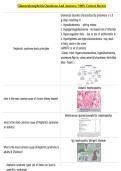
Diabetic nephropathy
what is the most common cause of chronic kidney disease?
Membranous glomerulonephritis (nephropathy)
what is the most common cause of Nephrotic syndrome
in adults?
IgA nephropathy (Berger's disease)
What is the most common cause of Nephritic syndrome in
adults & Children?
Nephrotic syndrome types (all of these can lead to
nephrOtic syndrome)
, Glomerulonephritis
Primary NS:
1- Minimal change disease (MCD)
2- Focal segmental glomerulosclerosis (FSG)
3- Membranous glomerulonephritis (can be primary or
secondary to lupus drugs--(NSAIDs)
4- membranoproliferative glomerulonephritis=Mesangio-
capillary GN(Mixed: share nephritic and nephrotic fea-
tures)
Secondary NS(another cause):
5- Diabetes mellitus
6- Systemic lupus erythematosus(SLE)
7-Amyloidosis
Glomerular disorders are characterized by glomerular in-
flammation and bleeding
1. Limited proteinuria (< 3.5 g/day)
2. Oliguria & azotemia
3. Salt retention with periorbital oedema and hyperten-
sion
Nephritic syndrome (Acute glomerulonephritis) basic
4. RBC casts and dysmorphic RBCs in urine(hematuria)
principles
B. Biopsy reveals hypercellular, inflamed glomeruli
C. Immune-complex deposition activates complement;
C5a attracts neutrophils, which mediate damage.
Nephritic syndrome types (all of these can lead to nephrIt-
ic syndrome)
, Glomerulonephritis
1- Postgonococcal glomerulonephritis
2- Rapidly progressive glomerulonephritis (crescent)
3-Membranoproliferative glomerulonephritis(Mixed:
share nephritic and nephrotic features)
4- IgA nephropathy (Nephritis) (Berger disease)
5- Alport syndrome
(Most are Nephritis)
• Most common cause of nephrotic syndrome in child-
hood (70%,90%)
• Its most important feature is the response to steroid
treatment. (unlike membranous nephropathy;;poor re-
Minimal change disease (=nil disease=lipoid nephrosis) sponse)
(O) • Indication for biopsy: steroid resistance or suspicion of
another glomerular disease
Although there is no immunocomplex/complement accu-
mulation, it shows that immune mechanisms are ettec-
tive:
- Association with upper respiratory tract infection or vac-
Minimal change disease pathogenesis cine
- Very rapid response to immunosuppression
- Association with atopy
- Frequent in some HLA groups
- Common in Hodgkin lymphoma
g/day) resulting in
1. Hypoalbuminemia - pitting edema
2. Hypogammaglobulinemia - increased risk of infection
3. Hypercoagulable state - due to loss of antithrombin III
4. Hyperlipidemia and hypercholesterolemia - may result
in fatty casts in the urine
Nephrotic syndrome basic principles nePROTic (a lot of protein)
-Classic triad: Hyperccholesteolima, hypoalbuminemia,
proteinuria f¾
ro t h y urine (urine full of protiens+ forth=Bub-
bles -foam )
Diabetic nephropathy
what is the most common cause of chronic kidney disease?
Membranous glomerulonephritis (nephropathy)
what is the most common cause of Nephrotic syndrome
in adults?
IgA nephropathy (Berger's disease)
What is the most common cause of Nephritic syndrome in
adults & Children?
Nephrotic syndrome types (all of these can lead to
nephrOtic syndrome)
, Glomerulonephritis
Primary NS:
1- Minimal change disease (MCD)
2- Focal segmental glomerulosclerosis (FSG)
3- Membranous glomerulonephritis (can be primary or
secondary to lupus drugs--(NSAIDs)
4- membranoproliferative glomerulonephritis=Mesangio-
capillary GN(Mixed: share nephritic and nephrotic fea-
tures)
Secondary NS(another cause):
5- Diabetes mellitus
6- Systemic lupus erythematosus(SLE)
7-Amyloidosis
Glomerular disorders are characterized by glomerular in-
flammation and bleeding
1. Limited proteinuria (< 3.5 g/day)
2. Oliguria & azotemia
3. Salt retention with periorbital oedema and hyperten-
sion
Nephritic syndrome (Acute glomerulonephritis) basic
4. RBC casts and dysmorphic RBCs in urine(hematuria)
principles
B. Biopsy reveals hypercellular, inflamed glomeruli
C. Immune-complex deposition activates complement;
C5a attracts neutrophils, which mediate damage.
Nephritic syndrome types (all of these can lead to nephrIt-
ic syndrome)
, Glomerulonephritis
1- Postgonococcal glomerulonephritis
2- Rapidly progressive glomerulonephritis (crescent)
3-Membranoproliferative glomerulonephritis(Mixed:
share nephritic and nephrotic features)
4- IgA nephropathy (Nephritis) (Berger disease)
5- Alport syndrome
(Most are Nephritis)
• Most common cause of nephrotic syndrome in child-
hood (70%,90%)
• Its most important feature is the response to steroid
treatment. (unlike membranous nephropathy;;poor re-
Minimal change disease (=nil disease=lipoid nephrosis) sponse)
(O) • Indication for biopsy: steroid resistance or suspicion of
another glomerular disease
Although there is no immunocomplex/complement accu-
mulation, it shows that immune mechanisms are ettec-
tive:
- Association with upper respiratory tract infection or vac-
Minimal change disease pathogenesis cine
- Very rapid response to immunosuppression
- Association with atopy
- Frequent in some HLA groups
- Common in Hodgkin lymphoma