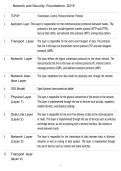
Network and Security- Foundations- D315
1. TCP/IP Transmission Control Protocol/Internet Protocol
2. Application Layer This layer is responsible for the communication protocols between nodes. The
protocols in this layer include hypertext transfer protocol (HTTP and HTTPS),
Secure Shell (SSH), and network time protocol (NTP), among many others.
3. Transport Layer This layer is responsible for the end-to-end transport of data. The protocols
that live in this layer are transmission control protocol (TCP) and user datagram
protocol (UDP).
4. Network Layer This layer defines the logical transmission protocols for the whole network. The
main protocols that live in this layer are internet protocol (IP), internet control
message protocol (ICMP), and address resolution protocol (ARP).
5. Network inter- This layer establishes how data should be physically sent through the network.
face Layer
6. OSI Model Open Systems Interconnection Model
7. Physical Layer This layer is responsible for the physical connections of the devices in the network.
(Layer 1) This layer is implemented through the use of devices such as hubs, repeaters,
modem devices, and physical cabling.
8. Data Link Layer This layer is responsible for the error-free delivery of data to the receiving device
(Layer 2) or node. This layer is implemented through the use of devices such as switches
and bridge devices, as well as anything with a network interface, like wireless or
wired network cards.
9. Network Layer This layer is responsible for the transmission of data between hosts in ditterent
(Layer 3) networks as well as routing of data packets. This layer is implemented through
the use of devices such as routers and some switches.
10. Transport layer
(layer 4)
, Network and Security- Foundations- D315
In this layer protocols ensure that data are transferred from point A to point B reli-
ably and without errors. this layer services include flow control, acknowledgment,
error correction, segmentation, reassembly, and sequencing.
11. Session Layer This layer is responsible for connection establishment, session maintenance, and
(Layer 5) authentication.
12. Presentation Lay- This layer is responsible for translating data from the application layer into the
er (Layer 6) format required to transmit the data over the network as well as encrypting the
data for security if encryption is used.
13. Application Layer This layer is responsible for network applications (like HTTP or FTP) and their
(Layer 7) production of data to be transferred over the network.
14. Hub {Physical -The simplest device used on an Ethernet network for connecting devices to each
Layer} other
-split the bandwidth of a connection among all the computers connected to it
- do not perform any packet filtering or addressing functions but instead broad-
cast data to all computers connected to it
15. Switch {Data and -Provides connectivity to devices in a local network
Network Layer}
-Creates a dedicated full-speed connection between two computers that are
communicating with each other
- makes use of the MAC address to deliver the message to the right destination
16. Router{Network -Interconnect two or more networks
Layer}
-Operate at the border of your network
-Stores information about the systems that are connected to it and where to send
, Network and Security- Foundations- D315
requests when the destination is unknown
-Works at the network layer of the OSI model
17. Wireless Access -Extends a wired network to wireless connections
point {WAP}
-Involves the IEEE 802.11 group of standards that defines wireless LAN's
{WLAN's}
-Central connecting point for computers equipped with wireless network
adapters
- identifies each computer by its MAC address
18. Patch Panel -A box designed as a junction point for twisted pair (TP) cable and fiber cable
used in networks.
-First step in organizing your cables
19. Firewall -A security hardware appliance or software application that protects a computer
or network from unwanted intrusion
-Blocks unwanted connections from untrusted networks and can block basic
network attacks
20. Modem {Physical -Connects a LAN to an internet service provider
and Data link Lay-
er} -Converts digital signals into analog signals and vice versa
21. Network Inter- -The interface on a computer or other device that connects to the LAN
face Card (NIC)
{Physical Layer} -Designed to take the communication ott the physical cable or wireless signal and
present it to the computer for processing
1. TCP/IP Transmission Control Protocol/Internet Protocol
2. Application Layer This layer is responsible for the communication protocols between nodes. The
protocols in this layer include hypertext transfer protocol (HTTP and HTTPS),
Secure Shell (SSH), and network time protocol (NTP), among many others.
3. Transport Layer This layer is responsible for the end-to-end transport of data. The protocols
that live in this layer are transmission control protocol (TCP) and user datagram
protocol (UDP).
4. Network Layer This layer defines the logical transmission protocols for the whole network. The
main protocols that live in this layer are internet protocol (IP), internet control
message protocol (ICMP), and address resolution protocol (ARP).
5. Network inter- This layer establishes how data should be physically sent through the network.
face Layer
6. OSI Model Open Systems Interconnection Model
7. Physical Layer This layer is responsible for the physical connections of the devices in the network.
(Layer 1) This layer is implemented through the use of devices such as hubs, repeaters,
modem devices, and physical cabling.
8. Data Link Layer This layer is responsible for the error-free delivery of data to the receiving device
(Layer 2) or node. This layer is implemented through the use of devices such as switches
and bridge devices, as well as anything with a network interface, like wireless or
wired network cards.
9. Network Layer This layer is responsible for the transmission of data between hosts in ditterent
(Layer 3) networks as well as routing of data packets. This layer is implemented through
the use of devices such as routers and some switches.
10. Transport layer
(layer 4)
, Network and Security- Foundations- D315
In this layer protocols ensure that data are transferred from point A to point B reli-
ably and without errors. this layer services include flow control, acknowledgment,
error correction, segmentation, reassembly, and sequencing.
11. Session Layer This layer is responsible for connection establishment, session maintenance, and
(Layer 5) authentication.
12. Presentation Lay- This layer is responsible for translating data from the application layer into the
er (Layer 6) format required to transmit the data over the network as well as encrypting the
data for security if encryption is used.
13. Application Layer This layer is responsible for network applications (like HTTP or FTP) and their
(Layer 7) production of data to be transferred over the network.
14. Hub {Physical -The simplest device used on an Ethernet network for connecting devices to each
Layer} other
-split the bandwidth of a connection among all the computers connected to it
- do not perform any packet filtering or addressing functions but instead broad-
cast data to all computers connected to it
15. Switch {Data and -Provides connectivity to devices in a local network
Network Layer}
-Creates a dedicated full-speed connection between two computers that are
communicating with each other
- makes use of the MAC address to deliver the message to the right destination
16. Router{Network -Interconnect two or more networks
Layer}
-Operate at the border of your network
-Stores information about the systems that are connected to it and where to send
, Network and Security- Foundations- D315
requests when the destination is unknown
-Works at the network layer of the OSI model
17. Wireless Access -Extends a wired network to wireless connections
point {WAP}
-Involves the IEEE 802.11 group of standards that defines wireless LAN's
{WLAN's}
-Central connecting point for computers equipped with wireless network
adapters
- identifies each computer by its MAC address
18. Patch Panel -A box designed as a junction point for twisted pair (TP) cable and fiber cable
used in networks.
-First step in organizing your cables
19. Firewall -A security hardware appliance or software application that protects a computer
or network from unwanted intrusion
-Blocks unwanted connections from untrusted networks and can block basic
network attacks
20. Modem {Physical -Connects a LAN to an internet service provider
and Data link Lay-
er} -Converts digital signals into analog signals and vice versa
21. Network Inter- -The interface on a computer or other device that connects to the LAN
face Card (NIC)
{Physical Layer} -Designed to take the communication ott the physical cable or wireless signal and
present it to the computer for processing