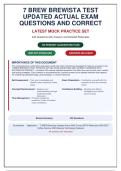
7 BREW BREWISTA TEST
UPDATED ACTUAL EXAM
QUESTIONS AND CORRECT
LATEST MOCK PRACTICE SET
240 Questions with Answers and Detailed Rationales
100 PERCENT GUARANTEED PASS
INSTANT DOWNLOAD ANSWERS INCLUDED
IMPORTANCE OF THIS DOCUMENT
This comprehensive examination preparation guide has been meticulously developed to help you succeed in the
7 BREW BREWISTA TEST UPDATED ACTUAL EXAM QUESTIONS AND CORRECT ANSWERS WITH
RATIONALES 2026\2027.. It contains 240 carefully selected questions that reflect the most current exam content
and testing strategies. Each question is accompanied by a correct answer and a detailed rationale that explains
the underlying pathophysiology, pharmacology, or clinical reasoning.
Self-Assessment – Test your knowledge and Exam Preparation – Familiarize yourself with the
identify areas requiring further question format and content
study areas
Concept Reinforcement – Deepen your Confidence Building – Develop test-taking
understanding through strategies and reduce
evidence-based exam anxiety
rationales
Time Management – Practice answering
questions under simulated
exam conditions
Review Summary 240 Questions
Foundations - Application - 7 BREW Brewista Updated Actual AND Correct WITH Rationales 2026 2027
Coffee Science AND Brewing Technology Graduate
All answers with rationales
,Table of Contents
Section A - Brewing Fundamentals Section B - Espresso Preparation
AND Equipment AND Techniques
Questions 1 to 60 Questions 61 to 120
Section C - MILK Steaming AND Latte Section D - Drink Recipes AND
ART Customization
Questions 121 to 180 Questions 181 to 240
,Section A - Brewing Fundamentals AND Equipment
Q1.
A brewista observes that a batch of cold brew has a noticeably lower extraction yield than
the target, despite identical grind size and brew time. Which of the following is the most
likely cause?
A. Water temperature too high, leading to B. Coffee-to-water ratio too low, reducing
channeling soluble availability
C. Grind distribution too bimodal, with D. Water hardness below 50 ppm CaCO3,
excess fines clogging the filter reducing extraction efficiency
Correct: D - Water hardness below 50 ppm CaCO3, reducing extraction efficiency
Rationale:Cold brew extraction is highly dependent on water chemistry; very soft water (<50
ppm) lacks sufficient buffering capacity and mineral ions to facilitate efficient extraction,
leading to lower yield. Option A is incorrect because cold brew uses ambient temperature, not
hot water. Option B would affect strength but not necessarily extraction yield as a percentage.
Option C would likely cause over-extraction or clogging, not under-extraction.
Q2.
A brewista measures the TDS of a pour-over coffee and finds it to be 1.15% with a brew
ratio of 1:16. What is the approximate extraction yield?
A. 18.4% B. 19.2%
C. 20.1% D. 21.5%
Correct: A - 18.4%
Rationale:Extraction yield is calculated as (TDS × beverage weight) / dry coffee weight. For a
1:16 ratio, beverage weight = 16 × dry coffee weight. So yield = (0.0115 × 16) = 0.184 =
18.4%. Option B would require TDS of 1.20%, C would require 1.26%, D would require
1.34%.
Q3.
Which of the following best describes the primary role of the 'bloom' phase in pour-over
brewing?
A. To saturate the coffee grounds and B. To raise the slurry temperature to the
initiate degassing, promoting even optimal extraction range
extraction
C. To pre-wet the filter and remove paper D. To create a uniform bed by stirring the
flavors grounds
Page 3
, Section A - Brewing Fundamentals AND Equipment
Correct: A - To saturate the coffee grounds and initiate degassing, promoting even
extraction
Rationale:The bloom phase involves adding a small amount of water to saturate the coffee
grounds and allow CO2 to escape, which prevents uneven extraction due to gas bubbles.
Option B is partially true but not the primary role; temperature is managed by water
temperature. Option C is a separate step (rinsing filter). Option D is a technique used after
blooming, not the bloom's purpose.
Q4.
A batch of espresso has a sour taste and a thin body. The brewista notes that the
extraction time was 18 seconds for a 36g yield from 18g dose. Which parameter
adjustment would most likely correct the flavor?
A. Increase the brew temperature by 2°C B. Decrease the grind size to slow the flow
C. Reduce the dose to 16g to increase the D. Increase the yield to 45g to extend
brew ratio extraction
Correct: B - Decrease the grind size to slow the flow
Rationale:Sourness and thin body indicate under-extraction, often due to fast flow.
Decreasing grind size increases resistance, slowing the flow and extending contact time,
which increases extraction. Option A might help but is less effective than grind adjustment.
Option C would reduce dose, potentially worsening under-extraction. Option D would increase
yield but may not fix the underlying flow rate issue and could lead to over-extraction on the tail
end.
Q5.
A brewista uses a refractometer to measure TDS and finds a reading of 1.45% for a filter
coffee. The target extraction yield is 20%. If the brew ratio is 1:15, what is the actual
extraction yield, and is it within the specialty coffee association's recommended range
(18-22%)?
A. 21.75%, within range B. 21.75%, above range
C. 19.33%, within range D. 19.33%, below range
Correct: A - 21.75%, within range
Rationale:Extraction yield = TDS × brew ratio = 0.0145 × 15 = 0.2175 = 21.75%. This is
within the 18-22% range. Option B is incorrect because 21.75% is within, not above. Options
C and D are based on a miscalculation (1.45% × 15 = 21.75%, not 19.33%).
Page 4
UPDATED ACTUAL EXAM
QUESTIONS AND CORRECT
LATEST MOCK PRACTICE SET
240 Questions with Answers and Detailed Rationales
100 PERCENT GUARANTEED PASS
INSTANT DOWNLOAD ANSWERS INCLUDED
IMPORTANCE OF THIS DOCUMENT
This comprehensive examination preparation guide has been meticulously developed to help you succeed in the
7 BREW BREWISTA TEST UPDATED ACTUAL EXAM QUESTIONS AND CORRECT ANSWERS WITH
RATIONALES 2026\2027.. It contains 240 carefully selected questions that reflect the most current exam content
and testing strategies. Each question is accompanied by a correct answer and a detailed rationale that explains
the underlying pathophysiology, pharmacology, or clinical reasoning.
Self-Assessment – Test your knowledge and Exam Preparation – Familiarize yourself with the
identify areas requiring further question format and content
study areas
Concept Reinforcement – Deepen your Confidence Building – Develop test-taking
understanding through strategies and reduce
evidence-based exam anxiety
rationales
Time Management – Practice answering
questions under simulated
exam conditions
Review Summary 240 Questions
Foundations - Application - 7 BREW Brewista Updated Actual AND Correct WITH Rationales 2026 2027
Coffee Science AND Brewing Technology Graduate
All answers with rationales
,Table of Contents
Section A - Brewing Fundamentals Section B - Espresso Preparation
AND Equipment AND Techniques
Questions 1 to 60 Questions 61 to 120
Section C - MILK Steaming AND Latte Section D - Drink Recipes AND
ART Customization
Questions 121 to 180 Questions 181 to 240
,Section A - Brewing Fundamentals AND Equipment
Q1.
A brewista observes that a batch of cold brew has a noticeably lower extraction yield than
the target, despite identical grind size and brew time. Which of the following is the most
likely cause?
A. Water temperature too high, leading to B. Coffee-to-water ratio too low, reducing
channeling soluble availability
C. Grind distribution too bimodal, with D. Water hardness below 50 ppm CaCO3,
excess fines clogging the filter reducing extraction efficiency
Correct: D - Water hardness below 50 ppm CaCO3, reducing extraction efficiency
Rationale:Cold brew extraction is highly dependent on water chemistry; very soft water (<50
ppm) lacks sufficient buffering capacity and mineral ions to facilitate efficient extraction,
leading to lower yield. Option A is incorrect because cold brew uses ambient temperature, not
hot water. Option B would affect strength but not necessarily extraction yield as a percentage.
Option C would likely cause over-extraction or clogging, not under-extraction.
Q2.
A brewista measures the TDS of a pour-over coffee and finds it to be 1.15% with a brew
ratio of 1:16. What is the approximate extraction yield?
A. 18.4% B. 19.2%
C. 20.1% D. 21.5%
Correct: A - 18.4%
Rationale:Extraction yield is calculated as (TDS × beverage weight) / dry coffee weight. For a
1:16 ratio, beverage weight = 16 × dry coffee weight. So yield = (0.0115 × 16) = 0.184 =
18.4%. Option B would require TDS of 1.20%, C would require 1.26%, D would require
1.34%.
Q3.
Which of the following best describes the primary role of the 'bloom' phase in pour-over
brewing?
A. To saturate the coffee grounds and B. To raise the slurry temperature to the
initiate degassing, promoting even optimal extraction range
extraction
C. To pre-wet the filter and remove paper D. To create a uniform bed by stirring the
flavors grounds
Page 3
, Section A - Brewing Fundamentals AND Equipment
Correct: A - To saturate the coffee grounds and initiate degassing, promoting even
extraction
Rationale:The bloom phase involves adding a small amount of water to saturate the coffee
grounds and allow CO2 to escape, which prevents uneven extraction due to gas bubbles.
Option B is partially true but not the primary role; temperature is managed by water
temperature. Option C is a separate step (rinsing filter). Option D is a technique used after
blooming, not the bloom's purpose.
Q4.
A batch of espresso has a sour taste and a thin body. The brewista notes that the
extraction time was 18 seconds for a 36g yield from 18g dose. Which parameter
adjustment would most likely correct the flavor?
A. Increase the brew temperature by 2°C B. Decrease the grind size to slow the flow
C. Reduce the dose to 16g to increase the D. Increase the yield to 45g to extend
brew ratio extraction
Correct: B - Decrease the grind size to slow the flow
Rationale:Sourness and thin body indicate under-extraction, often due to fast flow.
Decreasing grind size increases resistance, slowing the flow and extending contact time,
which increases extraction. Option A might help but is less effective than grind adjustment.
Option C would reduce dose, potentially worsening under-extraction. Option D would increase
yield but may not fix the underlying flow rate issue and could lead to over-extraction on the tail
end.
Q5.
A brewista uses a refractometer to measure TDS and finds a reading of 1.45% for a filter
coffee. The target extraction yield is 20%. If the brew ratio is 1:15, what is the actual
extraction yield, and is it within the specialty coffee association's recommended range
(18-22%)?
A. 21.75%, within range B. 21.75%, above range
C. 19.33%, within range D. 19.33%, below range
Correct: A - 21.75%, within range
Rationale:Extraction yield = TDS × brew ratio = 0.0145 × 15 = 0.2175 = 21.75%. This is
within the 18-22% range. Option B is incorrect because 21.75% is within, not above. Options
C and D are based on a miscalculation (1.45% × 15 = 21.75%, not 19.33%).
Page 4