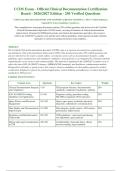
CCDS Exam - Official Clinical Documentation Certification
Board - 2026/2027 Edition - 250 Verified Questions
CCDS Exam 2026-2027 QUESTIONS AND ANSWERS ALREADY GRADED A+. 100% Verified Solutions |
Updated Per Latest Guidelines | Graded A+
This comprehensive exam prep document contains 250 verified questions and answers for the Certified
Clinical Documentation Specialist (CCDS) exam, covering all domains of clinical documentation
improvement. Designed for HIM professionals and clinical documentation specialists, this resource
reflects the 2026/2027 academic year and the latest official guidelines. Each question includes detailed
rationales to reinforce learning and ensure exam readiness.
Abstract:
The Certified Clinical Documentation Specialist (CCDS) exam is a rigorous assessment for professionals
specializing in clinical documentation improvement (CDI). This document provides 250 verified questions and
answers that mirror the exam's content outline, covering key areas such as documentation integrity, coding
guidelines, query management, and regulatory compliance. Each question is accompanied by a detailed rationale
explaining the correct answer and common pitfalls. The material is updated for the 2026/2027 academic year to
reflect the latest ICD-10-CM/PCS changes, AHIMA/ACDIS standards, and healthcare reimbursement models.
Designed for self-study or group review, this resource ensures candidates are thoroughly prepared to achieve
certification. Emphasis is placed on practical application, critical thinking, and adherence to ethical and legal
standards in CDI practice.
Content Area Overview:
Content Area Questions Key Topics Weight
Clinical Documentation Integrity 1-50 CDI program structure, documentation 20%
and Compliance standards, compliance regulations, auditing
ICD-10-CM/PCS Coding 51-100 Diagnosis coding, procedure coding, 20%
Guidelines and Application MS-DRG assignment, POA indicators
Query Process and Physician 101-150 Query types, query escalation, physician 20%
Engagement education, collaborative communication
Data Quality and Documentation 151-200 Data integrity, quality metrics, CDI metrics, 20%
Improvement performance improvement
Regulatory and Reimbursement 201-225 CMS guidelines, value-based purchasing, 10%
Frameworks risk adjustment, payer policies
Ethical and Legal Considerations 226-250 Confidentiality, fraud and abuse, ethical 10%
in CDI decision-making, legal standards
Page 1
,Q1. A patient with end-stage renal disease on hemodialysis is admitted for acute hypoxic respiratory
failure due to pneumonia. The physician documents 'acute respiratory failure' and 'pneumonia due
to Pseudomonas.' Which of the following is the correct MS-DRG assignment principle?
A. Assign principal diagnosis as acute respiratory failure; pneumonia is a complication.
B. Assign principal diagnosis as pneumonia; acute respiratory failure is a manifestation.
C. Assign principal diagnosis as acute respiratory failure; pneumonia is a secondary diagnosis with
MCC.
D. Assign principal diagnosis as pneumonia; acute respiratory failure is a secondary diagnosis with
CC.
Correct Answer: B. Assign principal diagnosis as pneumonia; acute respiratory failure is a
manifestation.
Rationale: Under ICD-10-CM Official Guidelines, when a respiratory failure is due to another condition
(e.g., pneumonia), the underlying condition is sequenced as principal diagnosis, and respiratory failure is
coded as a secondary diagnosis. This ensures accurate DRG assignment reflecting the reason for
admission.
Why Wrong:
A - Sequencing respiratory failure as principal would be incorrect because it is a manifestation of the
pneumonia.
C - While respiratory failure may be an MCC, it should not be principal; pneumonia is the
underlying cause.
D - Respiratory failure is typically an MCC, not a CC, and sequencing pneumonia as principal is
correct, but this option incorrectly labels respiratory failure as CC.
Reference: ICD-10-CM Official Guidelines for Coding and Reporting, FY 2026, Section I.C.10.a.2
Q2. A query is sent to a physician regarding a patient with sepsis and acute kidney injury (AKI).
The physician responds: 'The AKI is due to sepsis.' However, the clinical indicators (elevated
creatinine, oliguria) are present, but the sepsis documentation does not meet SIRS criteria.
According to ACDIS/AHIMA query best practices, what is the appropriate next step?
A. Accept the physician's response and code sepsis with AKI as a complication.
B. Query again for clarification of sepsis, as the initial response may not be supported.
C. Override the query and assign AKI to a different etiology based on clinical judgment.
D. Code AKI as due to sepsis without further query, assuming the physician's statement is definitive.
Correct Answer: B. Query again for clarification of sepsis, as the initial response may not be
supported.
Rationale: Best practices require that a query response must be clinically supported. If the physician's
response conflicts with clinical indicators (e.g., no SIRS criteria), a follow-up query is warranted to
ensure accurate documentation. Accepting an unsupported response risks inaccurate coding and potential
audit issues.
Why Wrong:
A - Accepting without validation violates query integrity standards.
C - CDI specialists cannot override physician documentation based on personal clinical judgment.
D - Coding without confirmed clinical support is inappropriate; the sepsis must be clearly
documented.
Reference: ACDIS/AHIMA (2025). Practice Brief: Querying for Clarification, 2nd Ed.
Page 2
,Q3. A patient is admitted for a total knee arthroplasty. On day 2, the patient develops chest pain,
and a CT pulmonary angiogram reveals a pulmonary embolism (PE). The physician documents
'acute pulmonary embolism' as a secondary diagnosis. Which of the following DRG assignment
strategies is correct regarding the impact of the PE?
A. The PE is a post-operative complication and qualifies as an MCC, increasing DRG weight.
B. The PE is a CC only, as it is a common post-operative event.
C. The PE is not considered a complication because it is not related to the procedure.
D. The PE should be coded as a principal diagnosis, overriding the knee replacement.
Correct Answer: A. The PE is a post-operative complication and qualifies as an MCC, increasing
DRG weight.
Rationale: Pulmonary embolism following total knee arthroplasty is a known post-operative
complication. According to MS-DRG definitions, it qualifies as an MCC (Major Complication or
Comorbidity) because it is a significant condition that increases resource use. The principal diagnosis
remains the reason for admission (knee replacement), but the PE as a secondary diagnosis with MCC
status increases the DRG weight.
Why Wrong:
B - PE is considered an MCC, not a CC, due to its severity.
C - The PE is directly related to the procedure (post-operative complication).
D - The principal diagnosis is the reason for admission, which is the knee replacement; PE is a
secondary complication.
Reference: CMS MS-DRG Definitions Manual, FY 2026, Appendix C: Complication/Comorbidity List
Q4. A patient with chronic obstructive pulmonary disease (COPD) is admitted for an acute
exacerbation. The physician documents 'acute on chronic hypoxic respiratory failure' and
'pneumonia due to influenza A.' Which of the following represents the correct hierarchical
sequencing for principal diagnosis?
A. Acute hypoxic respiratory failure (J96.01) as principal, then pneumonia (J15.9), then influenza
(J10.1).
B. Pneumonia due to influenza A (J10.0) as principal, then acute respiratory failure (J96.01), then
COPD exacerbation (J44.1).
C. COPD exacerbation (J44.1) as principal, then pneumonia (J15.9), then respiratory failure (J96.01).
D. Influenza A (J10.1) as principal, then pneumonia (J15.9), then acute respiratory failure (J96.01).
Correct Answer: B. Pneumonia due to influenza A (J10.0) as principal, then acute respiratory
failure (J96.01), then COPD exacerbation (J44.1).
Rationale: According to ICD-10-CM guidelines, when pneumonia is due to influenza, the combination
code J10.0 (influenza with pneumonia) is used as principal diagnosis if it is the reason for admission. The
acute respiratory failure is a manifestation and should be sequenced as a secondary diagnosis. COPD
exacerbation is also secondary.
Why Wrong:
A - Respiratory failure should not be principal; it is a manifestation of the underlying infection.
C - COPD exacerbation is not the principal cause; the infection is the reason for admission.
D - Influenza alone without pneumonia code would miss the pneumonia component; J10.0 is the
correct combination code.
Reference: ICD-10-CM Official Guidelines, FY 2026, Section I.C.1.b.1 and I.C.10.a.2
Page 3
, Q5. A query is written for a patient with acute pancreatitis and hypertriglyceridemia. The physician
responds: 'Pancreatitis is likely due to hypertriglyceridemia.' However, the patient's triglyceride
level on admission was 450 mg/dL. According to current literature, what is the appropriate
threshold for supporting hypertriglyceridemia as the etiology of pancreatitis?
A. Triglyceride level > 200 mg/dL
B. Triglyceride level > 500 mg/dL
C. Triglyceride level > 1000 mg/dL
D. Any elevated triglyceride level in the presence of pancreatitis
Correct Answer: C. Triglyceride level > 1000 mg/dL
Rationale: Current clinical evidence indicates that hypertriglyceridemia-induced pancreatitis typically
requires triglyceride levels > 1000 mg/dL. A level of 450 mg/dL is not sufficient to establish causation.
Therefore, the query response is not clinically supported, and a follow-up query may be needed.
Why Wrong:
A - Level > 200 mg/dL is considered hypertriglyceridemia but not typically causative of pancreatitis.
B - Level > 500 mg/dL is not the widely accepted threshold; > 1000 mg/dL is standard.
D - Causation requires a specific threshold; not all elevated levels cause pancreatitis.
Reference: Berglund, L., et al. (2025). Hypertriglyceridemia and Acute Pancreatitis: A Review. Journal of
Clinical Lipidology, 19(2), 150-158.
Q6. A patient with a history of congestive heart failure (CHF) is admitted for dehydration. During
the stay, the patient develops acute kidney injury (AKI) due to contrast-induced nephropathy after
a CT scan. The physician documents 'AKI due to contrast.' Which of the following is the correct
approach to CC/MCC capture?
A. AKI is a CC; CHF is a CC; both are captured.
B. AKI is an MCC; CHF is a CC; both are captured.
C. AKI is a CC; CHF is an MCC; both are captured.
D. AKI is an MCC; CHF is an MCC; both are captured.
Correct Answer: B. AKI is an MCC; CHF is a CC; both are captured.
Rationale: Acute kidney injury (N17.9) is classified as an MCC in the MS-DRG system due to its
significant impact on resource utilization. Chronic CHF (I50.22, etc.) is typically a CC unless it is acute
or acute-on-chronic, which may be an MCC. In this case, CHF is chronic, so it is a CC.
Why Wrong:
A - AKI is an MCC, not a CC.
C - CHF is a CC, not an MCC, in its chronic form.
D - CHF is not an MCC unless documented as acute or acute-on-chronic with specific severity.
Reference: CMS MS-DRG Definitions Manual, FY 2026, Appendix C: CC/MCC List
Page 4
Board - 2026/2027 Edition - 250 Verified Questions
CCDS Exam 2026-2027 QUESTIONS AND ANSWERS ALREADY GRADED A+. 100% Verified Solutions |
Updated Per Latest Guidelines | Graded A+
This comprehensive exam prep document contains 250 verified questions and answers for the Certified
Clinical Documentation Specialist (CCDS) exam, covering all domains of clinical documentation
improvement. Designed for HIM professionals and clinical documentation specialists, this resource
reflects the 2026/2027 academic year and the latest official guidelines. Each question includes detailed
rationales to reinforce learning and ensure exam readiness.
Abstract:
The Certified Clinical Documentation Specialist (CCDS) exam is a rigorous assessment for professionals
specializing in clinical documentation improvement (CDI). This document provides 250 verified questions and
answers that mirror the exam's content outline, covering key areas such as documentation integrity, coding
guidelines, query management, and regulatory compliance. Each question is accompanied by a detailed rationale
explaining the correct answer and common pitfalls. The material is updated for the 2026/2027 academic year to
reflect the latest ICD-10-CM/PCS changes, AHIMA/ACDIS standards, and healthcare reimbursement models.
Designed for self-study or group review, this resource ensures candidates are thoroughly prepared to achieve
certification. Emphasis is placed on practical application, critical thinking, and adherence to ethical and legal
standards in CDI practice.
Content Area Overview:
Content Area Questions Key Topics Weight
Clinical Documentation Integrity 1-50 CDI program structure, documentation 20%
and Compliance standards, compliance regulations, auditing
ICD-10-CM/PCS Coding 51-100 Diagnosis coding, procedure coding, 20%
Guidelines and Application MS-DRG assignment, POA indicators
Query Process and Physician 101-150 Query types, query escalation, physician 20%
Engagement education, collaborative communication
Data Quality and Documentation 151-200 Data integrity, quality metrics, CDI metrics, 20%
Improvement performance improvement
Regulatory and Reimbursement 201-225 CMS guidelines, value-based purchasing, 10%
Frameworks risk adjustment, payer policies
Ethical and Legal Considerations 226-250 Confidentiality, fraud and abuse, ethical 10%
in CDI decision-making, legal standards
Page 1
,Q1. A patient with end-stage renal disease on hemodialysis is admitted for acute hypoxic respiratory
failure due to pneumonia. The physician documents 'acute respiratory failure' and 'pneumonia due
to Pseudomonas.' Which of the following is the correct MS-DRG assignment principle?
A. Assign principal diagnosis as acute respiratory failure; pneumonia is a complication.
B. Assign principal diagnosis as pneumonia; acute respiratory failure is a manifestation.
C. Assign principal diagnosis as acute respiratory failure; pneumonia is a secondary diagnosis with
MCC.
D. Assign principal diagnosis as pneumonia; acute respiratory failure is a secondary diagnosis with
CC.
Correct Answer: B. Assign principal diagnosis as pneumonia; acute respiratory failure is a
manifestation.
Rationale: Under ICD-10-CM Official Guidelines, when a respiratory failure is due to another condition
(e.g., pneumonia), the underlying condition is sequenced as principal diagnosis, and respiratory failure is
coded as a secondary diagnosis. This ensures accurate DRG assignment reflecting the reason for
admission.
Why Wrong:
A - Sequencing respiratory failure as principal would be incorrect because it is a manifestation of the
pneumonia.
C - While respiratory failure may be an MCC, it should not be principal; pneumonia is the
underlying cause.
D - Respiratory failure is typically an MCC, not a CC, and sequencing pneumonia as principal is
correct, but this option incorrectly labels respiratory failure as CC.
Reference: ICD-10-CM Official Guidelines for Coding and Reporting, FY 2026, Section I.C.10.a.2
Q2. A query is sent to a physician regarding a patient with sepsis and acute kidney injury (AKI).
The physician responds: 'The AKI is due to sepsis.' However, the clinical indicators (elevated
creatinine, oliguria) are present, but the sepsis documentation does not meet SIRS criteria.
According to ACDIS/AHIMA query best practices, what is the appropriate next step?
A. Accept the physician's response and code sepsis with AKI as a complication.
B. Query again for clarification of sepsis, as the initial response may not be supported.
C. Override the query and assign AKI to a different etiology based on clinical judgment.
D. Code AKI as due to sepsis without further query, assuming the physician's statement is definitive.
Correct Answer: B. Query again for clarification of sepsis, as the initial response may not be
supported.
Rationale: Best practices require that a query response must be clinically supported. If the physician's
response conflicts with clinical indicators (e.g., no SIRS criteria), a follow-up query is warranted to
ensure accurate documentation. Accepting an unsupported response risks inaccurate coding and potential
audit issues.
Why Wrong:
A - Accepting without validation violates query integrity standards.
C - CDI specialists cannot override physician documentation based on personal clinical judgment.
D - Coding without confirmed clinical support is inappropriate; the sepsis must be clearly
documented.
Reference: ACDIS/AHIMA (2025). Practice Brief: Querying for Clarification, 2nd Ed.
Page 2
,Q3. A patient is admitted for a total knee arthroplasty. On day 2, the patient develops chest pain,
and a CT pulmonary angiogram reveals a pulmonary embolism (PE). The physician documents
'acute pulmonary embolism' as a secondary diagnosis. Which of the following DRG assignment
strategies is correct regarding the impact of the PE?
A. The PE is a post-operative complication and qualifies as an MCC, increasing DRG weight.
B. The PE is a CC only, as it is a common post-operative event.
C. The PE is not considered a complication because it is not related to the procedure.
D. The PE should be coded as a principal diagnosis, overriding the knee replacement.
Correct Answer: A. The PE is a post-operative complication and qualifies as an MCC, increasing
DRG weight.
Rationale: Pulmonary embolism following total knee arthroplasty is a known post-operative
complication. According to MS-DRG definitions, it qualifies as an MCC (Major Complication or
Comorbidity) because it is a significant condition that increases resource use. The principal diagnosis
remains the reason for admission (knee replacement), but the PE as a secondary diagnosis with MCC
status increases the DRG weight.
Why Wrong:
B - PE is considered an MCC, not a CC, due to its severity.
C - The PE is directly related to the procedure (post-operative complication).
D - The principal diagnosis is the reason for admission, which is the knee replacement; PE is a
secondary complication.
Reference: CMS MS-DRG Definitions Manual, FY 2026, Appendix C: Complication/Comorbidity List
Q4. A patient with chronic obstructive pulmonary disease (COPD) is admitted for an acute
exacerbation. The physician documents 'acute on chronic hypoxic respiratory failure' and
'pneumonia due to influenza A.' Which of the following represents the correct hierarchical
sequencing for principal diagnosis?
A. Acute hypoxic respiratory failure (J96.01) as principal, then pneumonia (J15.9), then influenza
(J10.1).
B. Pneumonia due to influenza A (J10.0) as principal, then acute respiratory failure (J96.01), then
COPD exacerbation (J44.1).
C. COPD exacerbation (J44.1) as principal, then pneumonia (J15.9), then respiratory failure (J96.01).
D. Influenza A (J10.1) as principal, then pneumonia (J15.9), then acute respiratory failure (J96.01).
Correct Answer: B. Pneumonia due to influenza A (J10.0) as principal, then acute respiratory
failure (J96.01), then COPD exacerbation (J44.1).
Rationale: According to ICD-10-CM guidelines, when pneumonia is due to influenza, the combination
code J10.0 (influenza with pneumonia) is used as principal diagnosis if it is the reason for admission. The
acute respiratory failure is a manifestation and should be sequenced as a secondary diagnosis. COPD
exacerbation is also secondary.
Why Wrong:
A - Respiratory failure should not be principal; it is a manifestation of the underlying infection.
C - COPD exacerbation is not the principal cause; the infection is the reason for admission.
D - Influenza alone without pneumonia code would miss the pneumonia component; J10.0 is the
correct combination code.
Reference: ICD-10-CM Official Guidelines, FY 2026, Section I.C.1.b.1 and I.C.10.a.2
Page 3
, Q5. A query is written for a patient with acute pancreatitis and hypertriglyceridemia. The physician
responds: 'Pancreatitis is likely due to hypertriglyceridemia.' However, the patient's triglyceride
level on admission was 450 mg/dL. According to current literature, what is the appropriate
threshold for supporting hypertriglyceridemia as the etiology of pancreatitis?
A. Triglyceride level > 200 mg/dL
B. Triglyceride level > 500 mg/dL
C. Triglyceride level > 1000 mg/dL
D. Any elevated triglyceride level in the presence of pancreatitis
Correct Answer: C. Triglyceride level > 1000 mg/dL
Rationale: Current clinical evidence indicates that hypertriglyceridemia-induced pancreatitis typically
requires triglyceride levels > 1000 mg/dL. A level of 450 mg/dL is not sufficient to establish causation.
Therefore, the query response is not clinically supported, and a follow-up query may be needed.
Why Wrong:
A - Level > 200 mg/dL is considered hypertriglyceridemia but not typically causative of pancreatitis.
B - Level > 500 mg/dL is not the widely accepted threshold; > 1000 mg/dL is standard.
D - Causation requires a specific threshold; not all elevated levels cause pancreatitis.
Reference: Berglund, L., et al. (2025). Hypertriglyceridemia and Acute Pancreatitis: A Review. Journal of
Clinical Lipidology, 19(2), 150-158.
Q6. A patient with a history of congestive heart failure (CHF) is admitted for dehydration. During
the stay, the patient develops acute kidney injury (AKI) due to contrast-induced nephropathy after
a CT scan. The physician documents 'AKI due to contrast.' Which of the following is the correct
approach to CC/MCC capture?
A. AKI is a CC; CHF is a CC; both are captured.
B. AKI is an MCC; CHF is a CC; both are captured.
C. AKI is a CC; CHF is an MCC; both are captured.
D. AKI is an MCC; CHF is an MCC; both are captured.
Correct Answer: B. AKI is an MCC; CHF is a CC; both are captured.
Rationale: Acute kidney injury (N17.9) is classified as an MCC in the MS-DRG system due to its
significant impact on resource utilization. Chronic CHF (I50.22, etc.) is typically a CC unless it is acute
or acute-on-chronic, which may be an MCC. In this case, CHF is chronic, so it is a CC.
Why Wrong:
A - AKI is an MCC, not a CC.
C - CHF is a CC, not an MCC, in its chronic form.
D - CHF is not an MCC unless documented as acute or acute-on-chronic with specific severity.
Reference: CMS MS-DRG Definitions Manual, FY 2026, Appendix C: CC/MCC List
Page 4