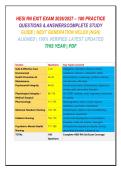
HESI RN EXIT EXAM 2026/2027 – 180 PRACTICE
QUESTIONS & ANSWERSCOMPLETE STUDY
GUIDE | NEXT GENERATION NCLEX (NGN)
ALIGNED | 100% VERIFIED LATEST UPDATED
THIS YEAR | PDF
Section Questions Key Topics Covered
Safe & Effective Care 1-25 Delegation, restraints, infection control,
Environment transfusion reactions, medication safety
Health Promotion & 26-45 Immunizations, screenings, nutrition, exercise,
Maintenance prenatal care, safe sleep
Psychosocial Integrity 46-65 Suicide assessment, schizophrenia, depression,
anxiety, grief, personality disorders
Physiological Integrity – 66-110 HF, COPD, diabetes, renal, respiratory, endocrine,
Medical-Surgical GI, cardiac
Pharmacology 111-135 Anticoagulants, statins, insulin, digoxin,
antibiotics, psychiatric medications
Maternal-Newborn Nursing 136-155 Preeclampsia, newborn care, breastfeeding,
postpartum assessment
Pediatric Nursing 156-170 Growth and development, immunizations,
Kawasaki, sickle cell, asthma, meningitis
Psychiatric-Mental Health 171-180 Schizophrenia, depression, bipolar, anxiety,
Nursing personality disorders, substance use
TOTAL 180 Complete HESI RN Exit Exam Coverage
Questions
,SECTION 1: SAFE & EFFECTIVE CARE ENVIRONMENT (Questions 1–25)
1. A nurse is preparing to delegate tasks to an unlicensed assistive personnel (UAP).
Which task is appropriate for the nurse to delegate?
A) Assessing a client's pain level
B) Administering oral medications
C) Ambulating a stable client
D) Evaluating the effectiveness of pain medication
Answer: C
UAPs can ambulate stable clients and assist with activities of daily living. Assessment,
medication administration, and evaluation are the responsibility of the licensed nurse .
2. A nurse receives a telephone order from a provider for a client's pain medication.
What is the nurse's priority action?
A) Implement the order immediately
B) Write the order in the chart and sign "TO"
C) Read the order back to the provider for verification
D) Ask another nurse to listen to the order
Answer: C
The "read back" process is a critical safety measure that ensures accurate communication
of verbal and telephone orders .
,3. A nurse is caring for a client who is post-operative day 2 and has a platelet count
of 20,000/mm³. Which intervention should the nurse implement?
A) Use an electric razor for shaving
B) Administer IM pain medication
C) Apply warm compresses to IV sites
D) Encourage the client to floss teeth daily
Answer: A
With severe thrombocytopenia (platelets <50,000), bleeding precautions should be
implemented: electric razor, soft toothbrush, no IM injections, and avoid rectal
temperatures .
4. A nurse is preparing to administer a blood transfusion to a client. Which IV
solution is compatible with blood products?
A) Lactated Ringer's solution
B) 5% Dextrose in water
C) 0.9% Normal saline
D) 0.45% Normal saline
Answer: C
Only 0.9% normal saline is compatible with blood products. Dextrose solutions can cause
hemolysis, and lactated Ringer's contains calcium that can cause clotting in the tubing .
, 5. A nurse is caring for a client who has a new prescription for wrist restraints. Which
action is most important?
A) Document the reason for restraint use
B) Tie the restraints to the bed frame (not side rail)
C) Remove restraints every 4 hours for range of motion
D) Obtain a PRN order for restraints
Answer: B
Restraints must be tied to the bed frame, not the side rail, to prevent injury if the side rail is
lowered. Restraints should be removed every 2 hours for range of motion .
6. A nurse is caring for a client receiving a continuous heparin infusion. Which
laboratory value should the nurse monitor?
A) INR
B) aPTT (activated partial thromboplastin time)
C) Platelet count
D) Hemoglobin
Answer: B
aPTT is monitored for heparin therapy. The therapeutic range is typically 1.5-2.5 times the
control value .
QUESTIONS & ANSWERSCOMPLETE STUDY
GUIDE | NEXT GENERATION NCLEX (NGN)
ALIGNED | 100% VERIFIED LATEST UPDATED
THIS YEAR | PDF
Section Questions Key Topics Covered
Safe & Effective Care 1-25 Delegation, restraints, infection control,
Environment transfusion reactions, medication safety
Health Promotion & 26-45 Immunizations, screenings, nutrition, exercise,
Maintenance prenatal care, safe sleep
Psychosocial Integrity 46-65 Suicide assessment, schizophrenia, depression,
anxiety, grief, personality disorders
Physiological Integrity – 66-110 HF, COPD, diabetes, renal, respiratory, endocrine,
Medical-Surgical GI, cardiac
Pharmacology 111-135 Anticoagulants, statins, insulin, digoxin,
antibiotics, psychiatric medications
Maternal-Newborn Nursing 136-155 Preeclampsia, newborn care, breastfeeding,
postpartum assessment
Pediatric Nursing 156-170 Growth and development, immunizations,
Kawasaki, sickle cell, asthma, meningitis
Psychiatric-Mental Health 171-180 Schizophrenia, depression, bipolar, anxiety,
Nursing personality disorders, substance use
TOTAL 180 Complete HESI RN Exit Exam Coverage
Questions
,SECTION 1: SAFE & EFFECTIVE CARE ENVIRONMENT (Questions 1–25)
1. A nurse is preparing to delegate tasks to an unlicensed assistive personnel (UAP).
Which task is appropriate for the nurse to delegate?
A) Assessing a client's pain level
B) Administering oral medications
C) Ambulating a stable client
D) Evaluating the effectiveness of pain medication
Answer: C
UAPs can ambulate stable clients and assist with activities of daily living. Assessment,
medication administration, and evaluation are the responsibility of the licensed nurse .
2. A nurse receives a telephone order from a provider for a client's pain medication.
What is the nurse's priority action?
A) Implement the order immediately
B) Write the order in the chart and sign "TO"
C) Read the order back to the provider for verification
D) Ask another nurse to listen to the order
Answer: C
The "read back" process is a critical safety measure that ensures accurate communication
of verbal and telephone orders .
,3. A nurse is caring for a client who is post-operative day 2 and has a platelet count
of 20,000/mm³. Which intervention should the nurse implement?
A) Use an electric razor for shaving
B) Administer IM pain medication
C) Apply warm compresses to IV sites
D) Encourage the client to floss teeth daily
Answer: A
With severe thrombocytopenia (platelets <50,000), bleeding precautions should be
implemented: electric razor, soft toothbrush, no IM injections, and avoid rectal
temperatures .
4. A nurse is preparing to administer a blood transfusion to a client. Which IV
solution is compatible with blood products?
A) Lactated Ringer's solution
B) 5% Dextrose in water
C) 0.9% Normal saline
D) 0.45% Normal saline
Answer: C
Only 0.9% normal saline is compatible with blood products. Dextrose solutions can cause
hemolysis, and lactated Ringer's contains calcium that can cause clotting in the tubing .
, 5. A nurse is caring for a client who has a new prescription for wrist restraints. Which
action is most important?
A) Document the reason for restraint use
B) Tie the restraints to the bed frame (not side rail)
C) Remove restraints every 4 hours for range of motion
D) Obtain a PRN order for restraints
Answer: B
Restraints must be tied to the bed frame, not the side rail, to prevent injury if the side rail is
lowered. Restraints should be removed every 2 hours for range of motion .
6. A nurse is caring for a client receiving a continuous heparin infusion. Which
laboratory value should the nurse monitor?
A) INR
B) aPTT (activated partial thromboplastin time)
C) Platelet count
D) Hemoglobin
Answer: B
aPTT is monitored for heparin therapy. The therapeutic range is typically 1.5-2.5 times the
control value .