CHAPTER 1
Atomic Theory and Structure
1. Which of the following shows the correct number of protons, neutrons,
and electrons in a neutral cadmium-112 atom?
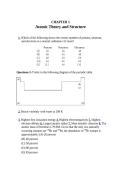
Questions 2–7 refer to the following diagram of the periodic table.
2. Reacts violently with water at 298 K
3. Highest first ionization energy 4. Highest electronegativity 5. Highest
electron affinity 6. Largest atomic radius 7. Most metallic character 8. The
atomic mass of bromine is 79.904. Given that the only two naturally
occurring isotopes are 79Br and 81Br, the abundance of 79Br isotope is
approximately: (A) 20 percent
(B) 40 percent
(C) 50 percent
(D) 80 percent
(E) 99 percent
, 9. The atomic mass of Sr is 87.62. Given that there are only three naturally
occurring isotopes of strontium, 86Sr, 87Sr, and 88Sr, which of the
following must be true?
(A) 86Sr is the most abundant isotope.
(B) 87Sr is the most abundant isotope.
(C) 88Sr is the most abundant isotope.
(D) 86Sr is the least abundant isotope.
(E) The isotopes 87Sr and 88Sr occur in approximately equal amounts.
10. Which of the following properties generally decreases from left to right
across a period (from potassium to bromine)?
(A) Electronegativity
(B) Electron affinity
(C) Atomic number
(D) Atomic radius
(E) Maximum value of oxidation number
11. All of the following statements describe the elements of the group 1 alkali
metals (not including hydrogen) except: (A) Their reactivity increases with
increasing period number.
(B) They have low first ionization energies.
(C) They react violently with water to form strong acids.
(D) They have strong metallic character.
(E) They are all silver solids at 1 atm and 298 K.
12. Which of the following elements would be expected to have chemical
properties most similar to those of phosphorus?
(A) S
(B) Se
(C) O
(D) As
(E) Si
,13. Which of the following pairs are isoelectronic (have the same number of
electrons)?
(A) Kr−, Br+
(B) F−, Na+
(C) Sc, Ti−
(D) Be2+, Ne
(E) Cs, Ba2+
14. Which of the following ions has the same number of electrons as I−?
(A) Sr2+
(B) Rb+
(C) Cs+
(D) Ba2+
(E) Br−
15. Which of the following best explains why the F−ion is smaller than the
O2– ion?
(A) F− has a more massive nucleus than O2–.
(B) F− has a higher electronegativity than O2–.
(C) F− has a greater nuclear charge than O2–.
(D) F− has a greater number of electrons than O2–.
(E) F− has more nucleons and electrons than O2–.
16. All of the following are true statements about the periodic table except:
(A) The reactivity of the group 1 alkali metals increases with increasing
period.
(B) The reactivity of the group 17 halogens decreases with increasing
period.
(C) The group 1 and 2 metals react with water to form basic solutions.
(D) The group 18 noble gases can exist only as inert, monatomic gases.
(E) All elements with an atomic number equal to or greater than 84 are
, radioactive.
17. Which of the following lists contains all the diatomic, elemental gases at
standard temperatures and pressures?
(A) H, N, O
(B) H, N, O, F, Cl
(C) H, N, O, F, Cl, Br, I
(D) H, N, O, Cl, Br, I, Hg, Rn
(E) H, N, O, Cl, He, Ne, Ar, Kr, Xe, Rn
18. As atomic number increases from 11 to 17 in the periodic table, what
happens to atomic radius?
(A) It remains constant.
(B) It increases only.
(C) It decreases only.
(D) It increases, then decreases.
(E) It decreases, then increases.
19. The effective nuclear charge experienced by a valence Kr is different than
the effective nuclear charge experienced by a valence electron of K.
Which of the following accurately illustrates this difference?
(A) K is a solid while Kr is a gas.
(B) The valence electrons of Kr have a lower first ionization energy than
K.
(C) The proton-to-electron ratio is higher for Kr than for K.
(D) Kr has a higher first ionization energy than K.
(E) The valence electrons of Kr experience less shielding by the inner
electrons than the valence electrons of K.
20. Based on the ionization energies for element X listed in the table above,
Atomic Theory and Structure
1. Which of the following shows the correct number of protons, neutrons,
and electrons in a neutral cadmium-112 atom?
Questions 2–7 refer to the following diagram of the periodic table.
2. Reacts violently with water at 298 K
3. Highest first ionization energy 4. Highest electronegativity 5. Highest
electron affinity 6. Largest atomic radius 7. Most metallic character 8. The
atomic mass of bromine is 79.904. Given that the only two naturally
occurring isotopes are 79Br and 81Br, the abundance of 79Br isotope is
approximately: (A) 20 percent
(B) 40 percent
(C) 50 percent
(D) 80 percent
(E) 99 percent
, 9. The atomic mass of Sr is 87.62. Given that there are only three naturally
occurring isotopes of strontium, 86Sr, 87Sr, and 88Sr, which of the
following must be true?
(A) 86Sr is the most abundant isotope.
(B) 87Sr is the most abundant isotope.
(C) 88Sr is the most abundant isotope.
(D) 86Sr is the least abundant isotope.
(E) The isotopes 87Sr and 88Sr occur in approximately equal amounts.
10. Which of the following properties generally decreases from left to right
across a period (from potassium to bromine)?
(A) Electronegativity
(B) Electron affinity
(C) Atomic number
(D) Atomic radius
(E) Maximum value of oxidation number
11. All of the following statements describe the elements of the group 1 alkali
metals (not including hydrogen) except: (A) Their reactivity increases with
increasing period number.
(B) They have low first ionization energies.
(C) They react violently with water to form strong acids.
(D) They have strong metallic character.
(E) They are all silver solids at 1 atm and 298 K.
12. Which of the following elements would be expected to have chemical
properties most similar to those of phosphorus?
(A) S
(B) Se
(C) O
(D) As
(E) Si
,13. Which of the following pairs are isoelectronic (have the same number of
electrons)?
(A) Kr−, Br+
(B) F−, Na+
(C) Sc, Ti−
(D) Be2+, Ne
(E) Cs, Ba2+
14. Which of the following ions has the same number of electrons as I−?
(A) Sr2+
(B) Rb+
(C) Cs+
(D) Ba2+
(E) Br−
15. Which of the following best explains why the F−ion is smaller than the
O2– ion?
(A) F− has a more massive nucleus than O2–.
(B) F− has a higher electronegativity than O2–.
(C) F− has a greater nuclear charge than O2–.
(D) F− has a greater number of electrons than O2–.
(E) F− has more nucleons and electrons than O2–.
16. All of the following are true statements about the periodic table except:
(A) The reactivity of the group 1 alkali metals increases with increasing
period.
(B) The reactivity of the group 17 halogens decreases with increasing
period.
(C) The group 1 and 2 metals react with water to form basic solutions.
(D) The group 18 noble gases can exist only as inert, monatomic gases.
(E) All elements with an atomic number equal to or greater than 84 are
, radioactive.
17. Which of the following lists contains all the diatomic, elemental gases at
standard temperatures and pressures?
(A) H, N, O
(B) H, N, O, F, Cl
(C) H, N, O, F, Cl, Br, I
(D) H, N, O, Cl, Br, I, Hg, Rn
(E) H, N, O, Cl, He, Ne, Ar, Kr, Xe, Rn
18. As atomic number increases from 11 to 17 in the periodic table, what
happens to atomic radius?
(A) It remains constant.
(B) It increases only.
(C) It decreases only.
(D) It increases, then decreases.
(E) It decreases, then increases.
19. The effective nuclear charge experienced by a valence Kr is different than
the effective nuclear charge experienced by a valence electron of K.
Which of the following accurately illustrates this difference?
(A) K is a solid while Kr is a gas.
(B) The valence electrons of Kr have a lower first ionization energy than
K.
(C) The proton-to-electron ratio is higher for Kr than for K.
(D) Kr has a higher first ionization energy than K.
(E) The valence electrons of Kr experience less shielding by the inner
electrons than the valence electrons of K.
20. Based on the ionization energies for element X listed in the table above,