

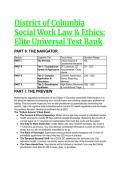
District of Columbia
Social Work Law & Ethics:
Elite Universal Test Bank
PART 0: THE NAVIGATOR
Section Cognitive Tier Focus Area Question Range
PART I The Preview Critical Axioms & N/A
Operational Mandates
PART II Tier 1: Foundational DC Licensure, CE Q1 – Q15
Syntax & Application Requirements, Clean
Hands
PART II Tier 2: Complex Consent, Supervision Q16 – Q35
Application & Ratios, Reporting
Simulation Matrices
PART II Tier 3: Grandmaster High-Stakes Dilemmas Q36 – Q60
Synthesis & Jurisdictional Traps
PART I: THE PREVIEW
Mastering the regulatory architecture of the District of Columbia transcends memorization; it is
the absolute baseline for protecting your clinical license and averting catastrophic professional
liability. This document forges you into an elite practitioner by systematically dismantling the
specific, high-risk cognitive traps embedded within current DC Health regulations and the Health
Occupations Revision General Amendment Act of 2024.
The "Critical Axioms" Cheat Sheet:
● The Consent & Privacy Boundary: Minors of any age may consent to outpatient mental
health services for exactly 90 days without parental knowledge. Releasing the records of
a minor aged 14–17 requires joint authorization from both the youth and the parent.
● The Duty to Warn Distinction: Unlike states with strict Tarasoff mandates, DC Code §
7-1203.03 is permissive. You may disclose confidential information to avert an imminent
threat, but you are not statutorily mandated to do so.
● The Ratio of Oversight: Supervised clinical practice strictly mandates one (1) hour of
immediate supervision for every thirty-two (32) hours of practice.
● The Temporal Renewal Shift: As of 2024, DC abandoned the odd-year July 31st
expiration model. Licenses now strictly expire on the last day of the licensee's birth month.
● The Clean Hands Rule: Your license will be blocked or revoked if you owe the District
government more than $1,000 in taxes, fines, or penalties.
,PART II: THE ELITE TEST BANK
Tier 1: Foundational Syntax & Application
Q1: A Licensed Independent Clinical Social Worker (LICSW) is preparing for license renewal in
the District of Columbia. Under the modernized DC Health regulatory framework effective
mid-2024, on what exact date does the practitioner's license legally expire? Based on the
principles of Licensure Maintenance, which action/conclusion is the MOST ACCURATE? A) July
31st of every odd-numbered year B) The exact calendar anniversary of the date the license was
issued C) The last day of the licensee's birth month D) December 31st of every even-numbered
year
● The Answer: C (The last day of the licensee's birth month)
● Distractor Analysis:
○ A is incorrect: This is the legacy deadline that was abolished by the 2024 DC Health
system update.
○ B is incorrect: DC Health aligns renewals universally with birth months, not original
issuance dates.
○ D is incorrect: This is a generalized board cycle used in other states, entirely
irrelevant to the current DC framework.
The Mentor's Analysis: DC Health transitioned to a staggered, birth-month renewal system to
reduce administrative bottlenecks at the processing center. When facing licensure expiration,
the immediate priority is verifying your birth month deadline. By utilizing the birth-month timeline,
you bypass the common trap of relying on outdated July 31st legacy calendars.
Professional/Academic Intuition: Your birth month dictates your professional survival;
never assume legacy grace periods apply.
Q2: A social worker submits their license renewal and is flagged by the District's "Clean Hands"
mandate. What is the maximum allowable debt threshold the practitioner can owe to the District
before their license is automatically blocked? Based on the principles of Municipal Financial
Compliance, which action/conclusion is the MOST ACCURATE? A) $100.00 B) $500.00 C)
$1,000.00 D) $2,500.00
● The Answer: C ($1,000.00)
● Distractor Analysis:
○ A is incorrect: This is the outdated, highly punitive threshold that was raised by the
DC Council in recent budget support acts.
○ B is incorrect: This is an arbitrary figure not supported by current DC Code §
47-2862.
○ D is incorrect: While advocacy groups proposed $2,500 to expand economic
opportunity, the finalized legislative threshold was legally capped at $1,000.
The Mentor's Analysis: Municipal financial compliance is directly tethered to clinical privilege.
When facing a Clean Hands audit, the immediate priority is clearing debts exceeding the
statutory limit. By utilizing the $1,000 threshold, you bypass the common trap of believing minor
traffic tickets will immediately revoke your livelihood. Professional/Academic Intuition: Unpaid
municipal debt over $1,000 equals immediate license suspension.
Q3: During a two-year renewal cycle, a DC Licensed Graduate Social Worker (LGSW)
completes 45 hours of Continuing Education (CE). How many of these hours must be
completed via live, face-to-face instruction focused specifically on ethics? Based on the
, principles of Continuing Education Mandates, which action/conclusion is the MOST
ACCURATE? A) 3 hours B) 4 hours C) 6 hours D) 12 hours
● The Answer: C (6 hours)
● Distractor Analysis:
○ A is incorrect: This is a standard requirement in adjacent states but insufficient for
DC.
○ B is incorrect: Four hours is the distinct requirement for Public Health Priorities, not
ethics.
○ D is incorrect: Twelve hours represents the maximum total allowance for
asynchronous/distance learning across the entire cycle, not the ethics minimum.
The Mentor's Analysis: DC maintains one of the strictest face-to-face ethics mandates in the
region. When curating CE credits, the immediate priority is securing interactive ethics training.
By utilizing the 6-hour live requirement, you bypass the common trap of acquiring unverified,
asynchronous ethics credits that will trigger an audit failure. Professional/Academic Intuition:
Ethics cannot be learned in a vacuum; DC demands 6 hours of synchronous, live
engagement.
Q4: A practitioner wishes to complete all of their CE requirements online due to a busy clinical
schedule. Under 17 DCMR Chapter 70 , what is the absolute maximum number of CE hours
that the Board will accept from distance learning, internet courses, or independent home study?
Based on the principles of Educational Compliance, which action/conclusion is the MOST
ACCURATE? A) 12 hours B) 20 hours C) 28 hours D) 40 hours
● The Answer: A (12 hours)
● Distractor Analysis:
○ B is incorrect: Allowing 50% online is common in other jurisdictions, but DC caps it
strictly at 12 hours out of the 40 required.
○ C is incorrect: This represents the number of hours that must be live/interactive, not
the distance learning cap.
○ D is incorrect: Attempting to complete 100% of CEs asynchronously will result in a
failed renewal and potential disciplinary action.
The Mentor's Analysis: The Board prioritizes peer interaction for professional development.
When planning continuing education, the immediate priority is balancing formats. By adhering to
the 12-hour distance learning cap, you bypass the common trap of invalidating your renewal via
excessive online modules. Professional/Academic Intuition: Only 30% of your academic
maintenance can occur behind a screen.
Q5: DC Health periodically updates its "Public Health Priorities" which comprise 10% (4 hours)
of a social worker's required CE. For the 2025–2026 renewal cycle, which of the following is an
officially designated domain for this requirement? Based on the principles of District Health
Directives, which action/conclusion is the MOST ACCURATE? A) Advanced
Psychopharmacology B) One Health (Vector and non-vector borne diseases) C) Play Therapy
Techniques D) Business Marketing for Private Practice
● The Answer: B (One Health (Vector and non-vector borne diseases))
● Distractor Analysis:
○ A is incorrect: While clinically relevant, this is not an official public health priority
domain published by the Director.
○ C is incorrect: This is a specialized clinical modality, not a population-level health
priority.
○ D is incorrect: Practice management never qualifies for public health continuing
education credit.
Social Work Law & Ethics:
Elite Universal Test Bank
PART 0: THE NAVIGATOR
Section Cognitive Tier Focus Area Question Range
PART I The Preview Critical Axioms & N/A
Operational Mandates
PART II Tier 1: Foundational DC Licensure, CE Q1 – Q15
Syntax & Application Requirements, Clean
Hands
PART II Tier 2: Complex Consent, Supervision Q16 – Q35
Application & Ratios, Reporting
Simulation Matrices
PART II Tier 3: Grandmaster High-Stakes Dilemmas Q36 – Q60
Synthesis & Jurisdictional Traps
PART I: THE PREVIEW
Mastering the regulatory architecture of the District of Columbia transcends memorization; it is
the absolute baseline for protecting your clinical license and averting catastrophic professional
liability. This document forges you into an elite practitioner by systematically dismantling the
specific, high-risk cognitive traps embedded within current DC Health regulations and the Health
Occupations Revision General Amendment Act of 2024.
The "Critical Axioms" Cheat Sheet:
● The Consent & Privacy Boundary: Minors of any age may consent to outpatient mental
health services for exactly 90 days without parental knowledge. Releasing the records of
a minor aged 14–17 requires joint authorization from both the youth and the parent.
● The Duty to Warn Distinction: Unlike states with strict Tarasoff mandates, DC Code §
7-1203.03 is permissive. You may disclose confidential information to avert an imminent
threat, but you are not statutorily mandated to do so.
● The Ratio of Oversight: Supervised clinical practice strictly mandates one (1) hour of
immediate supervision for every thirty-two (32) hours of practice.
● The Temporal Renewal Shift: As of 2024, DC abandoned the odd-year July 31st
expiration model. Licenses now strictly expire on the last day of the licensee's birth month.
● The Clean Hands Rule: Your license will be blocked or revoked if you owe the District
government more than $1,000 in taxes, fines, or penalties.
,PART II: THE ELITE TEST BANK
Tier 1: Foundational Syntax & Application
Q1: A Licensed Independent Clinical Social Worker (LICSW) is preparing for license renewal in
the District of Columbia. Under the modernized DC Health regulatory framework effective
mid-2024, on what exact date does the practitioner's license legally expire? Based on the
principles of Licensure Maintenance, which action/conclusion is the MOST ACCURATE? A) July
31st of every odd-numbered year B) The exact calendar anniversary of the date the license was
issued C) The last day of the licensee's birth month D) December 31st of every even-numbered
year
● The Answer: C (The last day of the licensee's birth month)
● Distractor Analysis:
○ A is incorrect: This is the legacy deadline that was abolished by the 2024 DC Health
system update.
○ B is incorrect: DC Health aligns renewals universally with birth months, not original
issuance dates.
○ D is incorrect: This is a generalized board cycle used in other states, entirely
irrelevant to the current DC framework.
The Mentor's Analysis: DC Health transitioned to a staggered, birth-month renewal system to
reduce administrative bottlenecks at the processing center. When facing licensure expiration,
the immediate priority is verifying your birth month deadline. By utilizing the birth-month timeline,
you bypass the common trap of relying on outdated July 31st legacy calendars.
Professional/Academic Intuition: Your birth month dictates your professional survival;
never assume legacy grace periods apply.
Q2: A social worker submits their license renewal and is flagged by the District's "Clean Hands"
mandate. What is the maximum allowable debt threshold the practitioner can owe to the District
before their license is automatically blocked? Based on the principles of Municipal Financial
Compliance, which action/conclusion is the MOST ACCURATE? A) $100.00 B) $500.00 C)
$1,000.00 D) $2,500.00
● The Answer: C ($1,000.00)
● Distractor Analysis:
○ A is incorrect: This is the outdated, highly punitive threshold that was raised by the
DC Council in recent budget support acts.
○ B is incorrect: This is an arbitrary figure not supported by current DC Code §
47-2862.
○ D is incorrect: While advocacy groups proposed $2,500 to expand economic
opportunity, the finalized legislative threshold was legally capped at $1,000.
The Mentor's Analysis: Municipal financial compliance is directly tethered to clinical privilege.
When facing a Clean Hands audit, the immediate priority is clearing debts exceeding the
statutory limit. By utilizing the $1,000 threshold, you bypass the common trap of believing minor
traffic tickets will immediately revoke your livelihood. Professional/Academic Intuition: Unpaid
municipal debt over $1,000 equals immediate license suspension.
Q3: During a two-year renewal cycle, a DC Licensed Graduate Social Worker (LGSW)
completes 45 hours of Continuing Education (CE). How many of these hours must be
completed via live, face-to-face instruction focused specifically on ethics? Based on the
, principles of Continuing Education Mandates, which action/conclusion is the MOST
ACCURATE? A) 3 hours B) 4 hours C) 6 hours D) 12 hours
● The Answer: C (6 hours)
● Distractor Analysis:
○ A is incorrect: This is a standard requirement in adjacent states but insufficient for
DC.
○ B is incorrect: Four hours is the distinct requirement for Public Health Priorities, not
ethics.
○ D is incorrect: Twelve hours represents the maximum total allowance for
asynchronous/distance learning across the entire cycle, not the ethics minimum.
The Mentor's Analysis: DC maintains one of the strictest face-to-face ethics mandates in the
region. When curating CE credits, the immediate priority is securing interactive ethics training.
By utilizing the 6-hour live requirement, you bypass the common trap of acquiring unverified,
asynchronous ethics credits that will trigger an audit failure. Professional/Academic Intuition:
Ethics cannot be learned in a vacuum; DC demands 6 hours of synchronous, live
engagement.
Q4: A practitioner wishes to complete all of their CE requirements online due to a busy clinical
schedule. Under 17 DCMR Chapter 70 , what is the absolute maximum number of CE hours
that the Board will accept from distance learning, internet courses, or independent home study?
Based on the principles of Educational Compliance, which action/conclusion is the MOST
ACCURATE? A) 12 hours B) 20 hours C) 28 hours D) 40 hours
● The Answer: A (12 hours)
● Distractor Analysis:
○ B is incorrect: Allowing 50% online is common in other jurisdictions, but DC caps it
strictly at 12 hours out of the 40 required.
○ C is incorrect: This represents the number of hours that must be live/interactive, not
the distance learning cap.
○ D is incorrect: Attempting to complete 100% of CEs asynchronously will result in a
failed renewal and potential disciplinary action.
The Mentor's Analysis: The Board prioritizes peer interaction for professional development.
When planning continuing education, the immediate priority is balancing formats. By adhering to
the 12-hour distance learning cap, you bypass the common trap of invalidating your renewal via
excessive online modules. Professional/Academic Intuition: Only 30% of your academic
maintenance can occur behind a screen.
Q5: DC Health periodically updates its "Public Health Priorities" which comprise 10% (4 hours)
of a social worker's required CE. For the 2025–2026 renewal cycle, which of the following is an
officially designated domain for this requirement? Based on the principles of District Health
Directives, which action/conclusion is the MOST ACCURATE? A) Advanced
Psychopharmacology B) One Health (Vector and non-vector borne diseases) C) Play Therapy
Techniques D) Business Marketing for Private Practice
● The Answer: B (One Health (Vector and non-vector borne diseases))
● Distractor Analysis:
○ A is incorrect: While clinically relevant, this is not an official public health priority
domain published by the Director.
○ C is incorrect: This is a specialized clinical modality, not a population-level health
priority.
○ D is incorrect: Practice management never qualifies for public health continuing
education credit.


