

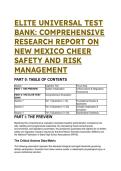
ELITE UNIVERSAL TEST
BANK: COMPREHENSIVE
RESEARCH REPORT ON
NEW MEXICO CHEER
SAFETY AND RISK
MANAGEMENT
PART 0: TABLE OF CONTENTS
Section Cognitive Tier Focus Area
PART I: THE PREVIEW System Initialization Critical Axioms & Regulatory
Frameworks
PART II: THE ELITE TEST Comprehensive Evaluation
BANK
Section 1 Tier 1 (Questions 1–10) Foundational Syntax &
Application
Section 2 Tier 2 (Questions 11–20) Complex Application &
Simulation
Section 3 Tier 3 (Questions 21–30) Grandmaster Synthesis
PART I: THE PREVIEW
Mastering this comprehensive evaluation translates baseline administrative compliance into
elite, liability-proof programmatic leadership. By internalizing these biomechanical,
environmental, and legislative parameters, the practitioner guarantees the highest tier of athletic
safety and regulatory mastery required by the New Mexico Activities Association (NMAA) and
the National Federation of State High School Associations (NFHS).
The Critical Axioms Data Matrix
The following parameters represent the absolute biological and legal thresholds governing
athletic participation. Deviation from these metrics results in catastrophic physiological injury or
severe institutional sanction.
,Regulatory Domain Core Parameter Physiological / Legal Citation Reference
Rationale
Neurological Trauma Minimum 240-hour Neurometabolic
suspension following cascades require a
any suspected non-negotiable
concussion. minimum of 10 days for
basal stabilization prior
to specific medical
clearance.
Environmental Stress Absolute cancellation of Exertional Heat Stroke
outdoor activity if risk becomes
WBGT > 92.0°F. uncontrollable; WBGT
accurately synthesizes
ambient temperature,
humidity, wind, and
solar radiation.
Cardiac Emergencies Sub-3-minute Myocardial necrosis
Automated External and irreversible
Defibrillator (AED) cerebral hypoxia occur
access radius. rapidly; the chain of
survival demands
immediate on-site
defibrillation.
Biomechanical Limits Absolute prohibition of Uncontrolled kinetic
unassisted inverted energy during airborne
catches and inversions introduces
hip-over-head release unacceptable cervical
tosses. spine compression
risks.
Administrative Roster maximum of 24 Spatial awareness
Integrity performers; maximum limits collision vectors;
4-athlete transition transition caps prevent
between state routines. unauthorized
programmatic
manipulations.
PART II: THE ELITE TEST BANK
Tier 1: Foundational Syntax & Application
Q1: An athlete sustains a suspected head injury during a Friday evening competition. Based on
the principles of New Mexico Senate Bill 38 and NMAA concussion protocols, which action is
the FIRST legal milestone that must be met before this athlete can return to full unrestricted
activity? A) The athlete completes a 7-day graduated return-to-play protocol managed by a
certified athletic trainer. B) The athlete is cleared by a registered school nurse after 48 hours of
being completely symptom-free. C) The athlete sits out for a minimum of 240 hours and is
cleared by an approved medical professional. D) The athlete passes a baseline cognitive
reassessment after 14 days of mandatory academic rest.
, ● Answer: C (The athlete sits out for a minimum of 240 hours and is cleared by an
approved medical professional.)
● Distractor Analysis:
○ A is incorrect: While graduated physiological stress protocols are standard practice,
a 7-day timeline violates the strict state legislative mandate of 240 hours (10 days).
○ B is incorrect: A registered school nurse is not statutorily listed as an approved
medical professional for concussion clearance under NM Senate Bill 38, and a
48-hour window is vastly insufficient for neurometabolic recovery.
○ D is incorrect: While 14 days exceeds the minimum required timeframe, baseline
cognitive testing alone without specific medical clearance from a designated
provider does not satisfy the legislative requirement.
The Mentor's Analysis: State legislation removes all subjective timeline interpretation from
concussion management. The 240-hour parameter is a rigid, non-negotiable floor, not a ceiling.
By utilizing strictly approved providers under the Senate Bill 38 protocols, the practitioner
bypasses the common trap of relying solely on symptom resolution for clearance.
Professional/Academic Intuition: The biological healing of neurological trauma does not
adhere to competitive schedules; the 240-hour rule is the absolute floor for
neurocognitive recovery.
Q2: When evaluating environmental heat stress prior to an August afternoon practice, the
practitioner must select the most accurate meteorological metric. According to NMAA Heat
Illness Prevention Protocols, which measurement tool is the MOST APPROPRIATE primary
choice for activity modification? A) A standard dry-bulb thermometer to measure ambient air
temperature. B) A digital hygrometer to calculate the localized heat index. C) A Wet Bulb Globe
Temperature (WBGT) device. D) A local weather application providing regional relative humidity.
● Answer: C (A Wet Bulb Globe Temperature (WBGT) device.)
● Distractor Analysis:
○ A is incorrect: Dry-bulb ambient temperature fails to account for atmospheric
moisture, solar radiation, and wind speed, leaving athletes highly vulnerable to
unquantified exertional heat stroke risks.
○ B is incorrect: Heat index is only permitted in the absolute absence of a WBGT
device, making it a secondary, inferior choice that ignores solar radiation.
○ D is incorrect: Regional applications do not provide micro-climate data specific to
the exact practice surface, which is critical for evaluating radiant heat.
The Mentor's Analysis: Environmental heat stress is a multifaceted physiological threat.
WBGT represents the gold standard because it synthesizes ambient temperature, relative
humidity, wind speed, and solar radiation into a single actionable metric. When facing extreme
thermal loads, the immediate priority is localized, real-time data acquisition.
Professional/Academic Intuition: WBGT represents the exact physiological reality of the
micro-environment; Heat Index is merely a secondary proxy.
Q3: To maintain legal compliance and programmatic eligibility, a high school spirit coach in New
Mexico must renew specific certifications. Which requirement sequence is MOST ACCURATE
regarding licensure renewal? A) Concussion in Sports annually, and CPR/AED certification
purely via online modules every two years. B) Cheer & Dance Safety Certification every four
years, and in-person CPR/AED training. C) Fundamentals of Coaching every two years, and
Protecting Students from Abuse annually. D) First Aid, Health and Safety every four years, and
a background check every season.
● Answer: B (Cheer & Dance Safety Certification every four years, and in-person
CPR/AED training.)
BANK: COMPREHENSIVE
RESEARCH REPORT ON
NEW MEXICO CHEER
SAFETY AND RISK
MANAGEMENT
PART 0: TABLE OF CONTENTS
Section Cognitive Tier Focus Area
PART I: THE PREVIEW System Initialization Critical Axioms & Regulatory
Frameworks
PART II: THE ELITE TEST Comprehensive Evaluation
BANK
Section 1 Tier 1 (Questions 1–10) Foundational Syntax &
Application
Section 2 Tier 2 (Questions 11–20) Complex Application &
Simulation
Section 3 Tier 3 (Questions 21–30) Grandmaster Synthesis
PART I: THE PREVIEW
Mastering this comprehensive evaluation translates baseline administrative compliance into
elite, liability-proof programmatic leadership. By internalizing these biomechanical,
environmental, and legislative parameters, the practitioner guarantees the highest tier of athletic
safety and regulatory mastery required by the New Mexico Activities Association (NMAA) and
the National Federation of State High School Associations (NFHS).
The Critical Axioms Data Matrix
The following parameters represent the absolute biological and legal thresholds governing
athletic participation. Deviation from these metrics results in catastrophic physiological injury or
severe institutional sanction.
,Regulatory Domain Core Parameter Physiological / Legal Citation Reference
Rationale
Neurological Trauma Minimum 240-hour Neurometabolic
suspension following cascades require a
any suspected non-negotiable
concussion. minimum of 10 days for
basal stabilization prior
to specific medical
clearance.
Environmental Stress Absolute cancellation of Exertional Heat Stroke
outdoor activity if risk becomes
WBGT > 92.0°F. uncontrollable; WBGT
accurately synthesizes
ambient temperature,
humidity, wind, and
solar radiation.
Cardiac Emergencies Sub-3-minute Myocardial necrosis
Automated External and irreversible
Defibrillator (AED) cerebral hypoxia occur
access radius. rapidly; the chain of
survival demands
immediate on-site
defibrillation.
Biomechanical Limits Absolute prohibition of Uncontrolled kinetic
unassisted inverted energy during airborne
catches and inversions introduces
hip-over-head release unacceptable cervical
tosses. spine compression
risks.
Administrative Roster maximum of 24 Spatial awareness
Integrity performers; maximum limits collision vectors;
4-athlete transition transition caps prevent
between state routines. unauthorized
programmatic
manipulations.
PART II: THE ELITE TEST BANK
Tier 1: Foundational Syntax & Application
Q1: An athlete sustains a suspected head injury during a Friday evening competition. Based on
the principles of New Mexico Senate Bill 38 and NMAA concussion protocols, which action is
the FIRST legal milestone that must be met before this athlete can return to full unrestricted
activity? A) The athlete completes a 7-day graduated return-to-play protocol managed by a
certified athletic trainer. B) The athlete is cleared by a registered school nurse after 48 hours of
being completely symptom-free. C) The athlete sits out for a minimum of 240 hours and is
cleared by an approved medical professional. D) The athlete passes a baseline cognitive
reassessment after 14 days of mandatory academic rest.
, ● Answer: C (The athlete sits out for a minimum of 240 hours and is cleared by an
approved medical professional.)
● Distractor Analysis:
○ A is incorrect: While graduated physiological stress protocols are standard practice,
a 7-day timeline violates the strict state legislative mandate of 240 hours (10 days).
○ B is incorrect: A registered school nurse is not statutorily listed as an approved
medical professional for concussion clearance under NM Senate Bill 38, and a
48-hour window is vastly insufficient for neurometabolic recovery.
○ D is incorrect: While 14 days exceeds the minimum required timeframe, baseline
cognitive testing alone without specific medical clearance from a designated
provider does not satisfy the legislative requirement.
The Mentor's Analysis: State legislation removes all subjective timeline interpretation from
concussion management. The 240-hour parameter is a rigid, non-negotiable floor, not a ceiling.
By utilizing strictly approved providers under the Senate Bill 38 protocols, the practitioner
bypasses the common trap of relying solely on symptom resolution for clearance.
Professional/Academic Intuition: The biological healing of neurological trauma does not
adhere to competitive schedules; the 240-hour rule is the absolute floor for
neurocognitive recovery.
Q2: When evaluating environmental heat stress prior to an August afternoon practice, the
practitioner must select the most accurate meteorological metric. According to NMAA Heat
Illness Prevention Protocols, which measurement tool is the MOST APPROPRIATE primary
choice for activity modification? A) A standard dry-bulb thermometer to measure ambient air
temperature. B) A digital hygrometer to calculate the localized heat index. C) A Wet Bulb Globe
Temperature (WBGT) device. D) A local weather application providing regional relative humidity.
● Answer: C (A Wet Bulb Globe Temperature (WBGT) device.)
● Distractor Analysis:
○ A is incorrect: Dry-bulb ambient temperature fails to account for atmospheric
moisture, solar radiation, and wind speed, leaving athletes highly vulnerable to
unquantified exertional heat stroke risks.
○ B is incorrect: Heat index is only permitted in the absolute absence of a WBGT
device, making it a secondary, inferior choice that ignores solar radiation.
○ D is incorrect: Regional applications do not provide micro-climate data specific to
the exact practice surface, which is critical for evaluating radiant heat.
The Mentor's Analysis: Environmental heat stress is a multifaceted physiological threat.
WBGT represents the gold standard because it synthesizes ambient temperature, relative
humidity, wind speed, and solar radiation into a single actionable metric. When facing extreme
thermal loads, the immediate priority is localized, real-time data acquisition.
Professional/Academic Intuition: WBGT represents the exact physiological reality of the
micro-environment; Heat Index is merely a secondary proxy.
Q3: To maintain legal compliance and programmatic eligibility, a high school spirit coach in New
Mexico must renew specific certifications. Which requirement sequence is MOST ACCURATE
regarding licensure renewal? A) Concussion in Sports annually, and CPR/AED certification
purely via online modules every two years. B) Cheer & Dance Safety Certification every four
years, and in-person CPR/AED training. C) Fundamentals of Coaching every two years, and
Protecting Students from Abuse annually. D) First Aid, Health and Safety every four years, and
a background check every season.
● Answer: B (Cheer & Dance Safety Certification every four years, and in-person
CPR/AED training.)


