

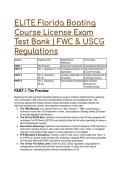
ELITE Florida Boating
Course License Exam
Test Bank | FWC & USCG
Regulations
Section Cognitive Tier Page/Section Focus Area
Reference
PART I The Preview Axioms & Frameworks Foundational Directives
PART II Tier 1: Questions 1–15 Foundational Syntax & Hard Deck Definitions
Application & Core Formulas
PART II Tier 2: Questions Complex Application & Variable Adjustments &
16–35 Simulation Immediate Actions
PART II Tier 3: Questions Grandmaster Synthesis Multi-Variable
36–50 Scenarios &
Troubleshooting
PART I: The Preview
Mastering this elite test bank translates directly to superior maritime performance by replacing
rote memorization with a structural understanding of physics and navigational law. This
immersive assessment forges scholars whose theoretical mastery translates directly into
high-level professional, clinical, and analytical competence on the water.
● The 1988 Mandate: Any operator born on or after January 1, 1988, commanding a
motorized vessel with 10 horsepower or more, must possess a Boating Safety Education
ID and photographic identification.
● The 26-Foot ECOS Rule: Operators of recreational vessels under 26 feet equipped with
an Engine Cut-Off Switch (ECOS) must actively utilize the link when operating on plane or
above displacement speed.
● Diver-Down Distancing: Operators must maintain a minimum distance of 300 feet from a
diver-down warning device in open water, and 100 feet within rivers, inlets, or navigation
channels, proceeding at idle speed if a closer approach is unavoidable.
● PFD Mandates & Exceptions: Children under 6 must wear a USCG-approved Type I, II,
or III PFD on vessels under 26 feet while underway. Inflatable PFDs are strictly prohibited
for Personal Watercraft (PWC) operations and towed watersports.
● The 12-Year Fire Safety Limit: Under the 2022 USCG regulations, disposable fire
extinguishers must be removed from service exactly 12 years from their date of
manufacture, standardizing the minimum classification to 5-B.
,PART II: The Elite Test Bank
Q1: An operator born in 1990 is navigating a 15-horsepower motorized vessel on Florida
waters. The operator holds a valid Boating Safety Education ID Card but left their physical photo
identification on shore. Based on the principles of Florida Vessel Regulations, which conclusion
is the MOST ACCURATE?
A) The operator is compliant because the Boating Safety Education ID Card serves as a
standalone credential for operators born after January 1, 1988. B) The operator is compliant
because photo identification is only required for operators commanding vessels exceeding 26
feet in length. C) The operator is in violation because Florida law mandates the simultaneous
possession of both the Boating Safety Education ID and photographic identification. D) The
operator is in violation because the Boating Safety Education ID must be renewed annually
alongside the vessel registration.
● The Answer: C (The operator is in violation because Florida law mandates the
simultaneous possession of both the Boating Safety Education ID and photographic
identification.)
● Distractor Analysis:
○ A is incorrect: The Boating Safety Education ID Card does not replace the legal
requirement to carry a separate photographic identification.
○ B is incorrect: The 26-foot threshold pertains to Engine Cut-Off Switch (ECOS)
mandates and child PFD rules, not the requirement for photo identification.
○ D is incorrect: A Florida Boating Safety Education ID Card is valid for life and does
not require annual renewal.
The Mentor's Analysis: The fundamental requirement for operating motorized vessels of 10
horsepower or greater in Florida rests on a strict dual-credential system. By utilizing dual
credentialing, enforcement officers mathematically verify that the educational certificate matches
the individual physically operating the vessel. Professional/Academic Intuition: Educational
certification is legally void without corresponding photographic verification physically
present on the water.
Q2: A 13-year-old individual wishes to operate a Personal Watercraft (PWC) on a saltwater bay
in Florida, under the direct, onboard supervision of a 40-year-old parent who possesses a
USCG Master License. Based on the principles of Florida PWC Regulations, which action is the
MOST ACCURATE?
A) The operation is legal because the supervising parent holds a USCG Master License, which
overrides standard age restrictions. B) The operation is legal provided the 13-year-old
possesses a Florida Boating Safety Education ID Card. C) The operation is illegal because the
absolute minimum age to operate a PWC in Florida is 14 years old. D) The operation is illegal
because PWC operation requires the operator to be at least 18 years of age.
● The Answer: C (The operation is illegal because the absolute minimum age to operate a
PWC in Florida is 14 years old.)
● Distractor Analysis:
○ A is incorrect: Direct supervision or advanced licensure of a passenger does not
negate the statutory hard minimum age limit for PWC operation.
○ B is incorrect: Educational certification cannot bypass the statutory age requirement
of 14 for PWC operation.
○ D is incorrect: The age of 18 is the minimum requirement to rent a PWC, not the
, minimum age to operate one.
The Mentor's Analysis: Florida law distinguishes heavily between standard motorboats and
Personal Watercraft. While standard motorboats possess no minimum operating age (provided
the education requirement is met), PWCs enforce a strict baseline. By utilizing the 14-year
minimum rule, the state systematically mitigates the inherent risks of high-thrust, highly
maneuverable jet-drive vessels.
Vessel Type Minimum Operating Age Supervision Exemption
Available?
Standard Motorboat (10+ HP) None Yes (if supervised by certified
18+ adult)
Personal Watercraft (PWC) 14 Years Old No
PWC Rental 18 Years Old No
Professional/Academic Intuition: No exemption, supervision, or certification can bypass
the 14-year minimum age requirement for PWC operation.
Q3: A vessel owner is affixing a newly issued Florida registration validation decal to a 22-foot
center console. Based on the principles of Vessel Registration Display, which placement is the
MOST ACCURATE?
A) On the starboard side of the vessel, within 6 inches of the hull identification number. B) On
the port side of the vessel, within 6 inches of the registration number. C) On both the port and
starboard sides of the vessel, immediately following the registration numbers. D) On the
windshield or helm station where it is highly visible to law enforcement.
● The Answer: B (On the port side of the vessel, within 6 inches of the registration
number.)
● Distractor Analysis:
○ A is incorrect: The decal is not placed near the Hull Identification Number (HIN),
which is strictly located on the transom.
○ C is incorrect: The validation decal is only required on the port (left) side of the
vessel, not symmetrically on both sides.
○ D is incorrect: Decals must be displayed in line with the registration numbers on the
forward half of the hull, never on the windshield.
The Mentor's Analysis: Standardized vessel marking ensures rapid visual identification by
marine law enforcement operating in dynamic environments. The registration numbers (e.g., FL
1234 AB) go on both sides of the bow, but the validation decal is strictly asymmetrical. By
utilizing the port-side decal rule, marine officers can instantly verify current registration from a
standardized approach angle. Professional/Academic Intuition: Validation decals are
exclusively port-side indicators, positioned within 6 inches of the registration numbers.
Q4: A recreational boater purchases an Emergency Position Indicating Radio Beacon (EPIRB)
and properly registers it with the National Oceanic and Atmospheric Administration (NOAA).
Based on the principles of Florida Vessel Registration Incentives, what is the MOST LOGICAL
outcome when renewing the vessel's registration?
A) The owner will receive a permanent exemption from state vessel registration fees. B) The
owner will receive a reduced vessel registration fee upon providing proof of the NOAA
registration. C) The owner is required to pay a surcharge to fund the state's Search and Rescue
operations. D) The owner will receive a reduced registration fee only if the vessel is documented
by the USCG.
● The Answer: B (The owner will receive a reduced vessel registration fee upon providing
proof of the NOAA registration.)
Course License Exam
Test Bank | FWC & USCG
Regulations
Section Cognitive Tier Page/Section Focus Area
Reference
PART I The Preview Axioms & Frameworks Foundational Directives
PART II Tier 1: Questions 1–15 Foundational Syntax & Hard Deck Definitions
Application & Core Formulas
PART II Tier 2: Questions Complex Application & Variable Adjustments &
16–35 Simulation Immediate Actions
PART II Tier 3: Questions Grandmaster Synthesis Multi-Variable
36–50 Scenarios &
Troubleshooting
PART I: The Preview
Mastering this elite test bank translates directly to superior maritime performance by replacing
rote memorization with a structural understanding of physics and navigational law. This
immersive assessment forges scholars whose theoretical mastery translates directly into
high-level professional, clinical, and analytical competence on the water.
● The 1988 Mandate: Any operator born on or after January 1, 1988, commanding a
motorized vessel with 10 horsepower or more, must possess a Boating Safety Education
ID and photographic identification.
● The 26-Foot ECOS Rule: Operators of recreational vessels under 26 feet equipped with
an Engine Cut-Off Switch (ECOS) must actively utilize the link when operating on plane or
above displacement speed.
● Diver-Down Distancing: Operators must maintain a minimum distance of 300 feet from a
diver-down warning device in open water, and 100 feet within rivers, inlets, or navigation
channels, proceeding at idle speed if a closer approach is unavoidable.
● PFD Mandates & Exceptions: Children under 6 must wear a USCG-approved Type I, II,
or III PFD on vessels under 26 feet while underway. Inflatable PFDs are strictly prohibited
for Personal Watercraft (PWC) operations and towed watersports.
● The 12-Year Fire Safety Limit: Under the 2022 USCG regulations, disposable fire
extinguishers must be removed from service exactly 12 years from their date of
manufacture, standardizing the minimum classification to 5-B.
,PART II: The Elite Test Bank
Q1: An operator born in 1990 is navigating a 15-horsepower motorized vessel on Florida
waters. The operator holds a valid Boating Safety Education ID Card but left their physical photo
identification on shore. Based on the principles of Florida Vessel Regulations, which conclusion
is the MOST ACCURATE?
A) The operator is compliant because the Boating Safety Education ID Card serves as a
standalone credential for operators born after January 1, 1988. B) The operator is compliant
because photo identification is only required for operators commanding vessels exceeding 26
feet in length. C) The operator is in violation because Florida law mandates the simultaneous
possession of both the Boating Safety Education ID and photographic identification. D) The
operator is in violation because the Boating Safety Education ID must be renewed annually
alongside the vessel registration.
● The Answer: C (The operator is in violation because Florida law mandates the
simultaneous possession of both the Boating Safety Education ID and photographic
identification.)
● Distractor Analysis:
○ A is incorrect: The Boating Safety Education ID Card does not replace the legal
requirement to carry a separate photographic identification.
○ B is incorrect: The 26-foot threshold pertains to Engine Cut-Off Switch (ECOS)
mandates and child PFD rules, not the requirement for photo identification.
○ D is incorrect: A Florida Boating Safety Education ID Card is valid for life and does
not require annual renewal.
The Mentor's Analysis: The fundamental requirement for operating motorized vessels of 10
horsepower or greater in Florida rests on a strict dual-credential system. By utilizing dual
credentialing, enforcement officers mathematically verify that the educational certificate matches
the individual physically operating the vessel. Professional/Academic Intuition: Educational
certification is legally void without corresponding photographic verification physically
present on the water.
Q2: A 13-year-old individual wishes to operate a Personal Watercraft (PWC) on a saltwater bay
in Florida, under the direct, onboard supervision of a 40-year-old parent who possesses a
USCG Master License. Based on the principles of Florida PWC Regulations, which action is the
MOST ACCURATE?
A) The operation is legal because the supervising parent holds a USCG Master License, which
overrides standard age restrictions. B) The operation is legal provided the 13-year-old
possesses a Florida Boating Safety Education ID Card. C) The operation is illegal because the
absolute minimum age to operate a PWC in Florida is 14 years old. D) The operation is illegal
because PWC operation requires the operator to be at least 18 years of age.
● The Answer: C (The operation is illegal because the absolute minimum age to operate a
PWC in Florida is 14 years old.)
● Distractor Analysis:
○ A is incorrect: Direct supervision or advanced licensure of a passenger does not
negate the statutory hard minimum age limit for PWC operation.
○ B is incorrect: Educational certification cannot bypass the statutory age requirement
of 14 for PWC operation.
○ D is incorrect: The age of 18 is the minimum requirement to rent a PWC, not the
, minimum age to operate one.
The Mentor's Analysis: Florida law distinguishes heavily between standard motorboats and
Personal Watercraft. While standard motorboats possess no minimum operating age (provided
the education requirement is met), PWCs enforce a strict baseline. By utilizing the 14-year
minimum rule, the state systematically mitigates the inherent risks of high-thrust, highly
maneuverable jet-drive vessels.
Vessel Type Minimum Operating Age Supervision Exemption
Available?
Standard Motorboat (10+ HP) None Yes (if supervised by certified
18+ adult)
Personal Watercraft (PWC) 14 Years Old No
PWC Rental 18 Years Old No
Professional/Academic Intuition: No exemption, supervision, or certification can bypass
the 14-year minimum age requirement for PWC operation.
Q3: A vessel owner is affixing a newly issued Florida registration validation decal to a 22-foot
center console. Based on the principles of Vessel Registration Display, which placement is the
MOST ACCURATE?
A) On the starboard side of the vessel, within 6 inches of the hull identification number. B) On
the port side of the vessel, within 6 inches of the registration number. C) On both the port and
starboard sides of the vessel, immediately following the registration numbers. D) On the
windshield or helm station where it is highly visible to law enforcement.
● The Answer: B (On the port side of the vessel, within 6 inches of the registration
number.)
● Distractor Analysis:
○ A is incorrect: The decal is not placed near the Hull Identification Number (HIN),
which is strictly located on the transom.
○ C is incorrect: The validation decal is only required on the port (left) side of the
vessel, not symmetrically on both sides.
○ D is incorrect: Decals must be displayed in line with the registration numbers on the
forward half of the hull, never on the windshield.
The Mentor's Analysis: Standardized vessel marking ensures rapid visual identification by
marine law enforcement operating in dynamic environments. The registration numbers (e.g., FL
1234 AB) go on both sides of the bow, but the validation decal is strictly asymmetrical. By
utilizing the port-side decal rule, marine officers can instantly verify current registration from a
standardized approach angle. Professional/Academic Intuition: Validation decals are
exclusively port-side indicators, positioned within 6 inches of the registration numbers.
Q4: A recreational boater purchases an Emergency Position Indicating Radio Beacon (EPIRB)
and properly registers it with the National Oceanic and Atmospheric Administration (NOAA).
Based on the principles of Florida Vessel Registration Incentives, what is the MOST LOGICAL
outcome when renewing the vessel's registration?
A) The owner will receive a permanent exemption from state vessel registration fees. B) The
owner will receive a reduced vessel registration fee upon providing proof of the NOAA
registration. C) The owner is required to pay a surcharge to fund the state's Search and Rescue
operations. D) The owner will receive a reduced registration fee only if the vessel is documented
by the USCG.
● The Answer: B (The owner will receive a reduced vessel registration fee upon providing
proof of the NOAA registration.)


