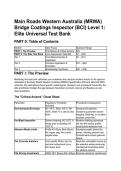
Main Roads Western Australia (MRWA)
Bridge Coatings Inspector (BCI) Level 1:
Elite Universal Test Bank
PART 0: Table of Contents
Section Topic Focus Question Range
PART I: The Preview The Mission & Critical Axioms N/A
PART II: The Elite Test Bank Core Assessment Gauntlet Q1 – Q30
Tier 1 Foundational Syntax & Q1 – Q10
Application
Tier 2 Complex Application & Q11 – Q20
Simulation
Tier 3 Grandmaster Synthesis Q21 – Q30
PART I: The Preview
Mastering this test bank calibrates your academic and practical intuition directly to the rigorous
standards of the Main Roads Western Australia (MRWA) Specification 835 and allied AS 3894
protocols. By internalizing these specific metallurgical, chemical, and procedural thresholds, the
elite practitioner bridges the gap between theoretical corrosion science and flawless on-site
asset protection.
The "Critical Axioms" Cheat Sheet
Parameter Regulatory Threshold / Procedural Consequence
Standard
Environmental Envelope Air >10°C, Steel <55°C, RH Absolute kill-switches.
<85%, Steel >3°C above Dew Violations guarantee solvent
Point. trapping, blistering, or invisible
moisture under-film.
Pre-Blast Imperative Solvent cleaning (AS 1627.1) Abrasive blasting pulverizes
strictly prior to blasting (AS oils into the anchor profile,
1627.4). causing fatal adhesion loss.
Abrasive Media Limits Profile 40–60µm (Max 80µm). Excessive peaks pierce the
No copper slag. No coarse primer, initiating pinpoint rust.
angular steel. Contaminants induce galvanic
failure.
The Concrete Interface Coat exactly 50mm into the Seals the vulnerable crevice at
concrete embedment zone, the waterline while preserving
then leave bare. mechanical bond deep within
the alkaline cement.
Pile Driving Constraints APAS 2971 Epoxy (Min 400µm Ensures maximum mechanical
,Parameter Regulatory Threshold / Procedural Consequence
Standard
DFT). Strict 7-day cure prior to shear resistance during
handling. extreme soil penetration.
PART II: The Elite Test Bank
Tier 1: Foundational Syntax & Application
Q1: A newly fabricated steel bridge girder is situated in a Perth fabrication yard at 0630 hours.
The ambient temperature is 14°C, the relative humidity is 82%, and the dew point is calculated
at 11°C. The steel surface temperature measures 12°C. Based on the fundamental principles of
MRWA Specification 835, which immediate action regarding the application of the inorganic zinc
silicate primer is MOST ACCURATE? A) Proceed with coating application because the ambient
temperature is fully compliant with the 10°C minimum threshold. B) Proceed with coating
application because the relative humidity is safely below the 85% absolute maximum threshold.
C) Halt the coating application immediately because the steel surface temperature violates the
dew point differential rule. D) Halt the coating application immediately because inorganic zinc
silicate cannot be applied below an ambient baseline of 15°C.
● The Answer: C (Halt the coating application immediately because the steel surface
temperature violates the dew point differential rule.)
● Distractor Analysis:
○ A is incorrect: While the ambient air temperature (14°C) satisfies the >10°C
baseline , environmental compliance requires all four climatic variables to be met
simultaneously.
○ B is incorrect: The RH is technically compliant at 82% (under the 85% limit) , but
this does not override the independent substrate temperature failure.
○ D is incorrect: There is no strict 15°C baseline in MRWA Specification 835; the
document explicitly mandates a hard ambient floor of 10°C.
The Mentor's Analysis: Coating over microscopic, invisible condensation guarantees osmotic
blistering and premature delamination. When facing marginal morning weather windows, the
immediate priority is calculating the exact dew point margin. By utilizing the strict 3°C differential
rule, you bypass the common trap of relying solely on ambient air temperatures while the colder
steel is actively condensing moisture. Professional/Academic Intuition: Steel temperature
must sit a minimum of 3°C above the dew point; any less, and you are painting over
invisible water.
Q2: A contractor is preparing to apply a protective coating system to heavy structural steelwork.
Before commencing abrasive blast cleaning to achieve the required AS 1627.4 Class Sa 2½
finish, which specific surface preparation protocol MUST be executed and verified by the
inspector? A) The execution of AS 3894.1 to ensure the surface is free of microscopic holidays.
B) The execution of AS 1627.1 to thoroughly remove oil, grease, wax, and foreign matter. C)
The recording of AS 3894.10 to document the precise depth of the initial mill scale. D) The
review of AS/NZS 2312.1 to select the appropriate garnet blast media.
● The Answer: B (The execution of AS 1627.1 to thoroughly remove oil, grease, wax, and
foreign matter.)
● Distractor Analysis:
○ A is incorrect: AS 3894.1 is a high-voltage continuity testing method applied to a
fully cured, non-conductive coating film, not a pre-treatment step for bare steel.
, ○ C is incorrect: AS 3894.10 is the daily surface and ambient conditions inspection
report, which logs weather data, not the physical condition of mill scale.
○ D is incorrect: AS/NZS 2312.1 is a high-level engineering design guide for selecting
protective paint systems against atmospheric corrosion, not a procedural standard
for blast media selection.
The Mentor's Analysis: High-velocity abrasive blasting does not clean hydrocarbons; it merely
shatters them and drives the molecular residue deep into the newly formed anchor valleys.
When preparing raw or handled steel, the immediate priority is total degreasing. By enforcing
AS 1627.1 prior to blasting, you bypass the common trap of irrevocably contaminating the
structural anchor profile, which leads to catastrophic adhesion failure. Professional/Academic
Intuition: Solvent degreasing must precede blast cleaning. Blasting oily steel creates oily
grit and a fatally flawed substrate.
Q3: During the initial QA inspection of abrasive blast-cleaned steelwork intended for an MRWA
highway overpass, the inspector must verify the surface profile. According to Specification 835,
which abrasive material is strictly PROHIBITED from being utilized to achieve the specified 40
to 60 micron mean profile? A) Chilled iron grit B) Alluvial garnet C) Copper slag D) Sintered
steel shot
● The Answer: C (Copper slag)
● Distractor Analysis:
○ A is incorrect: Chilled iron grit is permitted provided it yields the appropriate
roughness profile and does not leave rogue angular peaks that exceed 80 microns.
○ B is incorrect: Garnet is a universally approved, non-metallic abrasive highly
effective for achieving compliant profiles on highway infrastructure.
○ D is incorrect: Steel shot is permitted and frequently utilized in centrifugal
wheel-abrator systems to achieve a peened, compliant surface.
The Mentor's Analysis: Abrasive media selection dictates both the geometric topography of
the anchor profile and the chemical purity of the newly activated substrate. When reviewing a
contractor's methodology, the immediate priority is ensuring the media is inert and devoid of
dissimilar heavy metals. By strictly prohibiting copper slag, you bypass the common trap of
embedding galvanic contaminants directly into the active steel, which would rapidly accelerate
anodic dissolution. Professional/Academic Intuition: Never accept copper slag or coarse
steel angular grit; they impart heavy metal contamination or create jagged peaks that
protrude completely through the primer.
Q4: A contractor has completed the abrasive blast cleaning of a steel bridge pile and intends to
measure the surface roughness. According to Specification 835, once a consistent performance
pattern has been established using AS 3894.5 Method C (replica tape), which secondary
verification method may be utilized? A) An optical comparator under AS 3894.5 Method B. B) A
high-voltage brush under AS 3894.1. C) A relative dry hiding power test under AS 1580.213.1.
D) A magnetic thickness gauge calibrated to SSPC-PA 2.
● The Answer: A (An optical comparator under AS 3894.5 Method B.)
● Distractor Analysis:
○ B is incorrect: AS 3894.1 locates pinholes in a finished polymeric film, providing no
data regarding bare steel roughness. * C is incorrect: AS 1580.213.1 tests the
opacity of liquid paint, which is entirely irrelevant to metallurgical surface geometry.
○ D is incorrect: SSPC-PA 2 governs the statistical measurement frequency of Dry
Film Thickness (DFT), not bare surface profile.
The Mentor's Analysis: Surface profile must be rigorously quantified, as excessive peaks (over
80 microns) will protrude through the primer layer, causing immediate pinpoint rusting (rust
Bridge Coatings Inspector (BCI) Level 1:
Elite Universal Test Bank
PART 0: Table of Contents
Section Topic Focus Question Range
PART I: The Preview The Mission & Critical Axioms N/A
PART II: The Elite Test Bank Core Assessment Gauntlet Q1 – Q30
Tier 1 Foundational Syntax & Q1 – Q10
Application
Tier 2 Complex Application & Q11 – Q20
Simulation
Tier 3 Grandmaster Synthesis Q21 – Q30
PART I: The Preview
Mastering this test bank calibrates your academic and practical intuition directly to the rigorous
standards of the Main Roads Western Australia (MRWA) Specification 835 and allied AS 3894
protocols. By internalizing these specific metallurgical, chemical, and procedural thresholds, the
elite practitioner bridges the gap between theoretical corrosion science and flawless on-site
asset protection.
The "Critical Axioms" Cheat Sheet
Parameter Regulatory Threshold / Procedural Consequence
Standard
Environmental Envelope Air >10°C, Steel <55°C, RH Absolute kill-switches.
<85%, Steel >3°C above Dew Violations guarantee solvent
Point. trapping, blistering, or invisible
moisture under-film.
Pre-Blast Imperative Solvent cleaning (AS 1627.1) Abrasive blasting pulverizes
strictly prior to blasting (AS oils into the anchor profile,
1627.4). causing fatal adhesion loss.
Abrasive Media Limits Profile 40–60µm (Max 80µm). Excessive peaks pierce the
No copper slag. No coarse primer, initiating pinpoint rust.
angular steel. Contaminants induce galvanic
failure.
The Concrete Interface Coat exactly 50mm into the Seals the vulnerable crevice at
concrete embedment zone, the waterline while preserving
then leave bare. mechanical bond deep within
the alkaline cement.
Pile Driving Constraints APAS 2971 Epoxy (Min 400µm Ensures maximum mechanical
,Parameter Regulatory Threshold / Procedural Consequence
Standard
DFT). Strict 7-day cure prior to shear resistance during
handling. extreme soil penetration.
PART II: The Elite Test Bank
Tier 1: Foundational Syntax & Application
Q1: A newly fabricated steel bridge girder is situated in a Perth fabrication yard at 0630 hours.
The ambient temperature is 14°C, the relative humidity is 82%, and the dew point is calculated
at 11°C. The steel surface temperature measures 12°C. Based on the fundamental principles of
MRWA Specification 835, which immediate action regarding the application of the inorganic zinc
silicate primer is MOST ACCURATE? A) Proceed with coating application because the ambient
temperature is fully compliant with the 10°C minimum threshold. B) Proceed with coating
application because the relative humidity is safely below the 85% absolute maximum threshold.
C) Halt the coating application immediately because the steel surface temperature violates the
dew point differential rule. D) Halt the coating application immediately because inorganic zinc
silicate cannot be applied below an ambient baseline of 15°C.
● The Answer: C (Halt the coating application immediately because the steel surface
temperature violates the dew point differential rule.)
● Distractor Analysis:
○ A is incorrect: While the ambient air temperature (14°C) satisfies the >10°C
baseline , environmental compliance requires all four climatic variables to be met
simultaneously.
○ B is incorrect: The RH is technically compliant at 82% (under the 85% limit) , but
this does not override the independent substrate temperature failure.
○ D is incorrect: There is no strict 15°C baseline in MRWA Specification 835; the
document explicitly mandates a hard ambient floor of 10°C.
The Mentor's Analysis: Coating over microscopic, invisible condensation guarantees osmotic
blistering and premature delamination. When facing marginal morning weather windows, the
immediate priority is calculating the exact dew point margin. By utilizing the strict 3°C differential
rule, you bypass the common trap of relying solely on ambient air temperatures while the colder
steel is actively condensing moisture. Professional/Academic Intuition: Steel temperature
must sit a minimum of 3°C above the dew point; any less, and you are painting over
invisible water.
Q2: A contractor is preparing to apply a protective coating system to heavy structural steelwork.
Before commencing abrasive blast cleaning to achieve the required AS 1627.4 Class Sa 2½
finish, which specific surface preparation protocol MUST be executed and verified by the
inspector? A) The execution of AS 3894.1 to ensure the surface is free of microscopic holidays.
B) The execution of AS 1627.1 to thoroughly remove oil, grease, wax, and foreign matter. C)
The recording of AS 3894.10 to document the precise depth of the initial mill scale. D) The
review of AS/NZS 2312.1 to select the appropriate garnet blast media.
● The Answer: B (The execution of AS 1627.1 to thoroughly remove oil, grease, wax, and
foreign matter.)
● Distractor Analysis:
○ A is incorrect: AS 3894.1 is a high-voltage continuity testing method applied to a
fully cured, non-conductive coating film, not a pre-treatment step for bare steel.
, ○ C is incorrect: AS 3894.10 is the daily surface and ambient conditions inspection
report, which logs weather data, not the physical condition of mill scale.
○ D is incorrect: AS/NZS 2312.1 is a high-level engineering design guide for selecting
protective paint systems against atmospheric corrosion, not a procedural standard
for blast media selection.
The Mentor's Analysis: High-velocity abrasive blasting does not clean hydrocarbons; it merely
shatters them and drives the molecular residue deep into the newly formed anchor valleys.
When preparing raw or handled steel, the immediate priority is total degreasing. By enforcing
AS 1627.1 prior to blasting, you bypass the common trap of irrevocably contaminating the
structural anchor profile, which leads to catastrophic adhesion failure. Professional/Academic
Intuition: Solvent degreasing must precede blast cleaning. Blasting oily steel creates oily
grit and a fatally flawed substrate.
Q3: During the initial QA inspection of abrasive blast-cleaned steelwork intended for an MRWA
highway overpass, the inspector must verify the surface profile. According to Specification 835,
which abrasive material is strictly PROHIBITED from being utilized to achieve the specified 40
to 60 micron mean profile? A) Chilled iron grit B) Alluvial garnet C) Copper slag D) Sintered
steel shot
● The Answer: C (Copper slag)
● Distractor Analysis:
○ A is incorrect: Chilled iron grit is permitted provided it yields the appropriate
roughness profile and does not leave rogue angular peaks that exceed 80 microns.
○ B is incorrect: Garnet is a universally approved, non-metallic abrasive highly
effective for achieving compliant profiles on highway infrastructure.
○ D is incorrect: Steel shot is permitted and frequently utilized in centrifugal
wheel-abrator systems to achieve a peened, compliant surface.
The Mentor's Analysis: Abrasive media selection dictates both the geometric topography of
the anchor profile and the chemical purity of the newly activated substrate. When reviewing a
contractor's methodology, the immediate priority is ensuring the media is inert and devoid of
dissimilar heavy metals. By strictly prohibiting copper slag, you bypass the common trap of
embedding galvanic contaminants directly into the active steel, which would rapidly accelerate
anodic dissolution. Professional/Academic Intuition: Never accept copper slag or coarse
steel angular grit; they impart heavy metal contamination or create jagged peaks that
protrude completely through the primer.
Q4: A contractor has completed the abrasive blast cleaning of a steel bridge pile and intends to
measure the surface roughness. According to Specification 835, once a consistent performance
pattern has been established using AS 3894.5 Method C (replica tape), which secondary
verification method may be utilized? A) An optical comparator under AS 3894.5 Method B. B) A
high-voltage brush under AS 3894.1. C) A relative dry hiding power test under AS 1580.213.1.
D) A magnetic thickness gauge calibrated to SSPC-PA 2.
● The Answer: A (An optical comparator under AS 3894.5 Method B.)
● Distractor Analysis:
○ B is incorrect: AS 3894.1 locates pinholes in a finished polymeric film, providing no
data regarding bare steel roughness. * C is incorrect: AS 1580.213.1 tests the
opacity of liquid paint, which is entirely irrelevant to metallurgical surface geometry.
○ D is incorrect: SSPC-PA 2 governs the statistical measurement frequency of Dry
Film Thickness (DFT), not bare surface profile.
The Mentor's Analysis: Surface profile must be rigorously quantified, as excessive peaks (over
80 microns) will protrude through the primer layer, causing immediate pinpoint rusting (rust