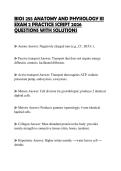
BIOS 255 ANATOMY AND PHYSIOLOGY III
EXAM 2 PRACTICE SCRIPT 2026
QUESTIONS WITH SOLUTIONS
⫸ Anions Answer: Negatively charged ions (e.g., Cl⁻, HCO₃⁻).
⫸ Passive transport Answer: Transport that does not require energy:
diffusion, osmosis, facilitated diffusion.
⫸ Active transport Answer: Transport that requires ATP: sodium-
potassium pump, endocytosis, exocytosis.
⫸ Mitosis Answer: Cell division for growth/repair; produces 2 identical
diploid cells.
⫸ Meiosis Answer: Produces gametes (sperm/egg); 4 non-identical
haploid cells.
⫸ Collagen Answer: Most abundant protein in the body; provides
tensile strength to connective tissues (skin, bones, tendons).
⫸ Hypertonic Answer: Higher solute outside → water leaves cell →
shrinks.
, ⫸ Hypotonic Answer: Lower solute outside → water enters cell →
swells/bursts.
⫸ Stratum Basale Answer: Deepest layer of the epidermis; contains
melanocytes: produce melanin for skin pigment and UV protection.
⫸ Eccrine glands Answer: Produce watery sweat (thermoregulation).
⫸ Apocrine glands Answer: Produce thicker secretion (stress,
armpits/genitals).
⫸ Osteoblast Answer: Builds bone.
⫸ Osteocyte Answer: Maintains bone.
⫸ Osteoclast Answer: Breaks down bone.
⫸ Metaphysis Answer: Contains growth plate (epiphyseal plate).
⫸ Epiphysis Answer: End of long bones; forms joints.
⫸ Axial Skeleton Answer: Includes skull, vertebrae, ribs, sternum.
EXAM 2 PRACTICE SCRIPT 2026
QUESTIONS WITH SOLUTIONS
⫸ Anions Answer: Negatively charged ions (e.g., Cl⁻, HCO₃⁻).
⫸ Passive transport Answer: Transport that does not require energy:
diffusion, osmosis, facilitated diffusion.
⫸ Active transport Answer: Transport that requires ATP: sodium-
potassium pump, endocytosis, exocytosis.
⫸ Mitosis Answer: Cell division for growth/repair; produces 2 identical
diploid cells.
⫸ Meiosis Answer: Produces gametes (sperm/egg); 4 non-identical
haploid cells.
⫸ Collagen Answer: Most abundant protein in the body; provides
tensile strength to connective tissues (skin, bones, tendons).
⫸ Hypertonic Answer: Higher solute outside → water leaves cell →
shrinks.
, ⫸ Hypotonic Answer: Lower solute outside → water enters cell →
swells/bursts.
⫸ Stratum Basale Answer: Deepest layer of the epidermis; contains
melanocytes: produce melanin for skin pigment and UV protection.
⫸ Eccrine glands Answer: Produce watery sweat (thermoregulation).
⫸ Apocrine glands Answer: Produce thicker secretion (stress,
armpits/genitals).
⫸ Osteoblast Answer: Builds bone.
⫸ Osteocyte Answer: Maintains bone.
⫸ Osteoclast Answer: Breaks down bone.
⫸ Metaphysis Answer: Contains growth plate (epiphyseal plate).
⫸ Epiphysis Answer: End of long bones; forms joints.
⫸ Axial Skeleton Answer: Includes skull, vertebrae, ribs, sternum.