

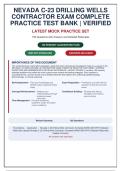
NEVADA C-23 DRILLING WELLS
CONTRACTOR EXAM COMPLETE
PRACTICE TEST BANK | VERIFIED
LATEST MOCK PRACTICE SET
150 Questions with Answers and Detailed Rationales
100 PERCENT GUARANTEED PASS
INSTANT DOWNLOAD ANSWERS INCLUDED
IMPORTANCE OF THIS DOCUMENT
This comprehensive examination preparation guide has been meticulously developed to help you succeed in the
NEVADA C-23 DRILLING WELLS CONTRACTOR EXAM COMPLETE PRACTICE TEST BANK | VERIFIED
QUESTIONS AND ANSWERS WITH DETAILED RATIONALES | LATEST UPDATE. It contains 150 carefully
selected questions that reflect the most current exam content and testing strategies. Each question is
accompanied by a correct answer and a detailed rationale that explains the underlying pathophysiology,
pharmacology, or clinical reasoning.
Self-Assessment – Test your knowledge and Exam Preparation – Familiarize yourself with the
identify areas requiring further question format and content
study areas
Concept Reinforcement – Deepen your Confidence Building – Develop test-taking
understanding through strategies and reduce
evidence-based exam anxiety
rationales
Time Management – Practice answering
questions under simulated
exam conditions
Review Summary 150 Questions
Foundations - Application - Nevada C-23 Drilling Wells Contractor Complete BANK AND WITH Detailed
Rationales Update Nevada C-23 Drilling Wells Contractor Complete BANK AND WITH Detailed Rationales
Update University
All answers with rationales
,Table of Contents
Section A - Drilling Equipment AND Section B - WELL Control AND
Operations Blowout Prevention
Questions 1 to 38 Questions 39 to 76
Section C - Drilling Fluids AND Section D - Casing AND Completion
Cementing Operations
Questions 77 to 114 Questions 115 to 150
,Section A - Drilling Equipment AND Operations
Q1.
During drilling, a sudden drop in mud pit volume and a decrease in pump pressure are
observed. Which condition is most likely occurring?
A. Lost circulation B. Kick
C. Pipe sticking D. Bit balling
Correct: A - Lost circulation
Rationale:Lost circulation is indicated by a drop in mud pit volume (mud escaping into
formations) and decreased pump pressure (less resistance). A kick would show increased pit
volume and pressure. Pipe sticking and bit balling do not directly reduce pit volume.
Q2.
A well is being drilled with a mud weight of 12 lb/gal. The formation fracture gradient at
the current depth is 14 lb/gal equivalent. What is the maximum allowable annular surface
pressure (MAASP) in psi if the well depth is 8,000 ft? (Assume 0.052 psi/ft per lb/gal
conversion.)
A. 832 psi B. 1,248 psi
C. 1,664 psi D. 2,080 psi
Correct: A - 832 psi
Rationale:MAASP = (Fracture gradient - Mud weight) × 0.052 × Depth = (14 - 12) × 0.052 ×
8000 = 2 × 0.052 × 8000 = 832 psi. Option B incorrectly uses (14-12)×0.052×6000. Option C
uses (14-10)×0.052×8000. Option D uses (14-12)×0.052×10000.
Q3.
Which factor most directly determines the selection of a cement slurry's thickening time
for a casing cementing job?
A. Compressive strength required B. Bottomhole circulating temperature
C. Mud displacement efficiency D. Cement slurry density
Correct: B - Bottomhole circulating temperature
Rationale:Thickening time is primarily set to allow safe placement before the slurry sets, and
bottomhole circulating temperature accelerates hydration. Compressive strength is a quality
measure, not a time determinant. Mud displacement and density affect placement but not the
thickening time requirement.
Page 3
, Section A - Drilling Equipment AND Operations
Q4.
In directional drilling, what is the primary advantage of using a positive displacement
motor (PDM) over a rotary steerable system (RSS) in a high-temperature well?
A. Higher dogleg capability B. Better tolerance to high temperatures
C. Lower cost per foot drilled D. Improved hole cleaning
Correct: B - Better tolerance to high temperatures
Rationale:PDMs have fewer electronic components and can withstand higher temperatures
than RSS, which rely on sensitive electronics. Dogleg capability can be high for both. Cost
per foot is not inherently lower for PDM. Hole cleaning depends on flow rates, not the steering
mechanism.
Q5.
A drilling fluid's yield point is measured at 15 lb/100 ft² and plastic viscosity at 25 cP.
Which property is most directly improved by adding a bentonite-based additive?
A. Yield point B. Plastic viscosity
C. Gel strength D. Density
Correct: A - Yield point
Rationale:Bentonite increases the yield point by enhancing the attractive forces between clay
particles. Plastic viscosity is more affected by solid content and size. Gel strength is related to
thixotropy, not directly to bentonite addition. Density is adjusted by weighting materials.
Q6.
During a drill stem test (DST), a flow period yields a stabilized pressure of 3,500 psi at the
gauge depth of 10,000 ft. The reservoir fluid gradient is 0.45 psi/ft. What is the approximate
formation pressure at the datum depth of 9,800 ft?
A. 3,410 psi B. 3,590 psi
C. 3,500 psi D. 3,410 psi
Correct: B - 3,590 psi
Rationale:Pressure at datum = Gauge pressure + (Gauge depth - Datum depth) × gradient =
3500 + (10000-9800)×0.45 = 3500 + 200×0.45 = 3500 + 90 = 3590 psi. Option A incorrectly
subtracts. Option C ignores depth correction. Option D is a miscalculation.
Page 4
CONTRACTOR EXAM COMPLETE
PRACTICE TEST BANK | VERIFIED
LATEST MOCK PRACTICE SET
150 Questions with Answers and Detailed Rationales
100 PERCENT GUARANTEED PASS
INSTANT DOWNLOAD ANSWERS INCLUDED
IMPORTANCE OF THIS DOCUMENT
This comprehensive examination preparation guide has been meticulously developed to help you succeed in the
NEVADA C-23 DRILLING WELLS CONTRACTOR EXAM COMPLETE PRACTICE TEST BANK | VERIFIED
QUESTIONS AND ANSWERS WITH DETAILED RATIONALES | LATEST UPDATE. It contains 150 carefully
selected questions that reflect the most current exam content and testing strategies. Each question is
accompanied by a correct answer and a detailed rationale that explains the underlying pathophysiology,
pharmacology, or clinical reasoning.
Self-Assessment – Test your knowledge and Exam Preparation – Familiarize yourself with the
identify areas requiring further question format and content
study areas
Concept Reinforcement – Deepen your Confidence Building – Develop test-taking
understanding through strategies and reduce
evidence-based exam anxiety
rationales
Time Management – Practice answering
questions under simulated
exam conditions
Review Summary 150 Questions
Foundations - Application - Nevada C-23 Drilling Wells Contractor Complete BANK AND WITH Detailed
Rationales Update Nevada C-23 Drilling Wells Contractor Complete BANK AND WITH Detailed Rationales
Update University
All answers with rationales
,Table of Contents
Section A - Drilling Equipment AND Section B - WELL Control AND
Operations Blowout Prevention
Questions 1 to 38 Questions 39 to 76
Section C - Drilling Fluids AND Section D - Casing AND Completion
Cementing Operations
Questions 77 to 114 Questions 115 to 150
,Section A - Drilling Equipment AND Operations
Q1.
During drilling, a sudden drop in mud pit volume and a decrease in pump pressure are
observed. Which condition is most likely occurring?
A. Lost circulation B. Kick
C. Pipe sticking D. Bit balling
Correct: A - Lost circulation
Rationale:Lost circulation is indicated by a drop in mud pit volume (mud escaping into
formations) and decreased pump pressure (less resistance). A kick would show increased pit
volume and pressure. Pipe sticking and bit balling do not directly reduce pit volume.
Q2.
A well is being drilled with a mud weight of 12 lb/gal. The formation fracture gradient at
the current depth is 14 lb/gal equivalent. What is the maximum allowable annular surface
pressure (MAASP) in psi if the well depth is 8,000 ft? (Assume 0.052 psi/ft per lb/gal
conversion.)
A. 832 psi B. 1,248 psi
C. 1,664 psi D. 2,080 psi
Correct: A - 832 psi
Rationale:MAASP = (Fracture gradient - Mud weight) × 0.052 × Depth = (14 - 12) × 0.052 ×
8000 = 2 × 0.052 × 8000 = 832 psi. Option B incorrectly uses (14-12)×0.052×6000. Option C
uses (14-10)×0.052×8000. Option D uses (14-12)×0.052×10000.
Q3.
Which factor most directly determines the selection of a cement slurry's thickening time
for a casing cementing job?
A. Compressive strength required B. Bottomhole circulating temperature
C. Mud displacement efficiency D. Cement slurry density
Correct: B - Bottomhole circulating temperature
Rationale:Thickening time is primarily set to allow safe placement before the slurry sets, and
bottomhole circulating temperature accelerates hydration. Compressive strength is a quality
measure, not a time determinant. Mud displacement and density affect placement but not the
thickening time requirement.
Page 3
, Section A - Drilling Equipment AND Operations
Q4.
In directional drilling, what is the primary advantage of using a positive displacement
motor (PDM) over a rotary steerable system (RSS) in a high-temperature well?
A. Higher dogleg capability B. Better tolerance to high temperatures
C. Lower cost per foot drilled D. Improved hole cleaning
Correct: B - Better tolerance to high temperatures
Rationale:PDMs have fewer electronic components and can withstand higher temperatures
than RSS, which rely on sensitive electronics. Dogleg capability can be high for both. Cost
per foot is not inherently lower for PDM. Hole cleaning depends on flow rates, not the steering
mechanism.
Q5.
A drilling fluid's yield point is measured at 15 lb/100 ft² and plastic viscosity at 25 cP.
Which property is most directly improved by adding a bentonite-based additive?
A. Yield point B. Plastic viscosity
C. Gel strength D. Density
Correct: A - Yield point
Rationale:Bentonite increases the yield point by enhancing the attractive forces between clay
particles. Plastic viscosity is more affected by solid content and size. Gel strength is related to
thixotropy, not directly to bentonite addition. Density is adjusted by weighting materials.
Q6.
During a drill stem test (DST), a flow period yields a stabilized pressure of 3,500 psi at the
gauge depth of 10,000 ft. The reservoir fluid gradient is 0.45 psi/ft. What is the approximate
formation pressure at the datum depth of 9,800 ft?
A. 3,410 psi B. 3,590 psi
C. 3,500 psi D. 3,410 psi
Correct: B - 3,590 psi
Rationale:Pressure at datum = Gauge pressure + (Gauge depth - Datum depth) × gradient =
3500 + (10000-9800)×0.45 = 3500 + 200×0.45 = 3500 + 90 = 3590 psi. Option A incorrectly
subtracts. Option C ignores depth correction. Option D is a miscalculation.
Page 4


