

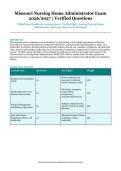
Missouri Nursing Home Administrator Exam
2026/2027 | Verified Questions
Official State Healthcare Licensing Board | Verified Q&A | Aspiring Nursing Home
Administrators and Long-Term Care Professionals
Introduction
This original practice examination covers Resident Care and Quality of Life, Facility Operations and Physical
Environment, Financial Management and Business Operations, and State and Federal Regulations, Ethics, and
Leadership. It reinforces licensing objectives through resident-centered care, regulatory compliance, physical-plant
safety, financial stewardship, quality improvement, and ethical leadership to support exam readiness and academic
success. “Verified” means internally reviewed against the cited sources and does not imply endorsement by the
Missouri Board of Nursing Home Administrators, DHSS, CMS, NAB, or another body. No study product can
guarantee licensure or a passing score. Rules change; candidates must consult current official Missouri and federal
sources.
Content Area Overview
Content Area Questions Key Topics Weight
Person-centered care,
Resident Care and Quality
25 assessment, infection 25%
of Life
control, nutrition, QAPI
Life safety, emergency
Facility Operations and preparedness,
25 25%
Physical Environment maintenance,
environmental services
Budgets, reimbursement,
Financial Management
25 payroll, controls, strategic 25%
and Business Operations
planning
State and Federal Missouri licensure, federal
Regulations, Ethics, and 25 compliance, ethics, 25%
Leadership leadership
Missouri Nursing Home Administrator Exam 2026/2027
,Domain: Resident Care and Quality of Life
1. Which statement most accurately describes person-centered care in Missouri long-term care
administration?
A. Care should reflect each resident’s goals, routines, culture, preferences, strengths, and informed choices
rather than forcing institutional convenience.
B. The facility provides needed care and services to maintain or improve abilities in bathing, dressing, grooming,
mobility, eating, toileting, and communication.
C. Nonpharmacologic approaches first examine pain, environment, communication, unmet needs, and triggers
before treating behavior as a medication problem.
D. Dietary services provide nourishing, palatable food that meets assessed needs and preferences, with
assistance and substitutions when appropriate.
Answer: A
Rationale: Care should reflect each resident’s goals, routines, culture, preferences, strengths, and informed
choices rather than forcing institutional convenience. This reflects standard long-term care administration
principles; administrators should verify the current Missouri rule, federal requirement, and facility-specific
policy before application.
2. Which statement most accurately describes comprehensive assessment in Missouri long-term
care administration?
A. Each medication must have an adequate indication, dose, duration, monitoring plan, and response to adverse
effects or clinically significant conditions.
B. An allegation requires immediate resident protection, reporting through required channels, prompt
investigation, evidence preservation, and corrective action.
C. Unplanned weight loss prompts assessment of intake, swallowing, disease, medication, mood, oral health,
assistance, preferences, and goals of care.
D. The interdisciplinary team uses a comprehensive, accurate assessment to identify needs, risks, strengths, and
preferences and to support the care plan.
Answer: D
Rationale: The interdisciplinary team uses a comprehensive, accurate assessment to identify needs, risks,
strengths, and preferences and to support the care plan. This reflects standard long-term care administration
principles; administrators should verify the current Missouri rule, federal requirement, and facility-specific
policy before application.
3. Which statement most accurately describes baseline care plan in Missouri long-term care
administration?
A. Psychotropic use requires documented clinical rationale, monitoring, and applicable gradual dose reduction
and behavioral-intervention efforts unless contraindicated.
B. The facility maintains a system for surveillance, prevention, reporting, investigation, and control of infections
and communicable diseases.
C. A baseline plan provides immediate instructions needed to deliver effective, person-centered care before the
comprehensive plan is completed.
D. Residents are offered sufficient fluids consistent with clinical needs and preferences, and dehydration risk is
monitored and addressed.
Answer: C
Rationale: A baseline plan provides immediate instructions needed to deliver effective, person-centered care
before the comprehensive plan is completed. This reflects standard long-term care administration principles;
administrators should verify the current Missouri rule, federal requirement, and facility-specific policy before
application.
4. Which statement most accurately describes comprehensive care plan in Missouri long-term care
administration?
A. Pain assessment considers resident report, function, goals, cognition, nonverbal signs, interventions, and
reassessment of effectiveness.
B. The plan establishes measurable objectives and timeframes and identifies services addressing needs found in
the assessment.
C. Hand hygiene is performed at indicated moments using soap and water or alcohol-based hand rub as
appropriate to organism, exposure, and task.
D. QAPI combines quality assurance and performance improvement through leadership, systematic data use,
feedback, projects, root-cause analysis, and sustained improvement.
Answer: B
Missouri Nursing Home Administrator Exam 2026/2027
,Rationale: The plan establishes measurable objectives and timeframes and identifies services addressing needs
found in the assessment. This reflects standard long-term care administration principles; administrators should
verify the current Missouri rule, federal requirement, and facility-specific policy before application.
5. Which statement most accurately describes resident participation in planning in Missouri long-
term care administration?
A. The resident and representative, when applicable, must be given a meaningful opportunity to participate in
care planning and decisions.
B. An individualized fall plan addresses modifiable risks while preserving mobility, dignity, and the least
restrictive environment.
C. Additional precautions are selected for the suspected or confirmed pathogen and balanced with resident
safety, dignity, and quality of life.
D. Root-cause analysis examines system contributors rather than stopping at individual blame and supports
corrective actions matched to causes.
Answer: A
Rationale: The resident and representative, when applicable, must be given a meaningful opportunity to
participate in care planning and decisions. This reflects standard long-term care administration principles;
administrators should verify the current Missouri rule, federal requirement, and facility-specific policy before
application.
6. Which statement most accurately describes significant change assessment in Missouri long-term
care administration?
A. Risk assessment, skin inspection, repositioning, moisture management, nutrition, mobility, and pressure
redistribution are individualized and evaluated.
B. A stewardship program uses protocols, monitoring, feedback, and leadership accountability to improve
antibiotic prescribing and limit resistance and harm.
C. Residents may voice grievances without retaliation and must receive prompt efforts toward resolution,
documentation, and required follow-up.
D. A major decline or improvement not expected to resolve normally prompts timely reassessment and revision
of the care plan.
Answer: D
Rationale: A major decline or improvement not expected to resolve normally prompts timely reassessment and
revision of the care plan. This reflects standard long-term care administration principles; administrators should
verify the current Missouri rule, federal requirement, and facility-specific policy before application.
7. Which statement most accurately describes activities of daily living in Missouri long-term care
administration?
A. Physical or chemical restraints may not be used for discipline or convenience and require a valid clinical basis
consistent with resident rights.
B. Dietary services provide nourishing, palatable food that meets assessed needs and preferences, with
assistance and substitutions when appropriate.
C. The facility provides needed care and services to maintain or improve abilities in bathing, dressing, grooming,
mobility, eating, toileting, and communication.
D. Care should reflect each resident’s goals, routines, culture, preferences, strengths, and informed choices
rather than forcing institutional convenience.
Answer: C
Rationale: The facility provides needed care and services to maintain or improve abilities in bathing, dressing,
grooming, mobility, eating, toileting, and communication. This reflects standard long-term care administration
principles; administrators should verify the current Missouri rule, federal requirement, and facility-specific
policy before application.
8. Which statement most accurately describes unnecessary drugs in Missouri long-term care
administration?
A. Nonpharmacologic approaches first examine pain, environment, communication, unmet needs, and triggers
before treating behavior as a medication problem.
B. Each medication must have an adequate indication, dose, duration, monitoring plan, and response to adverse
effects or clinically significant conditions.
C. Unplanned weight loss prompts assessment of intake, swallowing, disease, medication, mood, oral health,
assistance, preferences, and goals of care.
D. The interdisciplinary team uses a comprehensive, accurate assessment to identify needs, risks, strengths, and
preferences and to support the care plan.
Missouri Nursing Home Administrator Exam 2026/2027
, Answer: B
Rationale: Each medication must have an adequate indication, dose, duration, monitoring plan, and response to
adverse effects or clinically significant conditions. This reflects standard long-term care administration
principles; administrators should verify the current Missouri rule, federal requirement, and facility-specific
policy before application.
9. Which statement most accurately describes psychotropic medication review in Missouri long-
term care administration?
A. Psychotropic use requires documented clinical rationale, monitoring, and applicable gradual dose reduction
and behavioral-intervention efforts unless contraindicated.
B. An allegation requires immediate resident protection, reporting through required channels, prompt
investigation, evidence preservation, and corrective action.
C. Residents are offered sufficient fluids consistent with clinical needs and preferences, and dehydration risk is
monitored and addressed.
D. A baseline plan provides immediate instructions needed to deliver effective, person-centered care before the
comprehensive plan is completed.
Answer: A
Rationale: Psychotropic use requires documented clinical rationale, monitoring, and applicable gradual dose
reduction and behavioral-intervention efforts unless contraindicated. This reflects standard long-term care
administration principles; administrators should verify the current Missouri rule, federal requirement, and
facility-specific policy before application.
10. Which statement most accurately describes pain management in Missouri long-term care
administration?
A. The facility maintains a system for surveillance, prevention, reporting, investigation, and control of infections
and communicable diseases.
B. QAPI combines quality assurance and performance improvement through leadership, systematic data use,
feedback, projects, root-cause analysis, and sustained improvement.
C. The plan establishes measurable objectives and timeframes and identifies services addressing needs found in
the assessment.
D. Pain assessment considers resident report, function, goals, cognition, nonverbal signs, interventions, and
reassessment of effectiveness.
Answer: D
Rationale: Pain assessment considers resident report, function, goals, cognition, nonverbal signs, interventions,
and reassessment of effectiveness. This reflects standard long-term care administration principles;
administrators should verify the current Missouri rule, federal requirement, and facility-specific policy before
application.
11. Which statement most accurately describes fall prevention in Missouri long-term care
administration?
A. Hand hygiene is performed at indicated moments using soap and water or alcohol-based hand rub as
appropriate to organism, exposure, and task.
B. Root-cause analysis examines system contributors rather than stopping at individual blame and supports
corrective actions matched to causes.
C. An individualized fall plan addresses modifiable risks while preserving mobility, dignity, and the least
restrictive environment.
D. The resident and representative, when applicable, must be given a meaningful opportunity to participate in
care planning and decisions.
Answer: C
Rationale: An individualized fall plan addresses modifiable risks while preserving mobility, dignity, and the least
restrictive environment. This reflects standard long-term care administration principles; administrators should
verify the current Missouri rule, federal requirement, and facility-specific policy before application.
12. Which statement most accurately describes pressure injury prevention in Missouri long-term
care administration?
A. Additional precautions are selected for the suspected or confirmed pathogen and balanced with resident
safety, dignity, and quality of life.
B. Risk assessment, skin inspection, repositioning, moisture management, nutrition, mobility, and pressure
redistribution are individualized and evaluated.
C. Residents may voice grievances without retaliation and must receive prompt efforts toward resolution,
documentation, and required follow-up.
Missouri Nursing Home Administrator Exam 2026/2027
2026/2027 | Verified Questions
Official State Healthcare Licensing Board | Verified Q&A | Aspiring Nursing Home
Administrators and Long-Term Care Professionals
Introduction
This original practice examination covers Resident Care and Quality of Life, Facility Operations and Physical
Environment, Financial Management and Business Operations, and State and Federal Regulations, Ethics, and
Leadership. It reinforces licensing objectives through resident-centered care, regulatory compliance, physical-plant
safety, financial stewardship, quality improvement, and ethical leadership to support exam readiness and academic
success. “Verified” means internally reviewed against the cited sources and does not imply endorsement by the
Missouri Board of Nursing Home Administrators, DHSS, CMS, NAB, or another body. No study product can
guarantee licensure or a passing score. Rules change; candidates must consult current official Missouri and federal
sources.
Content Area Overview
Content Area Questions Key Topics Weight
Person-centered care,
Resident Care and Quality
25 assessment, infection 25%
of Life
control, nutrition, QAPI
Life safety, emergency
Facility Operations and preparedness,
25 25%
Physical Environment maintenance,
environmental services
Budgets, reimbursement,
Financial Management
25 payroll, controls, strategic 25%
and Business Operations
planning
State and Federal Missouri licensure, federal
Regulations, Ethics, and 25 compliance, ethics, 25%
Leadership leadership
Missouri Nursing Home Administrator Exam 2026/2027
,Domain: Resident Care and Quality of Life
1. Which statement most accurately describes person-centered care in Missouri long-term care
administration?
A. Care should reflect each resident’s goals, routines, culture, preferences, strengths, and informed choices
rather than forcing institutional convenience.
B. The facility provides needed care and services to maintain or improve abilities in bathing, dressing, grooming,
mobility, eating, toileting, and communication.
C. Nonpharmacologic approaches first examine pain, environment, communication, unmet needs, and triggers
before treating behavior as a medication problem.
D. Dietary services provide nourishing, palatable food that meets assessed needs and preferences, with
assistance and substitutions when appropriate.
Answer: A
Rationale: Care should reflect each resident’s goals, routines, culture, preferences, strengths, and informed
choices rather than forcing institutional convenience. This reflects standard long-term care administration
principles; administrators should verify the current Missouri rule, federal requirement, and facility-specific
policy before application.
2. Which statement most accurately describes comprehensive assessment in Missouri long-term
care administration?
A. Each medication must have an adequate indication, dose, duration, monitoring plan, and response to adverse
effects or clinically significant conditions.
B. An allegation requires immediate resident protection, reporting through required channels, prompt
investigation, evidence preservation, and corrective action.
C. Unplanned weight loss prompts assessment of intake, swallowing, disease, medication, mood, oral health,
assistance, preferences, and goals of care.
D. The interdisciplinary team uses a comprehensive, accurate assessment to identify needs, risks, strengths, and
preferences and to support the care plan.
Answer: D
Rationale: The interdisciplinary team uses a comprehensive, accurate assessment to identify needs, risks,
strengths, and preferences and to support the care plan. This reflects standard long-term care administration
principles; administrators should verify the current Missouri rule, federal requirement, and facility-specific
policy before application.
3. Which statement most accurately describes baseline care plan in Missouri long-term care
administration?
A. Psychotropic use requires documented clinical rationale, monitoring, and applicable gradual dose reduction
and behavioral-intervention efforts unless contraindicated.
B. The facility maintains a system for surveillance, prevention, reporting, investigation, and control of infections
and communicable diseases.
C. A baseline plan provides immediate instructions needed to deliver effective, person-centered care before the
comprehensive plan is completed.
D. Residents are offered sufficient fluids consistent with clinical needs and preferences, and dehydration risk is
monitored and addressed.
Answer: C
Rationale: A baseline plan provides immediate instructions needed to deliver effective, person-centered care
before the comprehensive plan is completed. This reflects standard long-term care administration principles;
administrators should verify the current Missouri rule, federal requirement, and facility-specific policy before
application.
4. Which statement most accurately describes comprehensive care plan in Missouri long-term care
administration?
A. Pain assessment considers resident report, function, goals, cognition, nonverbal signs, interventions, and
reassessment of effectiveness.
B. The plan establishes measurable objectives and timeframes and identifies services addressing needs found in
the assessment.
C. Hand hygiene is performed at indicated moments using soap and water or alcohol-based hand rub as
appropriate to organism, exposure, and task.
D. QAPI combines quality assurance and performance improvement through leadership, systematic data use,
feedback, projects, root-cause analysis, and sustained improvement.
Answer: B
Missouri Nursing Home Administrator Exam 2026/2027
,Rationale: The plan establishes measurable objectives and timeframes and identifies services addressing needs
found in the assessment. This reflects standard long-term care administration principles; administrators should
verify the current Missouri rule, federal requirement, and facility-specific policy before application.
5. Which statement most accurately describes resident participation in planning in Missouri long-
term care administration?
A. The resident and representative, when applicable, must be given a meaningful opportunity to participate in
care planning and decisions.
B. An individualized fall plan addresses modifiable risks while preserving mobility, dignity, and the least
restrictive environment.
C. Additional precautions are selected for the suspected or confirmed pathogen and balanced with resident
safety, dignity, and quality of life.
D. Root-cause analysis examines system contributors rather than stopping at individual blame and supports
corrective actions matched to causes.
Answer: A
Rationale: The resident and representative, when applicable, must be given a meaningful opportunity to
participate in care planning and decisions. This reflects standard long-term care administration principles;
administrators should verify the current Missouri rule, federal requirement, and facility-specific policy before
application.
6. Which statement most accurately describes significant change assessment in Missouri long-term
care administration?
A. Risk assessment, skin inspection, repositioning, moisture management, nutrition, mobility, and pressure
redistribution are individualized and evaluated.
B. A stewardship program uses protocols, monitoring, feedback, and leadership accountability to improve
antibiotic prescribing and limit resistance and harm.
C. Residents may voice grievances without retaliation and must receive prompt efforts toward resolution,
documentation, and required follow-up.
D. A major decline or improvement not expected to resolve normally prompts timely reassessment and revision
of the care plan.
Answer: D
Rationale: A major decline or improvement not expected to resolve normally prompts timely reassessment and
revision of the care plan. This reflects standard long-term care administration principles; administrators should
verify the current Missouri rule, federal requirement, and facility-specific policy before application.
7. Which statement most accurately describes activities of daily living in Missouri long-term care
administration?
A. Physical or chemical restraints may not be used for discipline or convenience and require a valid clinical basis
consistent with resident rights.
B. Dietary services provide nourishing, palatable food that meets assessed needs and preferences, with
assistance and substitutions when appropriate.
C. The facility provides needed care and services to maintain or improve abilities in bathing, dressing, grooming,
mobility, eating, toileting, and communication.
D. Care should reflect each resident’s goals, routines, culture, preferences, strengths, and informed choices
rather than forcing institutional convenience.
Answer: C
Rationale: The facility provides needed care and services to maintain or improve abilities in bathing, dressing,
grooming, mobility, eating, toileting, and communication. This reflects standard long-term care administration
principles; administrators should verify the current Missouri rule, federal requirement, and facility-specific
policy before application.
8. Which statement most accurately describes unnecessary drugs in Missouri long-term care
administration?
A. Nonpharmacologic approaches first examine pain, environment, communication, unmet needs, and triggers
before treating behavior as a medication problem.
B. Each medication must have an adequate indication, dose, duration, monitoring plan, and response to adverse
effects or clinically significant conditions.
C. Unplanned weight loss prompts assessment of intake, swallowing, disease, medication, mood, oral health,
assistance, preferences, and goals of care.
D. The interdisciplinary team uses a comprehensive, accurate assessment to identify needs, risks, strengths, and
preferences and to support the care plan.
Missouri Nursing Home Administrator Exam 2026/2027
, Answer: B
Rationale: Each medication must have an adequate indication, dose, duration, monitoring plan, and response to
adverse effects or clinically significant conditions. This reflects standard long-term care administration
principles; administrators should verify the current Missouri rule, federal requirement, and facility-specific
policy before application.
9. Which statement most accurately describes psychotropic medication review in Missouri long-
term care administration?
A. Psychotropic use requires documented clinical rationale, monitoring, and applicable gradual dose reduction
and behavioral-intervention efforts unless contraindicated.
B. An allegation requires immediate resident protection, reporting through required channels, prompt
investigation, evidence preservation, and corrective action.
C. Residents are offered sufficient fluids consistent with clinical needs and preferences, and dehydration risk is
monitored and addressed.
D. A baseline plan provides immediate instructions needed to deliver effective, person-centered care before the
comprehensive plan is completed.
Answer: A
Rationale: Psychotropic use requires documented clinical rationale, monitoring, and applicable gradual dose
reduction and behavioral-intervention efforts unless contraindicated. This reflects standard long-term care
administration principles; administrators should verify the current Missouri rule, federal requirement, and
facility-specific policy before application.
10. Which statement most accurately describes pain management in Missouri long-term care
administration?
A. The facility maintains a system for surveillance, prevention, reporting, investigation, and control of infections
and communicable diseases.
B. QAPI combines quality assurance and performance improvement through leadership, systematic data use,
feedback, projects, root-cause analysis, and sustained improvement.
C. The plan establishes measurable objectives and timeframes and identifies services addressing needs found in
the assessment.
D. Pain assessment considers resident report, function, goals, cognition, nonverbal signs, interventions, and
reassessment of effectiveness.
Answer: D
Rationale: Pain assessment considers resident report, function, goals, cognition, nonverbal signs, interventions,
and reassessment of effectiveness. This reflects standard long-term care administration principles;
administrators should verify the current Missouri rule, federal requirement, and facility-specific policy before
application.
11. Which statement most accurately describes fall prevention in Missouri long-term care
administration?
A. Hand hygiene is performed at indicated moments using soap and water or alcohol-based hand rub as
appropriate to organism, exposure, and task.
B. Root-cause analysis examines system contributors rather than stopping at individual blame and supports
corrective actions matched to causes.
C. An individualized fall plan addresses modifiable risks while preserving mobility, dignity, and the least
restrictive environment.
D. The resident and representative, when applicable, must be given a meaningful opportunity to participate in
care planning and decisions.
Answer: C
Rationale: An individualized fall plan addresses modifiable risks while preserving mobility, dignity, and the least
restrictive environment. This reflects standard long-term care administration principles; administrators should
verify the current Missouri rule, federal requirement, and facility-specific policy before application.
12. Which statement most accurately describes pressure injury prevention in Missouri long-term
care administration?
A. Additional precautions are selected for the suspected or confirmed pathogen and balanced with resident
safety, dignity, and quality of life.
B. Risk assessment, skin inspection, repositioning, moisture management, nutrition, mobility, and pressure
redistribution are individualized and evaluated.
C. Residents may voice grievances without retaliation and must receive prompt efforts toward resolution,
documentation, and required follow-up.
Missouri Nursing Home Administrator Exam 2026/2027


