

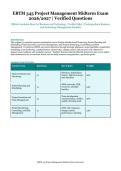
EBTM 343 Project Management Midterm Exam
2026/2027 | Verified Questions
Official Academic Board of Business and Technology | Verified Q&A | Undergraduate Business
and Technology Management Students
Introduction
This original 50-question practice examination covers Project Initiation and Chartering, Project Planning and
Scheduling, Project Execution and Team Management, and Project Monitoring, Controlling, and Risk
Management. It reinforces EBTM 343 course objectives through strategic alignment, scope discipline, quantitative
scheduling, team leadership, communication, earned value, change control, and proactive risk response to
support exam readiness and academic success. “Verified” denotes internal editorial and answer-key review rather
than endorsement by an academic board, and no study resource can guarantee a particular grade.
Content Area Overview
Content Area Questions Key Topics Weight
Selection, stakeholders,
Project Initiation and
13 charter, high-level scope 26%
Chartering
and objectives
WBS, networks, CPM,
Project Planning and
12 resources, schedule 24%
Scheduling
baseline
Team development,
Project Execution and
13 communication, conflict, 26%
Team Management
quality, directing work
Project Monitoring, EVM, risk responses,
Controlling, and Risk 12 change control, 24%
Management performance reporting
EBTM 343 Project Management Midterm Exam 2026/2027
, Domain: Project Initiation and Chartering
1. A steering committee is comparing proposed projects. Which criterion best demonstrates
strategic alignment?
A. The project uses the newest software
B. The project directly supports a documented organizational objective
C. The project has the longest schedule
D. The sponsor prefers the project’s title
Answer: B
Rationale: Strategic alignment exists when expected outcomes advance stated organizational goals; novelty or
personal preference alone does not establish alignment.
2. Two equally risky projects require the same investment. Project A has an NPV of $80,000 and
Project B has an NPV of $45,000. Based only on NPV, which should be selected?
A. Project A
B. Project B
C. Both are financially identical
D. Neither, because positive NPV is undesirable
Answer: A
Rationale: A higher positive NPV indicates greater expected value in present-dollar terms when other relevant
factors are equal.
3. What is a major limitation of using payback period alone to select a project?
A. It always includes qualitative benefits
B. It ignores cash flows after payback and may ignore the time value of money
C. It can be used only for government projects
D. It always favors the highest NPV
Answer: B
Rationale: Simple payback emphasizes how quickly the initial investment is recovered but can overlook later
benefits and discounting.
4. Which document most directly explains why a proposed project should be undertaken by
comparing expected benefits, costs, and alternatives?
A. Risk register
B. Business case
C. Team charter
D. Issue log
Answer: B
Rationale: The business case supports an investment decision by describing the need, options, expected value,
costs, risks, and strategic rationale.
5. Which activity is best classified as a project?
A. Processing payroll every two weeks
B. Operating a help desk continuously
C. Implementing a new inventory platform by September
D. Producing the same monthly report indefinitely
Answer: C
Rationale: A project is temporary and creates a unique product, service, or result; ongoing repetitive work is
operations.
6. What is the most important organizational effect of an approved project charter?
A. It replaces every subsidiary plan
B. It formally authorizes the project and the project manager’s use of resources
C. It guarantees all requested funding
D. It closes procurement contracts
Answer: B
Rationale: The charter formally authorizes the project and establishes the project manager’s authority within
stated constraints.
7. Which statement belongs in the charter as high-level scope?
A. Detailed work-package labor assignments
B. A summary of major deliverables and boundaries
EBTM 343 Project Management Midterm Exam 2026/2027
2026/2027 | Verified Questions
Official Academic Board of Business and Technology | Verified Q&A | Undergraduate Business
and Technology Management Students
Introduction
This original 50-question practice examination covers Project Initiation and Chartering, Project Planning and
Scheduling, Project Execution and Team Management, and Project Monitoring, Controlling, and Risk
Management. It reinforces EBTM 343 course objectives through strategic alignment, scope discipline, quantitative
scheduling, team leadership, communication, earned value, change control, and proactive risk response to
support exam readiness and academic success. “Verified” denotes internal editorial and answer-key review rather
than endorsement by an academic board, and no study resource can guarantee a particular grade.
Content Area Overview
Content Area Questions Key Topics Weight
Selection, stakeholders,
Project Initiation and
13 charter, high-level scope 26%
Chartering
and objectives
WBS, networks, CPM,
Project Planning and
12 resources, schedule 24%
Scheduling
baseline
Team development,
Project Execution and
13 communication, conflict, 26%
Team Management
quality, directing work
Project Monitoring, EVM, risk responses,
Controlling, and Risk 12 change control, 24%
Management performance reporting
EBTM 343 Project Management Midterm Exam 2026/2027
, Domain: Project Initiation and Chartering
1. A steering committee is comparing proposed projects. Which criterion best demonstrates
strategic alignment?
A. The project uses the newest software
B. The project directly supports a documented organizational objective
C. The project has the longest schedule
D. The sponsor prefers the project’s title
Answer: B
Rationale: Strategic alignment exists when expected outcomes advance stated organizational goals; novelty or
personal preference alone does not establish alignment.
2. Two equally risky projects require the same investment. Project A has an NPV of $80,000 and
Project B has an NPV of $45,000. Based only on NPV, which should be selected?
A. Project A
B. Project B
C. Both are financially identical
D. Neither, because positive NPV is undesirable
Answer: A
Rationale: A higher positive NPV indicates greater expected value in present-dollar terms when other relevant
factors are equal.
3. What is a major limitation of using payback period alone to select a project?
A. It always includes qualitative benefits
B. It ignores cash flows after payback and may ignore the time value of money
C. It can be used only for government projects
D. It always favors the highest NPV
Answer: B
Rationale: Simple payback emphasizes how quickly the initial investment is recovered but can overlook later
benefits and discounting.
4. Which document most directly explains why a proposed project should be undertaken by
comparing expected benefits, costs, and alternatives?
A. Risk register
B. Business case
C. Team charter
D. Issue log
Answer: B
Rationale: The business case supports an investment decision by describing the need, options, expected value,
costs, risks, and strategic rationale.
5. Which activity is best classified as a project?
A. Processing payroll every two weeks
B. Operating a help desk continuously
C. Implementing a new inventory platform by September
D. Producing the same monthly report indefinitely
Answer: C
Rationale: A project is temporary and creates a unique product, service, or result; ongoing repetitive work is
operations.
6. What is the most important organizational effect of an approved project charter?
A. It replaces every subsidiary plan
B. It formally authorizes the project and the project manager’s use of resources
C. It guarantees all requested funding
D. It closes procurement contracts
Answer: B
Rationale: The charter formally authorizes the project and establishes the project manager’s authority within
stated constraints.
7. Which statement belongs in the charter as high-level scope?
A. Detailed work-package labor assignments
B. A summary of major deliverables and boundaries
EBTM 343 Project Management Midterm Exam 2026/2027


