

TEAS 7 Comprehensive Academic Skills Exam
2026/2027 | Verified Questions
Official Academic Testing and Admissions Board | Verified Q&A | Prospective Nursing and
Allied Health Students
Introduction
This original practice examination covers Reading Comprehension and Informational Text, Applied Mathematics
and Numerical Reasoning, Science (Anatomy, Physiology, and Life/Physical Sciences), and English and Language
Usage. It reinforces academic-skills objectives through critical reading, quantitative accuracy, scientific literacy, and
effective written communication to support exam readiness and academic success. “Verified” denotes internal
editorial and answer-key review, not endorsement by ATI or any admissions board. No study resource can
guarantee admission, a passing score, or a particular academic result.
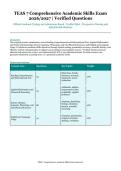
Content Area Overview
Content Area Questions Key Topics Weight
Main ideas, details,
Reading Comprehension inference, structure,
34 20%
and Informational Text arguments, source
evaluation
Arithmetic, algebra,
Applied Mathematics and measurement, data,
34 20%
Numerical Reasoning probability, applied
problems
Anatomy, physiology,
Science (Human
biology, chemistry,
Anatomy, Physiology, and 68 40%
physics, scientific
Life/Physical Sciences)
reasoning
Grammar, punctuation,
English and Language
34 sentence structure, 20%
Usage
spelling, vocabulary
TEAS 7 Comprehensive Academic Skills Exam 2026/2027
,Domain: Reading Comprehension and Informational Text
1. Read the passage: “A clinic replaced reminder postcards with text messages. Missed
appointments fell during the next three months, but the clinic also extended evening hours during
that period.”
Which statement best expresses the passage’s main idea?
A. Text reminders may have helped reduce missed appointments, although another change could also have
contributed.
B. Postcards are always ineffective.
C. Evening appointments cause missed visits.
D. The clinic proved that texting alone caused the decline.
Answer: A
Rationale: The passage reports an improvement but identifies a second simultaneous change, so causation cannot
be assigned to texting alone.
2. Read the passage: “A clinic replaced reminder postcards with text messages. Missed
appointments fell during the next three months, but the clinic also extended evening hours during
that period.”
Which detail prevents a firm conclusion that text reminders caused the decline?
A. The clinic once used postcards.
B. Evening hours were extended at the same time.
C. The study lasted three months.
D. Appointments were scheduled.
Answer: B
Rationale: The concurrent extension of evening hours is a confounding variable that could also explain fewer
missed visits.
3. Read the passage: “Mangrove roots slow coastal water, trap sediment, and provide shelter for
juvenile fish. When mangroves are removed, shorelines may erode more quickly and nursery
habitat declines.”
Which detail directly supports the claim that mangroves protect shorelines?
A. Their roots slow water and trap sediment.
B. Juvenile fish are small.
C. Coastlines contain salt water.
D. Some trees grow inland.
Answer: A
Rationale: Slower water and trapped sediment directly explain reduced erosion.
4. Read the passage: “Mangrove roots slow coastal water, trap sediment, and provide shelter for
juvenile fish. When mangroves are removed, shorelines may erode more quickly and nursery
habitat declines.”
According to the passage, what is one likely effect of mangrove removal?
A. Increased shoreline erosion
B. Lower ocean salinity everywhere
C. More trapped sediment
D. Immediate coral growth
Answer: A
Rationale: The passage explicitly links removal to faster erosion.
5. Read the passage: “The library will be closed Monday for electrical repairs. Digital resources will
remain available, and books due Monday may be returned Tuesday without penalty.”
What is the author’s primary purpose?
A. To entertain readers with a story
B. To inform patrons about a closure and accommodations
C. To argue against electrical repairs
D. To compare two libraries
Answer: B
Rationale: The notice communicates practical closure, access, and due-date information.
6. Read the passage: “The library will be closed Monday for electrical repairs. Digital resources will
remain available, and books due Monday may be returned Tuesday without penalty.”
Which action is permitted without penalty?
TEAS 7 Comprehensive Academic Skills Exam 2026/2027
, A. Returning a Monday-due book on Tuesday
B. Entering the building Monday
C. Keeping every book for another month
D. Requesting electrical work
Answer: A
Rationale: The notice explicitly grants a one-day return accommodation.
7. Read the passage: “First, rinse the quinoa. Next, combine one cup quinoa with two cups water.
Bring the mixture to a boil, cover it, and simmer for 15 minutes. Finally, remove it from heat and let
it stand for 5 minutes.”
What should occur immediately after the mixture reaches a boil?
A. Rinse the quinoa
B. Cover it and simmer
C. Let it stand uncovered for an hour
D. Add three more cups of water
Answer: B
Rationale: The procedure says to cover and simmer after boiling.
8. Read the passage: “First, rinse the quinoa. Next, combine one cup quinoa with two cups water.
Bring the mixture to a boil, cover it, and simmer for 15 minutes. Finally, remove it from heat and let
it stand for 5 minutes.”
Which organizational structure does the passage primarily use?
A. Chronological sequence
B. Problem and solution
C. Compare and contrast
D. Cause and effect only
Answer: A
Rationale: Signal words such as first, next, and finally organize ordered steps.
9. Read the passage: “Although rooftop gardens require structural planning and regular
maintenance, they can reduce storm-water runoff, insulate buildings, and create habitat for
pollinators.”
Which statement best describes the author’s viewpoint?
A. Rooftop gardens offer benefits despite practical challenges.
B. Rooftop gardens have no disadvantages.
C. All roofs must become gardens.
D. Pollinators damage buildings.
Answer: A
Rationale: The concessive opening acknowledges drawbacks before presenting several benefits.
10. Read the passage: “Although rooftop gardens require structural planning and regular
maintenance, they can reduce storm-water runoff, insulate buildings, and create habitat for
pollinators.”
What can reasonably be inferred?
A. A building should be evaluated before a rooftop garden is installed.
B. Every roof can carry unlimited weight.
C. Maintenance is unnecessary.
D. Storm water never reaches streets.
Answer: A
Rationale: The need for structural planning implies prior evaluation of the building.
11. Read the passage: “Survey: 120 commuters were asked how they traveled to work. Bus: 42; car:
36; bicycle: 24; walking: 18.”
Which mode was reported by the greatest number of commuters?
A. Bus
B. Car
C. Bicycle
D. Walking
Answer: A
Rationale: Forty-two is the largest reported count.
TEAS 7 Comprehensive Academic Skills Exam 2026/2027
, 12. Read the passage: “Survey: 120 commuters were asked how they traveled to work. Bus: 42; car:
36; bicycle: 24; walking: 18.”
How many more commuters used the bus than walked?
A. 18
B. 20
C. 24
D. 60
Answer: C
Rationale: Subtract 18 walkers from 42 bus riders to obtain 24.
13. Read the passage: “A columnist argues that the city should plant more shade trees because
shaded blocks measured lower afternoon surface temperatures. The measurements were taken on
six blocks during one sunny day.”
What is the columnist’s central claim?
A. The city should plant more shade trees.
B. All sunny days have identical temperatures.
C. Six blocks represent every neighborhood.
D. Surface temperature cannot be measured.
Answer: A
Rationale: The recommendation that the city plant trees is the claim; the temperature finding is evidence.
14. Read the passage: “A columnist argues that the city should plant more shade trees because
shaded blocks measured lower afternoon surface temperatures. The measurements were taken on
six blocks during one sunny day.”
Which limitation most weakens the generalization?
A. Measurements came from only six blocks on one day.
B. Trees produce shade.
C. The city has blocks.
D. Afternoon occurs after noon.
Answer: A
Rationale: A small sample and single-day measurement may not represent other locations or conditions.
15. Read the passage: “In the novel, Mara keeps a packed suitcase under her bed even after signing
a year-long lease. She tells friends she is settled, yet checks train schedules each morning.”
What does Mara’s behavior most strongly suggest?
A. She remains uncertain about staying.
B. She has forgotten how trains work.
C. She owns no furniture.
D. She enjoys packing for friends.
Answer: A
Rationale: The suitcase and repeated schedule checking conflict with her statement and imply uncertainty.
16. Read the passage: “In the novel, Mara keeps a packed suitcase under her bed even after signing
a year-long lease. She tells friends she is settled, yet checks train schedules each morning.”
Which word best describes the tone of the passage?
A. Uneasy
B. Celebratory
C. Comical
D. Indifferent
Answer: A
Rationale: The contradiction between claimed stability and readiness to leave creates uneasiness.
17. Read the passage: “Battery recycling prevents certain metals from entering landfills and can
recover materials for new products. However, batteries should not be placed in curbside bins
unless the local program specifically accepts them.”
Which sentence best summarizes the passage?
A. Battery recycling has benefits, but disposal instructions depend on local rules.
B. All batteries belong in curbside bins.
C. Landfills manufacture batteries.
D. Recycling never recovers materials.
Answer: A
TEAS 7 Comprehensive Academic Skills Exam 2026/2027
2026/2027 | Verified Questions
Official Academic Testing and Admissions Board | Verified Q&A | Prospective Nursing and
Allied Health Students
Introduction
This original practice examination covers Reading Comprehension and Informational Text, Applied Mathematics
and Numerical Reasoning, Science (Anatomy, Physiology, and Life/Physical Sciences), and English and Language
Usage. It reinforces academic-skills objectives through critical reading, quantitative accuracy, scientific literacy, and
effective written communication to support exam readiness and academic success. “Verified” denotes internal
editorial and answer-key review, not endorsement by ATI or any admissions board. No study resource can
guarantee admission, a passing score, or a particular academic result.
Content Area Overview
Content Area Questions Key Topics Weight
Main ideas, details,
Reading Comprehension inference, structure,
34 20%
and Informational Text arguments, source
evaluation
Arithmetic, algebra,
Applied Mathematics and measurement, data,
34 20%
Numerical Reasoning probability, applied
problems
Anatomy, physiology,
Science (Human
biology, chemistry,
Anatomy, Physiology, and 68 40%
physics, scientific
Life/Physical Sciences)
reasoning
Grammar, punctuation,
English and Language
34 sentence structure, 20%
Usage
spelling, vocabulary
TEAS 7 Comprehensive Academic Skills Exam 2026/2027
,Domain: Reading Comprehension and Informational Text
1. Read the passage: “A clinic replaced reminder postcards with text messages. Missed
appointments fell during the next three months, but the clinic also extended evening hours during
that period.”
Which statement best expresses the passage’s main idea?
A. Text reminders may have helped reduce missed appointments, although another change could also have
contributed.
B. Postcards are always ineffective.
C. Evening appointments cause missed visits.
D. The clinic proved that texting alone caused the decline.
Answer: A
Rationale: The passage reports an improvement but identifies a second simultaneous change, so causation cannot
be assigned to texting alone.
2. Read the passage: “A clinic replaced reminder postcards with text messages. Missed
appointments fell during the next three months, but the clinic also extended evening hours during
that period.”
Which detail prevents a firm conclusion that text reminders caused the decline?
A. The clinic once used postcards.
B. Evening hours were extended at the same time.
C. The study lasted three months.
D. Appointments were scheduled.
Answer: B
Rationale: The concurrent extension of evening hours is a confounding variable that could also explain fewer
missed visits.
3. Read the passage: “Mangrove roots slow coastal water, trap sediment, and provide shelter for
juvenile fish. When mangroves are removed, shorelines may erode more quickly and nursery
habitat declines.”
Which detail directly supports the claim that mangroves protect shorelines?
A. Their roots slow water and trap sediment.
B. Juvenile fish are small.
C. Coastlines contain salt water.
D. Some trees grow inland.
Answer: A
Rationale: Slower water and trapped sediment directly explain reduced erosion.
4. Read the passage: “Mangrove roots slow coastal water, trap sediment, and provide shelter for
juvenile fish. When mangroves are removed, shorelines may erode more quickly and nursery
habitat declines.”
According to the passage, what is one likely effect of mangrove removal?
A. Increased shoreline erosion
B. Lower ocean salinity everywhere
C. More trapped sediment
D. Immediate coral growth
Answer: A
Rationale: The passage explicitly links removal to faster erosion.
5. Read the passage: “The library will be closed Monday for electrical repairs. Digital resources will
remain available, and books due Monday may be returned Tuesday without penalty.”
What is the author’s primary purpose?
A. To entertain readers with a story
B. To inform patrons about a closure and accommodations
C. To argue against electrical repairs
D. To compare two libraries
Answer: B
Rationale: The notice communicates practical closure, access, and due-date information.
6. Read the passage: “The library will be closed Monday for electrical repairs. Digital resources will
remain available, and books due Monday may be returned Tuesday without penalty.”
Which action is permitted without penalty?
TEAS 7 Comprehensive Academic Skills Exam 2026/2027
, A. Returning a Monday-due book on Tuesday
B. Entering the building Monday
C. Keeping every book for another month
D. Requesting electrical work
Answer: A
Rationale: The notice explicitly grants a one-day return accommodation.
7. Read the passage: “First, rinse the quinoa. Next, combine one cup quinoa with two cups water.
Bring the mixture to a boil, cover it, and simmer for 15 minutes. Finally, remove it from heat and let
it stand for 5 minutes.”
What should occur immediately after the mixture reaches a boil?
A. Rinse the quinoa
B. Cover it and simmer
C. Let it stand uncovered for an hour
D. Add three more cups of water
Answer: B
Rationale: The procedure says to cover and simmer after boiling.
8. Read the passage: “First, rinse the quinoa. Next, combine one cup quinoa with two cups water.
Bring the mixture to a boil, cover it, and simmer for 15 minutes. Finally, remove it from heat and let
it stand for 5 minutes.”
Which organizational structure does the passage primarily use?
A. Chronological sequence
B. Problem and solution
C. Compare and contrast
D. Cause and effect only
Answer: A
Rationale: Signal words such as first, next, and finally organize ordered steps.
9. Read the passage: “Although rooftop gardens require structural planning and regular
maintenance, they can reduce storm-water runoff, insulate buildings, and create habitat for
pollinators.”
Which statement best describes the author’s viewpoint?
A. Rooftop gardens offer benefits despite practical challenges.
B. Rooftop gardens have no disadvantages.
C. All roofs must become gardens.
D. Pollinators damage buildings.
Answer: A
Rationale: The concessive opening acknowledges drawbacks before presenting several benefits.
10. Read the passage: “Although rooftop gardens require structural planning and regular
maintenance, they can reduce storm-water runoff, insulate buildings, and create habitat for
pollinators.”
What can reasonably be inferred?
A. A building should be evaluated before a rooftop garden is installed.
B. Every roof can carry unlimited weight.
C. Maintenance is unnecessary.
D. Storm water never reaches streets.
Answer: A
Rationale: The need for structural planning implies prior evaluation of the building.
11. Read the passage: “Survey: 120 commuters were asked how they traveled to work. Bus: 42; car:
36; bicycle: 24; walking: 18.”
Which mode was reported by the greatest number of commuters?
A. Bus
B. Car
C. Bicycle
D. Walking
Answer: A
Rationale: Forty-two is the largest reported count.
TEAS 7 Comprehensive Academic Skills Exam 2026/2027
, 12. Read the passage: “Survey: 120 commuters were asked how they traveled to work. Bus: 42; car:
36; bicycle: 24; walking: 18.”
How many more commuters used the bus than walked?
A. 18
B. 20
C. 24
D. 60
Answer: C
Rationale: Subtract 18 walkers from 42 bus riders to obtain 24.
13. Read the passage: “A columnist argues that the city should plant more shade trees because
shaded blocks measured lower afternoon surface temperatures. The measurements were taken on
six blocks during one sunny day.”
What is the columnist’s central claim?
A. The city should plant more shade trees.
B. All sunny days have identical temperatures.
C. Six blocks represent every neighborhood.
D. Surface temperature cannot be measured.
Answer: A
Rationale: The recommendation that the city plant trees is the claim; the temperature finding is evidence.
14. Read the passage: “A columnist argues that the city should plant more shade trees because
shaded blocks measured lower afternoon surface temperatures. The measurements were taken on
six blocks during one sunny day.”
Which limitation most weakens the generalization?
A. Measurements came from only six blocks on one day.
B. Trees produce shade.
C. The city has blocks.
D. Afternoon occurs after noon.
Answer: A
Rationale: A small sample and single-day measurement may not represent other locations or conditions.
15. Read the passage: “In the novel, Mara keeps a packed suitcase under her bed even after signing
a year-long lease. She tells friends she is settled, yet checks train schedules each morning.”
What does Mara’s behavior most strongly suggest?
A. She remains uncertain about staying.
B. She has forgotten how trains work.
C. She owns no furniture.
D. She enjoys packing for friends.
Answer: A
Rationale: The suitcase and repeated schedule checking conflict with her statement and imply uncertainty.
16. Read the passage: “In the novel, Mara keeps a packed suitcase under her bed even after signing
a year-long lease. She tells friends she is settled, yet checks train schedules each morning.”
Which word best describes the tone of the passage?
A. Uneasy
B. Celebratory
C. Comical
D. Indifferent
Answer: A
Rationale: The contradiction between claimed stability and readiness to leave creates uneasiness.
17. Read the passage: “Battery recycling prevents certain metals from entering landfills and can
recover materials for new products. However, batteries should not be placed in curbside bins
unless the local program specifically accepts them.”
Which sentence best summarizes the passage?
A. Battery recycling has benefits, but disposal instructions depend on local rules.
B. All batteries belong in curbside bins.
C. Landfills manufacture batteries.
D. Recycling never recovers materials.
Answer: A
TEAS 7 Comprehensive Academic Skills Exam 2026/2027


