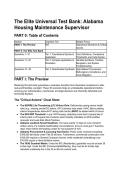
The Elite Universal Test Bank: Alabama
Housing Maintenance Supervisor
PART 0: Table of Contents
Section Cognitive Tier Subject Focus
PART I: The Preview N/A Operational Directives & Critical
Axioms
PART II: The Elite Test Bank
Questions 1–10 Tier 1: Foundational Syntax & Core Definitions, Compliance
Application Thresholds, and Code Syntax
Questions 11–20 Tier 2: Complex Application & Variable Synthesis, Timeline
Simulation Navigation, and System
Troubleshooting
Questions 21–30 Tier 3: Grandmaster Synthesis High-Stakes Procurement,
Multi-Agency Compliance, and
Crisis Mitigation
PART I: The Preview
Mastering this test bank guarantees a seamless transition from theoretical compliance to elite,
real-world facilities oversight. These 30 scenarios forge an unshakeable operational intuition,
ensuring your administrative, mechanical, and legal decisions are inherently defensible and
technically flawless.
The "Critical Axioms" Cheat Sheet
● The NSPIRE Life-Threatening (LT) 24-Hour Rule: Deficiencies posing severe health
risks (e.g., missing smoke/CO alarms, GFCI absence near water, HVAC failure yielding
interior temperatures below 64°F during cold months) MUST be abated within 24 hours.
● The EPA RRP Threshold: In pre-1978 housing, disturbing more than 6 square feet of
interior paint or 20 square feet of exterior paint instantly mandates an EPA-certified
renovator and Lead-Safe Work Practices.
● Alabama Landlord-Tenant Deadlines: You have exactly 14 days to cure a tenant's
written notice of a material health/safety noncompliance, and you must give 7 business
days' notice before terminating a lease for non-payment of rent.
● Alabama Procurement & Licensing Hard Decks: Public works contracts exceeding
$100,000 fall strictly under Title 39 bid laws. Furthermore, commercial construction over
$100,000 requires a General Contractor license, while residential undertakings over
$10,000 require a Home Builders license.
● The 36/42 Guardrail Matrix: Under the IRC (Residential), guardrails must be at least 36
inches high. Under the IBC (Commercial/Multifamily), they must be 42 inches high.
Handrails unilaterally live in the 34-to-38-inch vertical zone.
,PART II: THE ELITE TEST BANK
Q1: A maintenance technician is scheduled to cut into a living room wall to repair a leaking
waste line in a residential duplex built in 1974. The drywall removal will disturb approximately 8
square feet of painted surface. Based on the principles of the EPA Renovation, Repair, and
Painting (RRP) Rule, which action is the FIRST requirement? A) Proceed with standard
demolition, as the 8-square-foot disturbance is well below the 20-square-foot exterior limit. B)
Conduct an EPA-recognized swab test to confirm the absence of lead, or assign an
EPA-certified renovator to utilize lead-safe work practices. C) Issue a 14-day notice to the tenant
to vacate the premises due to life-threatening airborne particulates. D) Wear an N95 mask and
utilize a high-speed mechanical sander to remove the paint before cutting the drywall.
● The Answer: B (Conduct an EPA-recognized swab test to confirm the absence of lead, or
assign an EPA-certified renovator to utilize lead-safe work practices.)
● Distractor Analysis:
○ A is incorrect: The 20-square-foot threshold applies strictly to exterior surfaces. The
interior threshold is 6 square feet.
○ C is incorrect: The RRP rule requires isolation and containment, not necessarily a
14-day eviction or relocation of the tenant, provided safe practices are utilized.
○ D is incorrect: High-speed mechanical sanding without HEPA attachments is a
strictly prohibited practice under EPA lead-safe guidelines.
The Mentor's Analysis: Lead containment operates on a zero-tolerance compliance
framework. When interior paint disturbance in a pre-1978 structure exceeds 6 square feet, EPA
RRP protocols trigger instantly. The legislative intent behind this threshold is to capture minor
renovations that historically bypassed older abatement laws but still produced neurotoxic dust
clouds capable of causing permanent cognitive damage in children. By utilizing Lead-Safe Work
Practices and testing early, you bypass the common trap of severe federal fines that can exceed
$40,000 per violation, per day.
EPA RRP Application Area Disturbed Compliance Requirement
Interior Room > 6 sq. ft. EPA Firm/Renovator +
Lead-Safe Practices
Exterior Surface > 20 sq. ft. EPA Firm/Renovator +
Lead-Safe Practices
Professional/Academic Intuition: In pre-1978 housing, treat every painted surface as a
toxic asset until proven otherwise by a certified test.
Q2: During an annual unit walkthrough, a housing supervisor observes that an electrical outlet
located 4 feet from a kitchen sink lacks Ground-Fault Circuit Interrupter (GFCI) protection.
Based on the principles of HUD's National Standards for the Physical Inspection of Real Estate
(NSPIRE), which conclusion is the MOST ACCURATE? A) The outlet is a "Low" severity defect
and must be noted for eventual upgrade during the next unit turnover. B) The outlet constitutes
a "Moderate" defect, requiring abatement within 30 days. C) The outlet is a "Life-Threatening"
deficiency and must be corrected within 24 hours. D) The outlet complies with legacy HQS
standards and is grandfathered in without penalty.
● The Answer: C (The outlet is a "Life-Threatening" deficiency and must be corrected
within 24 hours.)
● Distractor Analysis:
○ A is incorrect: NSPIRE strictly classifies unprotected outlets within 6 feet of a water
, source as severe hazards, not advisory low-level defects.
○ B is incorrect: 30 days is the standard for Moderate or Severe defects that do not
pose an immediate risk of death. GFCI proximity to water bypasses this tier entirely.
○ D is incorrect: NSPIRE eliminated the grandfathering of life-safety hazards
prevalent under the older HQS model. Affirmative requirements demand
compliance today.
The Mentor's Analysis: NSPIRE shifts the paradigm from aesthetic evaluations to
uncompromising health and safety mandates. The physical proximity between water and
unprotected electrical current creates a catastrophic arc risk, prompting HUD to reclassify this
as a 24-hour critical failure. When confronting legacy infrastructure, property managers must
understand that current safety codes retroactively apply to life-threatening systems. By utilizing
24-Hour Abatement protocols, you bypass the common trap of regulatory negligence and HUD
abatement penalties. Professional/Academic Intuition: If water can splash it, a GFCI must
protect it—execute repairs within one solar day to maintain federal compliance.
Q3: A tenant submits a written request to the property manager on Tuesday, citing that the only
toilet in their single-family rental is severely clogged and unusable. Based on the principles of
the Alabama Uniform Residential Landlord and Tenant Act (AURLTA), which action is the MOST
APPROPRIATE response timeline? A) The landlord has 14 days to remedy the condition before
the tenant can legally break the lease without penalty. B) The landlord has 7 business days to
repair the toilet, matching the timeline for unpaid rent notices. C) The landlord must resolve the
issue within 24 hours because it violates NSPIRE life-safety standards. D) The tenant is legally
authorized to hire a plumber immediately and deduct the full invoice from the next month's rent.
● The Answer: A (The landlord has 14 days to remedy the condition before the tenant can
legally break the lease without penalty.)
● Distractor Analysis:
○ B is incorrect: 7 business days applies strictly to lease termination notices for
non-payment of rent, not maintenance requests.
○ C is incorrect: While a broken toilet is a severe issue under federal guidelines, the
AURLTA statutory timeline for material noncompliance affecting health and safety
dictates a 14-day cure period under state contract law.
○ D is incorrect: Alabama is not a broad "repair-and-deduct" state; unauthorized
withholding of rent can lead to lawful eviction.
The Mentor's Analysis: State law establishes a strict procedural runway for habitability
disputes. A landlord's duty to maintain sanitary conditions under Alabama Code § 35-9A-204 is
absolute, but the law affords a specific 14-day window for execution to prevent tenants from
unilaterally dissolving contracts over transient issues. The interplay between state law and
physical maintenance requires managers to log receipt dates meticulously. By utilizing 14-Day
Statutory Cure Periods, you bypass the common trap of tenant-initiated lease breaches and
potential litigation. Professional/Academic Intuition: AURLTA grants 14 days to restore
habitability; miss this deadline, and the lease dissolves at the tenant's discretion.
Q4: A housing authority is planning a major roof replacement for a large public housing
complex. The estimated cost of the project is $115,000. Based on the principles of Alabama
Public Works Law (Title 39), which action is IMMEDIATELY required? A) The project must be
competitively bid because it exceeds the $50,000 threshold for public works. B) The project can
be split into three separate $38,333 contracts to utilize informal small purchase procedures. C)
The project must be advertised for sealed bids because it exceeds the $100,000 threshold. D)
The project is exempt from competitive bidding if the authority utilizes an out-of-state
cooperative purchasing agreement.
Housing Maintenance Supervisor
PART 0: Table of Contents
Section Cognitive Tier Subject Focus
PART I: The Preview N/A Operational Directives & Critical
Axioms
PART II: The Elite Test Bank
Questions 1–10 Tier 1: Foundational Syntax & Core Definitions, Compliance
Application Thresholds, and Code Syntax
Questions 11–20 Tier 2: Complex Application & Variable Synthesis, Timeline
Simulation Navigation, and System
Troubleshooting
Questions 21–30 Tier 3: Grandmaster Synthesis High-Stakes Procurement,
Multi-Agency Compliance, and
Crisis Mitigation
PART I: The Preview
Mastering this test bank guarantees a seamless transition from theoretical compliance to elite,
real-world facilities oversight. These 30 scenarios forge an unshakeable operational intuition,
ensuring your administrative, mechanical, and legal decisions are inherently defensible and
technically flawless.
The "Critical Axioms" Cheat Sheet
● The NSPIRE Life-Threatening (LT) 24-Hour Rule: Deficiencies posing severe health
risks (e.g., missing smoke/CO alarms, GFCI absence near water, HVAC failure yielding
interior temperatures below 64°F during cold months) MUST be abated within 24 hours.
● The EPA RRP Threshold: In pre-1978 housing, disturbing more than 6 square feet of
interior paint or 20 square feet of exterior paint instantly mandates an EPA-certified
renovator and Lead-Safe Work Practices.
● Alabama Landlord-Tenant Deadlines: You have exactly 14 days to cure a tenant's
written notice of a material health/safety noncompliance, and you must give 7 business
days' notice before terminating a lease for non-payment of rent.
● Alabama Procurement & Licensing Hard Decks: Public works contracts exceeding
$100,000 fall strictly under Title 39 bid laws. Furthermore, commercial construction over
$100,000 requires a General Contractor license, while residential undertakings over
$10,000 require a Home Builders license.
● The 36/42 Guardrail Matrix: Under the IRC (Residential), guardrails must be at least 36
inches high. Under the IBC (Commercial/Multifamily), they must be 42 inches high.
Handrails unilaterally live in the 34-to-38-inch vertical zone.
,PART II: THE ELITE TEST BANK
Q1: A maintenance technician is scheduled to cut into a living room wall to repair a leaking
waste line in a residential duplex built in 1974. The drywall removal will disturb approximately 8
square feet of painted surface. Based on the principles of the EPA Renovation, Repair, and
Painting (RRP) Rule, which action is the FIRST requirement? A) Proceed with standard
demolition, as the 8-square-foot disturbance is well below the 20-square-foot exterior limit. B)
Conduct an EPA-recognized swab test to confirm the absence of lead, or assign an
EPA-certified renovator to utilize lead-safe work practices. C) Issue a 14-day notice to the tenant
to vacate the premises due to life-threatening airborne particulates. D) Wear an N95 mask and
utilize a high-speed mechanical sander to remove the paint before cutting the drywall.
● The Answer: B (Conduct an EPA-recognized swab test to confirm the absence of lead, or
assign an EPA-certified renovator to utilize lead-safe work practices.)
● Distractor Analysis:
○ A is incorrect: The 20-square-foot threshold applies strictly to exterior surfaces. The
interior threshold is 6 square feet.
○ C is incorrect: The RRP rule requires isolation and containment, not necessarily a
14-day eviction or relocation of the tenant, provided safe practices are utilized.
○ D is incorrect: High-speed mechanical sanding without HEPA attachments is a
strictly prohibited practice under EPA lead-safe guidelines.
The Mentor's Analysis: Lead containment operates on a zero-tolerance compliance
framework. When interior paint disturbance in a pre-1978 structure exceeds 6 square feet, EPA
RRP protocols trigger instantly. The legislative intent behind this threshold is to capture minor
renovations that historically bypassed older abatement laws but still produced neurotoxic dust
clouds capable of causing permanent cognitive damage in children. By utilizing Lead-Safe Work
Practices and testing early, you bypass the common trap of severe federal fines that can exceed
$40,000 per violation, per day.
EPA RRP Application Area Disturbed Compliance Requirement
Interior Room > 6 sq. ft. EPA Firm/Renovator +
Lead-Safe Practices
Exterior Surface > 20 sq. ft. EPA Firm/Renovator +
Lead-Safe Practices
Professional/Academic Intuition: In pre-1978 housing, treat every painted surface as a
toxic asset until proven otherwise by a certified test.
Q2: During an annual unit walkthrough, a housing supervisor observes that an electrical outlet
located 4 feet from a kitchen sink lacks Ground-Fault Circuit Interrupter (GFCI) protection.
Based on the principles of HUD's National Standards for the Physical Inspection of Real Estate
(NSPIRE), which conclusion is the MOST ACCURATE? A) The outlet is a "Low" severity defect
and must be noted for eventual upgrade during the next unit turnover. B) The outlet constitutes
a "Moderate" defect, requiring abatement within 30 days. C) The outlet is a "Life-Threatening"
deficiency and must be corrected within 24 hours. D) The outlet complies with legacy HQS
standards and is grandfathered in without penalty.
● The Answer: C (The outlet is a "Life-Threatening" deficiency and must be corrected
within 24 hours.)
● Distractor Analysis:
○ A is incorrect: NSPIRE strictly classifies unprotected outlets within 6 feet of a water
, source as severe hazards, not advisory low-level defects.
○ B is incorrect: 30 days is the standard for Moderate or Severe defects that do not
pose an immediate risk of death. GFCI proximity to water bypasses this tier entirely.
○ D is incorrect: NSPIRE eliminated the grandfathering of life-safety hazards
prevalent under the older HQS model. Affirmative requirements demand
compliance today.
The Mentor's Analysis: NSPIRE shifts the paradigm from aesthetic evaluations to
uncompromising health and safety mandates. The physical proximity between water and
unprotected electrical current creates a catastrophic arc risk, prompting HUD to reclassify this
as a 24-hour critical failure. When confronting legacy infrastructure, property managers must
understand that current safety codes retroactively apply to life-threatening systems. By utilizing
24-Hour Abatement protocols, you bypass the common trap of regulatory negligence and HUD
abatement penalties. Professional/Academic Intuition: If water can splash it, a GFCI must
protect it—execute repairs within one solar day to maintain federal compliance.
Q3: A tenant submits a written request to the property manager on Tuesday, citing that the only
toilet in their single-family rental is severely clogged and unusable. Based on the principles of
the Alabama Uniform Residential Landlord and Tenant Act (AURLTA), which action is the MOST
APPROPRIATE response timeline? A) The landlord has 14 days to remedy the condition before
the tenant can legally break the lease without penalty. B) The landlord has 7 business days to
repair the toilet, matching the timeline for unpaid rent notices. C) The landlord must resolve the
issue within 24 hours because it violates NSPIRE life-safety standards. D) The tenant is legally
authorized to hire a plumber immediately and deduct the full invoice from the next month's rent.
● The Answer: A (The landlord has 14 days to remedy the condition before the tenant can
legally break the lease without penalty.)
● Distractor Analysis:
○ B is incorrect: 7 business days applies strictly to lease termination notices for
non-payment of rent, not maintenance requests.
○ C is incorrect: While a broken toilet is a severe issue under federal guidelines, the
AURLTA statutory timeline for material noncompliance affecting health and safety
dictates a 14-day cure period under state contract law.
○ D is incorrect: Alabama is not a broad "repair-and-deduct" state; unauthorized
withholding of rent can lead to lawful eviction.
The Mentor's Analysis: State law establishes a strict procedural runway for habitability
disputes. A landlord's duty to maintain sanitary conditions under Alabama Code § 35-9A-204 is
absolute, but the law affords a specific 14-day window for execution to prevent tenants from
unilaterally dissolving contracts over transient issues. The interplay between state law and
physical maintenance requires managers to log receipt dates meticulously. By utilizing 14-Day
Statutory Cure Periods, you bypass the common trap of tenant-initiated lease breaches and
potential litigation. Professional/Academic Intuition: AURLTA grants 14 days to restore
habitability; miss this deadline, and the lease dissolves at the tenant's discretion.
Q4: A housing authority is planning a major roof replacement for a large public housing
complex. The estimated cost of the project is $115,000. Based on the principles of Alabama
Public Works Law (Title 39), which action is IMMEDIATELY required? A) The project must be
competitively bid because it exceeds the $50,000 threshold for public works. B) The project can
be split into three separate $38,333 contracts to utilize informal small purchase procedures. C)
The project must be advertised for sealed bids because it exceeds the $100,000 threshold. D)
The project is exempt from competitive bidding if the authority utilizes an out-of-state
cooperative purchasing agreement.