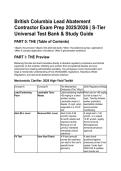
British Columbia Lead Abatement
Contractor Exam Prep 2025/2026 | S-Tier
Universal Test Bank & Study Guide
PART 0: THE (Table of Contents)
*(#part-i-the-preview) *(#part-ii-the-elite-test-bank) *(#tier-1-foundational-syntax--application)
*(#tier-2-complex-application--simulation) *(#tier-3-grandmaster-synthesis)
PART I: THE Preview
Mastering this elite test bank translates directly to absolute regulatory compliance and tactical
superiority on the worksite, shielding your workers from occupational disease and your
enterprise from crippling administrative penalties. You will bypass novice memorization and
forge a mechanistic understanding of how WorkSafeBC regulations, Hazardous Waste
Regulations, and real-world abatement physics intersect.
Mechanistic Clarifier: 2026 High-Yield Toolkit
Concept A Concept B The Mechanistic 2026 Regulatory Bridge
Distinction (The "Why")
Lead-Containing Leachable Toxic Lead-containing implies Paint can be >90 mg/kg
Paint Waste >90 mg/kg in a dried but fail to leach >5
surface coating. mg/L. Toxicity dictates
Leachable means it worker protection;
bleeds >5 mg/L when leachability dictates
subjected to a TCLP environmental
test. manifesting.
Alert BLL Level Removal BLL Level Alert (0.48–0.96 A single test >1.45
µmol/L) requires µmol/L, or a repeat
6-month retests and >0.97 µmol/L, legally
exposure review. forces removal.
Removal (≥1.45 Reinstatement
µmol/L) mandates demands physician
immediate clinical approval.
extraction.
Fit Test User Seal Check A fit test (annual) A seal check
proves the respirator (positive/negative
can seal to the user's pressure) proves it has
specific facial sealed. Under April
geometry. 2026 Part 8 updates,
seal checks are
,Concept A Concept B The Mechanistic 2026 Regulatory Bridge
Distinction (The "Why")
mandatory before each
use.
NOP-H (48 Hours) Waste Manifest A Notice of Project A manifest tracks the
(Hazardous cradle-to-grave
Substances) must be transport of hazardous
filed 48 hours before waste once it exceeds
significantly disturbing 5 kg (solid) or 5 L
lead. (liquid).
The "Critical Axioms" Cheat Sheet
● The ALARA Mandate: The BC 8-hour Time-Weighted Average (TWA) limit is 0.05 mg/m³.
However, the ALARA principle legally requires reducing exposure further if practicable,
regardless of the TWA.
● Clearance Dynamics: Clearance criteria strictly depend on building use.
Residential/Daycare floors demand 0.11 mg/m²; Commercial floors allow 2.2 mg/m².
● Aerosolization is the Enemy: Dry sweeping and compressed air are strictly prohibited.
PART II: THE ELITE TEST BANK
Tier 1: Foundational Syntax & Application
Q1: A contractor tests a wall coating in a pre-1990 residential building. To be legally classified
as a "lead-containing surface coating material" under Canadian and BC standards, the dried
sample must contain a lead concentration EXCEEDING which threshold? A) 50 mg/kg B) 90
mg/kg C) 500 mg/kg D) 1,000 mg/kg
● The Answer: B (90 mg/kg)
● Distractor Analysis:
○ A is incorrect: This is an arbitrary figure not recognized by Health Canada.
○ C is incorrect: This represents outdated legacy thresholds from other jurisdictions.
○ D is incorrect: This represents the HUD definition for lead-based paint, not the BC
surface coating threshold.
The Mentor's Analysis: Precision in classification dictates your risk assessment protocol.
Under the federal Surface Coating Materials Regulations adopted by BC, 90 mg/kg is the
absolute trigger point. Professional/Academic Intuition: Treat 90 mg/kg as the absolute
baseline; anything above this legally constitutes a lead-containing material requiring
specialized handling.
Q2: Under WorkSafeBC's OHS Regulation Part 5 (updated for 2026), what is the official 8-hour
Time-Weighted Average (TWA) occupational exposure limit for elemental lead? A) 0.02 mg/m³
B) 0.05 mg/m³ C) 0.10 mg/m³ D) 0.15 mg/m³
● The Answer: B (0.05 mg/m³)
● Distractor Analysis:
○ A is incorrect: This is the limit for specific other heavy metals, not lead.
○ C is incorrect: This is a legacy limit previously used in outdated industrial hygiene
standards.
○ D is incorrect: This is the generic particulate nuisance dust limit.
, The Mentor's Analysis: The TWA is the hard deck for atmospheric safety. While 0.05 mg/m³ is
the legal maximum, elite contractors operate far below this due to the ALARA principle.
Professional/Academic Intuition: Never view the TWA as a target; it is a ceiling of failure.
ALARA is the true standard.
Q3: A technician runs a Toxicity Characteristic Leaching Procedure (TCLP) on collected debris.
The waste must be manifested as a "leachable toxic waste" if the lead concentration EXCEEDS
which limit? A) 1 mg/L B) 2 mg/L C) 5 mg/L D) 10 mg/L
● The Answer: C (5 mg/L)
● Distractor Analysis:
○ A is incorrect: This is too stringent and does not align with the BC Hazardous Waste
Regulation.
○ B is incorrect: Often confused with limits for other leachable contaminants.
○ D is incorrect: A legacy threshold that would allow highly toxic leachate to bypass
manifesting.
The Mentor's Analysis: TCLP measures what bleeds into the groundwater, not the total lead
mass. A result over 5 mg/L transitions the debris into regulated hazardous waste.
Professional/Academic Intuition: Waste characterization dictates logistics. Over 5 mg/L
TCLP means specialized transport, specific manifesting, and specialized disposal.
Q4: A worker in a BC abatement project returns a Blood Lead Level (BLL) test result of 1.50
µmol/L. According to WorkSafeBC medical surveillance guidelines, what is the IMMEDIATE
required action? A) Retest the worker in 6 months. B) Provide a respirator with a higher
Assigned Protection Factor (APF). C) Remove the worker from further lead exposure. D)
Implement administrative controls to shorten their shift.
● The Answer: C (Remove the worker from further lead exposure.)
● Distractor Analysis:
○ A is incorrect: Retesting in 6 months is the protocol for Alert levels (0.48–0.96
µmol/L).
○ B is incorrect: While a good secondary step, it does not satisfy the statutory
mandate for medical removal at this blood level.
○ D is incorrect: Shortening shifts is an administrative control, but it is illegal to leave
a worker with this BLL in the exposure zone.
The Mentor's Analysis: BLLs are biological lagging indicators. A level ≥1.45 µmol/L (30 µg/dL)
demands immediate medical removal to prevent irreversible neurological damage.
Professional/Academic Intuition: When biology fails, remove the human. Never attempt to
"PPE your way out" of an elevated BLL.
Q5: You are planning a demolition that will significantly disturb lead-containing paint. What is the
MINIMUM notice required to submit a Notice of Project for Hazardous Substances (NOP-H) to
WorkSafeBC? A) 24 hours B) 48 hours C) 72 hours D) 1 week
● The Answer: B (48 hours)
● Distractor Analysis:
○ A is incorrect: 24 hours applies to certain forestry or diving operations, not
hazardous substances.
○ C is incorrect: This is the requirement in Alberta, representing a common novice
cross-jurisdictional error.
○ D is incorrect: Excessive and not statutorily required.
The Mentor's Analysis: The NOP-H gives regulators the window to audit your site plan before
the hazard becomes airborne. Failing the 48-hour rule is an unarguable administrative violation.
Professional/Academic Intuition: Documentation precedes execution. The clock starts
Contractor Exam Prep 2025/2026 | S-Tier
Universal Test Bank & Study Guide
PART 0: THE (Table of Contents)
*(#part-i-the-preview) *(#part-ii-the-elite-test-bank) *(#tier-1-foundational-syntax--application)
*(#tier-2-complex-application--simulation) *(#tier-3-grandmaster-synthesis)
PART I: THE Preview
Mastering this elite test bank translates directly to absolute regulatory compliance and tactical
superiority on the worksite, shielding your workers from occupational disease and your
enterprise from crippling administrative penalties. You will bypass novice memorization and
forge a mechanistic understanding of how WorkSafeBC regulations, Hazardous Waste
Regulations, and real-world abatement physics intersect.
Mechanistic Clarifier: 2026 High-Yield Toolkit
Concept A Concept B The Mechanistic 2026 Regulatory Bridge
Distinction (The "Why")
Lead-Containing Leachable Toxic Lead-containing implies Paint can be >90 mg/kg
Paint Waste >90 mg/kg in a dried but fail to leach >5
surface coating. mg/L. Toxicity dictates
Leachable means it worker protection;
bleeds >5 mg/L when leachability dictates
subjected to a TCLP environmental
test. manifesting.
Alert BLL Level Removal BLL Level Alert (0.48–0.96 A single test >1.45
µmol/L) requires µmol/L, or a repeat
6-month retests and >0.97 µmol/L, legally
exposure review. forces removal.
Removal (≥1.45 Reinstatement
µmol/L) mandates demands physician
immediate clinical approval.
extraction.
Fit Test User Seal Check A fit test (annual) A seal check
proves the respirator (positive/negative
can seal to the user's pressure) proves it has
specific facial sealed. Under April
geometry. 2026 Part 8 updates,
seal checks are
,Concept A Concept B The Mechanistic 2026 Regulatory Bridge
Distinction (The "Why")
mandatory before each
use.
NOP-H (48 Hours) Waste Manifest A Notice of Project A manifest tracks the
(Hazardous cradle-to-grave
Substances) must be transport of hazardous
filed 48 hours before waste once it exceeds
significantly disturbing 5 kg (solid) or 5 L
lead. (liquid).
The "Critical Axioms" Cheat Sheet
● The ALARA Mandate: The BC 8-hour Time-Weighted Average (TWA) limit is 0.05 mg/m³.
However, the ALARA principle legally requires reducing exposure further if practicable,
regardless of the TWA.
● Clearance Dynamics: Clearance criteria strictly depend on building use.
Residential/Daycare floors demand 0.11 mg/m²; Commercial floors allow 2.2 mg/m².
● Aerosolization is the Enemy: Dry sweeping and compressed air are strictly prohibited.
PART II: THE ELITE TEST BANK
Tier 1: Foundational Syntax & Application
Q1: A contractor tests a wall coating in a pre-1990 residential building. To be legally classified
as a "lead-containing surface coating material" under Canadian and BC standards, the dried
sample must contain a lead concentration EXCEEDING which threshold? A) 50 mg/kg B) 90
mg/kg C) 500 mg/kg D) 1,000 mg/kg
● The Answer: B (90 mg/kg)
● Distractor Analysis:
○ A is incorrect: This is an arbitrary figure not recognized by Health Canada.
○ C is incorrect: This represents outdated legacy thresholds from other jurisdictions.
○ D is incorrect: This represents the HUD definition for lead-based paint, not the BC
surface coating threshold.
The Mentor's Analysis: Precision in classification dictates your risk assessment protocol.
Under the federal Surface Coating Materials Regulations adopted by BC, 90 mg/kg is the
absolute trigger point. Professional/Academic Intuition: Treat 90 mg/kg as the absolute
baseline; anything above this legally constitutes a lead-containing material requiring
specialized handling.
Q2: Under WorkSafeBC's OHS Regulation Part 5 (updated for 2026), what is the official 8-hour
Time-Weighted Average (TWA) occupational exposure limit for elemental lead? A) 0.02 mg/m³
B) 0.05 mg/m³ C) 0.10 mg/m³ D) 0.15 mg/m³
● The Answer: B (0.05 mg/m³)
● Distractor Analysis:
○ A is incorrect: This is the limit for specific other heavy metals, not lead.
○ C is incorrect: This is a legacy limit previously used in outdated industrial hygiene
standards.
○ D is incorrect: This is the generic particulate nuisance dust limit.
, The Mentor's Analysis: The TWA is the hard deck for atmospheric safety. While 0.05 mg/m³ is
the legal maximum, elite contractors operate far below this due to the ALARA principle.
Professional/Academic Intuition: Never view the TWA as a target; it is a ceiling of failure.
ALARA is the true standard.
Q3: A technician runs a Toxicity Characteristic Leaching Procedure (TCLP) on collected debris.
The waste must be manifested as a "leachable toxic waste" if the lead concentration EXCEEDS
which limit? A) 1 mg/L B) 2 mg/L C) 5 mg/L D) 10 mg/L
● The Answer: C (5 mg/L)
● Distractor Analysis:
○ A is incorrect: This is too stringent and does not align with the BC Hazardous Waste
Regulation.
○ B is incorrect: Often confused with limits for other leachable contaminants.
○ D is incorrect: A legacy threshold that would allow highly toxic leachate to bypass
manifesting.
The Mentor's Analysis: TCLP measures what bleeds into the groundwater, not the total lead
mass. A result over 5 mg/L transitions the debris into regulated hazardous waste.
Professional/Academic Intuition: Waste characterization dictates logistics. Over 5 mg/L
TCLP means specialized transport, specific manifesting, and specialized disposal.
Q4: A worker in a BC abatement project returns a Blood Lead Level (BLL) test result of 1.50
µmol/L. According to WorkSafeBC medical surveillance guidelines, what is the IMMEDIATE
required action? A) Retest the worker in 6 months. B) Provide a respirator with a higher
Assigned Protection Factor (APF). C) Remove the worker from further lead exposure. D)
Implement administrative controls to shorten their shift.
● The Answer: C (Remove the worker from further lead exposure.)
● Distractor Analysis:
○ A is incorrect: Retesting in 6 months is the protocol for Alert levels (0.48–0.96
µmol/L).
○ B is incorrect: While a good secondary step, it does not satisfy the statutory
mandate for medical removal at this blood level.
○ D is incorrect: Shortening shifts is an administrative control, but it is illegal to leave
a worker with this BLL in the exposure zone.
The Mentor's Analysis: BLLs are biological lagging indicators. A level ≥1.45 µmol/L (30 µg/dL)
demands immediate medical removal to prevent irreversible neurological damage.
Professional/Academic Intuition: When biology fails, remove the human. Never attempt to
"PPE your way out" of an elevated BLL.
Q5: You are planning a demolition that will significantly disturb lead-containing paint. What is the
MINIMUM notice required to submit a Notice of Project for Hazardous Substances (NOP-H) to
WorkSafeBC? A) 24 hours B) 48 hours C) 72 hours D) 1 week
● The Answer: B (48 hours)
● Distractor Analysis:
○ A is incorrect: 24 hours applies to certain forestry or diving operations, not
hazardous substances.
○ C is incorrect: This is the requirement in Alberta, representing a common novice
cross-jurisdictional error.
○ D is incorrect: Excessive and not statutorily required.
The Mentor's Analysis: The NOP-H gives regulators the window to audit your site plan before
the hazard becomes airborne. Failing the 48-hour rule is an unarguable administrative violation.
Professional/Academic Intuition: Documentation precedes execution. The clock starts