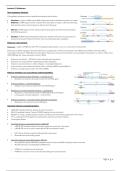
Lecture 9: Enhancers
Gene-regulatory elements:
Cis-regulatory elements can be classified according to their function:
• Promoter: A region of DNA where RNA polymerase binds to initiate transcription of a gene.
• Enhancer: A DNA sequence that increases the transcription of a gene, often by interacting
with specific proteins and working at a distance from the gene.
• Silencer: A DNA sequence that represses gene transcription by interacting with proteins
that inhibit expression.
• Insulator: A DNA element that blocks interactions between enhancers and promoters or
prevents the spread of heterochromatin, thus ensuring proper gene regulation.
Enhancers: stats and facts
Enhancers = regions of DNA that bind TFs and regulate distant genes in cis (i.e., on the same chromosome).
Enhancers are distal regulatory elements that loop to a target gene: a few kb in Drosophila, 10s-100s kb (up to Mb!) in mammals. Many
mammalian enhancers (~50%) skip the nearest gene. They are on the same chromosome; can be upstream, downstream or intronic. Often short
(100-1000 bp), but "super-enhancers" can be 100 kb.
• Enhancers can lead to ~100-fold increase of target gene expression
• Enhancers are responsible for spatiotemporal gene regulation
• Enhancers can be silencers in other cell types - meaningful distinction
• Active enhancers are marked by histone marks, including H3K27ac and H3K4me1
• Enhancers usually produce short, short-lived eRNAs
Enhancer mutations can cause disease (enhanceropathies):
• Enhancer-promoter contact disruption → aniridia (no iris):
o Disruption of enhancer-promoter contact for the PAX6 gene.
• Enhancer deletion → X-linked deafness:
o Deletion of an enhancer distant from the POU3F4 gene
• Mutations in a limb bud-specific enhancer → polydactyly:
o Mutations in a limb-specific enhancer (ZRS) affecting the SHH gene
o Limb-specific enhancer deletions → loss of limbs
• Enhancer mutations → increased risk for Hirschsprung disease:
o Mutations in an enhancer near the RET gene
Important enhancer-associated proteins:
• p300/CBP acetylate histones, leading to active chromatin
• MLL3/4 methylate histone 3 lysine 4 (H3K4), leading to active chromatin
• Mediator is a huge, variable protein complex connecting and transmitting signals from TFs to Pol-II
• YY1 is a ubiquitous TF thought to be important for enhancer-promoter looping
• Transcription factors
• Important enhancer-associated proteins: p300/CBP
o p300 & CBP acetylate histones and other proteins in proximity: "acyl spray"
o p300 & CBP are very similar, especially HAT & bromodomain region
o HAT domain (histone acetyl transferase) adds acyl groups
o Bromodomain binds acetyl groups
• Important enhancer-associated proteins: MLL3/4
o MLL3 (KMT2C) & MLL4 (KMT2D) methylate histone 3 lysine 4 (H3K4), leading to active chromatin
o MLL3/4 add mono-/di-methylation (H3K4me1/2)
o H3K4me1 is predominant at enhancers
o H3K4me2 is common near 5'-end of transcribed genes and enhancers
1|Page
,Important enhancer-associated proteins:
• Important enhancer-associated proteins: Mediator
o Mediator is a huge multiprotein complex (yeast version shown)
o Mediator connects enhancers with promoters
o Coordinates TFs at enhancers and promoters and allows transmission of signals from TFs to Pol-II
o Intrinsically Disordered Regions (IDRs, called "splines" in Mediator) involved in protein interactions
• Important enhancer-associated proteins: TFs
o TFs assemble at enhancers and promoters and activate or repress gene expression
Enhanceosome Billboard TF collective
Protein DNA Highly cooperative DNA binding Cooperative and additive Cooperative DNA binding
DNA sequence acts as scaffold binding Both DNA and protein may act as scaffold
Protein interface Fixed (formed from a higher-order TF-DNA complex) Variable Variable
Motif Fixed motif positioning (grammar) Flexible motif grammar Flexible motif grammar
Fixed motif composition (sites for all factors must be there) Fixed motif composition Flexible motif composition (as different TFs
directly bind to DNA)
Output Unitary (requires the integrated activity of all TFs) Only requires a subset of Collective (requires most TFs but not clear if it
factors to be active requires all TFs)
Enhancers have distinct histone modifications:
• Active: H3K27ac / H3K4me1 / H3K4me2
• Poised: H3K27me3 / H3K4me1 / H3K4me2
• Repressed: H3K27me3
Enhancers produce short, short-lived RNAs:
• Enhancers recruit Pol-II and have RNAs transcribed: eRNAs
• eRNA transcription is often bi-directional
• Most eRNAs are short and short-lived, but some are longer, and may have poly-A tail
• eRNA transcription correlates with enhancer activity
• eRNAs: function
o Maintaining open chromatin
o Providing interaction surfaces and increasing local concentration of transcription machinery
o Establishing active epigenetic landscape
o Evasion of gene silencing machinery
Enhancer-promoter contacts are not static:
Enhancers contact and activate genes in bursts. Clustering of TFs and coactivators at enhancers drives bursts of
gene activation. A single enhancer can coordinate the activation of multiple genes through dynamic interactions.
• Low enhancer-promoter contact frequency → OFF promoter state → decreased transcriptional activity
• High enhancer-promoter contact frequency → ON promoter state → increased transcriptional activity
Enhancers control the expression pattern of evenskipped:
• Bicoid (Bcd) = activator and concentration peaks in the anterior end
• Giant (Gt) = repressor and concentration peaks in the posterior end
• Hunchback (Hb) = activator and concentration peaks in the anterior end
• Krüppel (Kr) = repressor and concentration peaks in the central region
2|Page
, Enhancer study methods: lacZ assay
Candidate enhancer sequence is cloned in front of promoter and lacZ reporter gene. If sequence functions as enhancer, reporter gene is
expressed. Variation: Visualize enhancer variants.
• Advantages of method (+):
o High spatiotemporal resolution of activity pattern in vivo
• Disadvantages of method (–):
o Low throughput
o Random integrations do not reflect native chromatin environment
o Does not identify target gene
Enhancer study methods: Massively Parallel Reporter Assay (MPRA):
Large library of candidate enhancer sequences is cloned upstream a reporter gene with barcode, transfected into cells. Active enhancers lead to
transcription of reporters, which can be read out by sequencing barcode.
• Advantages of method (+):
o High throughput
• Disadvantages of method (–):
o Not in a native chromatin environment
o Does not identify target gene
Variations:
• SuRE: Tests DNA fragments for promoter and enhancer activity across the genome and detects the effects of genetic variations like SNPs.
• STARR-seq: Measures enhancer activity by placing DNA fragments downstream of a minimal promoter and linking their activity to RNA
output. High RNA levels indicate strong enhancer activity.
Enhancer study methods: CRISPR k/o or silencing:
Enhancer knockout or silencing using CRISPR. Either mutate enhancer sequence or silence enhancer through repressive KRAB domain.
• CRISPR knockout → mutation or deletion of enhancers in cells.
• CRISPR interference → library of guide RNAs introduced into cells to direct repression by dCas9-KRAB
• Advantages of method (+):
o Tests in native locus
o Can identify target gene
o Can be made high throughput
• Disadvantages of method (–):
o Large effect size needed
o High false negative rates
Enhancer study methods: ChIP-seq
Enhancers: ChIP against p300 (DNA-binding protein) or histone modifications.
• Advantages of method (+):
o High throughput
o Identifies in native locus
o Can identify active and inactive enhancers
• Disadvantages of method (–):
o Assays proxies for enhancers
o Antibody can cross-react (ChIP-grade antibody needed)
o Does not identify target gene
3|Page
Gene-regulatory elements:
Cis-regulatory elements can be classified according to their function:
• Promoter: A region of DNA where RNA polymerase binds to initiate transcription of a gene.
• Enhancer: A DNA sequence that increases the transcription of a gene, often by interacting
with specific proteins and working at a distance from the gene.
• Silencer: A DNA sequence that represses gene transcription by interacting with proteins
that inhibit expression.
• Insulator: A DNA element that blocks interactions between enhancers and promoters or
prevents the spread of heterochromatin, thus ensuring proper gene regulation.
Enhancers: stats and facts
Enhancers = regions of DNA that bind TFs and regulate distant genes in cis (i.e., on the same chromosome).
Enhancers are distal regulatory elements that loop to a target gene: a few kb in Drosophila, 10s-100s kb (up to Mb!) in mammals. Many
mammalian enhancers (~50%) skip the nearest gene. They are on the same chromosome; can be upstream, downstream or intronic. Often short
(100-1000 bp), but "super-enhancers" can be 100 kb.
• Enhancers can lead to ~100-fold increase of target gene expression
• Enhancers are responsible for spatiotemporal gene regulation
• Enhancers can be silencers in other cell types - meaningful distinction
• Active enhancers are marked by histone marks, including H3K27ac and H3K4me1
• Enhancers usually produce short, short-lived eRNAs
Enhancer mutations can cause disease (enhanceropathies):
• Enhancer-promoter contact disruption → aniridia (no iris):
o Disruption of enhancer-promoter contact for the PAX6 gene.
• Enhancer deletion → X-linked deafness:
o Deletion of an enhancer distant from the POU3F4 gene
• Mutations in a limb bud-specific enhancer → polydactyly:
o Mutations in a limb-specific enhancer (ZRS) affecting the SHH gene
o Limb-specific enhancer deletions → loss of limbs
• Enhancer mutations → increased risk for Hirschsprung disease:
o Mutations in an enhancer near the RET gene
Important enhancer-associated proteins:
• p300/CBP acetylate histones, leading to active chromatin
• MLL3/4 methylate histone 3 lysine 4 (H3K4), leading to active chromatin
• Mediator is a huge, variable protein complex connecting and transmitting signals from TFs to Pol-II
• YY1 is a ubiquitous TF thought to be important for enhancer-promoter looping
• Transcription factors
• Important enhancer-associated proteins: p300/CBP
o p300 & CBP acetylate histones and other proteins in proximity: "acyl spray"
o p300 & CBP are very similar, especially HAT & bromodomain region
o HAT domain (histone acetyl transferase) adds acyl groups
o Bromodomain binds acetyl groups
• Important enhancer-associated proteins: MLL3/4
o MLL3 (KMT2C) & MLL4 (KMT2D) methylate histone 3 lysine 4 (H3K4), leading to active chromatin
o MLL3/4 add mono-/di-methylation (H3K4me1/2)
o H3K4me1 is predominant at enhancers
o H3K4me2 is common near 5'-end of transcribed genes and enhancers
1|Page
,Important enhancer-associated proteins:
• Important enhancer-associated proteins: Mediator
o Mediator is a huge multiprotein complex (yeast version shown)
o Mediator connects enhancers with promoters
o Coordinates TFs at enhancers and promoters and allows transmission of signals from TFs to Pol-II
o Intrinsically Disordered Regions (IDRs, called "splines" in Mediator) involved in protein interactions
• Important enhancer-associated proteins: TFs
o TFs assemble at enhancers and promoters and activate or repress gene expression
Enhanceosome Billboard TF collective
Protein DNA Highly cooperative DNA binding Cooperative and additive Cooperative DNA binding
DNA sequence acts as scaffold binding Both DNA and protein may act as scaffold
Protein interface Fixed (formed from a higher-order TF-DNA complex) Variable Variable
Motif Fixed motif positioning (grammar) Flexible motif grammar Flexible motif grammar
Fixed motif composition (sites for all factors must be there) Fixed motif composition Flexible motif composition (as different TFs
directly bind to DNA)
Output Unitary (requires the integrated activity of all TFs) Only requires a subset of Collective (requires most TFs but not clear if it
factors to be active requires all TFs)
Enhancers have distinct histone modifications:
• Active: H3K27ac / H3K4me1 / H3K4me2
• Poised: H3K27me3 / H3K4me1 / H3K4me2
• Repressed: H3K27me3
Enhancers produce short, short-lived RNAs:
• Enhancers recruit Pol-II and have RNAs transcribed: eRNAs
• eRNA transcription is often bi-directional
• Most eRNAs are short and short-lived, but some are longer, and may have poly-A tail
• eRNA transcription correlates with enhancer activity
• eRNAs: function
o Maintaining open chromatin
o Providing interaction surfaces and increasing local concentration of transcription machinery
o Establishing active epigenetic landscape
o Evasion of gene silencing machinery
Enhancer-promoter contacts are not static:
Enhancers contact and activate genes in bursts. Clustering of TFs and coactivators at enhancers drives bursts of
gene activation. A single enhancer can coordinate the activation of multiple genes through dynamic interactions.
• Low enhancer-promoter contact frequency → OFF promoter state → decreased transcriptional activity
• High enhancer-promoter contact frequency → ON promoter state → increased transcriptional activity
Enhancers control the expression pattern of evenskipped:
• Bicoid (Bcd) = activator and concentration peaks in the anterior end
• Giant (Gt) = repressor and concentration peaks in the posterior end
• Hunchback (Hb) = activator and concentration peaks in the anterior end
• Krüppel (Kr) = repressor and concentration peaks in the central region
2|Page
, Enhancer study methods: lacZ assay
Candidate enhancer sequence is cloned in front of promoter and lacZ reporter gene. If sequence functions as enhancer, reporter gene is
expressed. Variation: Visualize enhancer variants.
• Advantages of method (+):
o High spatiotemporal resolution of activity pattern in vivo
• Disadvantages of method (–):
o Low throughput
o Random integrations do not reflect native chromatin environment
o Does not identify target gene
Enhancer study methods: Massively Parallel Reporter Assay (MPRA):
Large library of candidate enhancer sequences is cloned upstream a reporter gene with barcode, transfected into cells. Active enhancers lead to
transcription of reporters, which can be read out by sequencing barcode.
• Advantages of method (+):
o High throughput
• Disadvantages of method (–):
o Not in a native chromatin environment
o Does not identify target gene
Variations:
• SuRE: Tests DNA fragments for promoter and enhancer activity across the genome and detects the effects of genetic variations like SNPs.
• STARR-seq: Measures enhancer activity by placing DNA fragments downstream of a minimal promoter and linking their activity to RNA
output. High RNA levels indicate strong enhancer activity.
Enhancer study methods: CRISPR k/o or silencing:
Enhancer knockout or silencing using CRISPR. Either mutate enhancer sequence or silence enhancer through repressive KRAB domain.
• CRISPR knockout → mutation or deletion of enhancers in cells.
• CRISPR interference → library of guide RNAs introduced into cells to direct repression by dCas9-KRAB
• Advantages of method (+):
o Tests in native locus
o Can identify target gene
o Can be made high throughput
• Disadvantages of method (–):
o Large effect size needed
o High false negative rates
Enhancer study methods: ChIP-seq
Enhancers: ChIP against p300 (DNA-binding protein) or histone modifications.
• Advantages of method (+):
o High throughput
o Identifies in native locus
o Can identify active and inactive enhancers
• Disadvantages of method (–):
o Assays proxies for enhancers
o Antibody can cross-react (ChIP-grade antibody needed)
o Does not identify target gene
3|Page