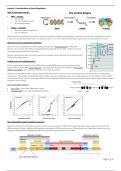
Lecture 1: Introductions to Gene Regulation
DNA as information storage:
• DNA → storage:
o Can replicate
o Can be efficiently repaired
o No enzymatic activity
• Protein → function:
o Enzymatic activity and structure
o Can not replicate
DNA is used to store genetic information in many viruses and all unicellular and multicellular organisms. It also contains information on how to
process the stored genetic information. The sequence of A, T, C, and G contains all information to give rise to all living organisms on earth.
Genome size versus organismal complexity:
Genomes vary in size (between and within groups of organisms). Central tendency = theory that
genome size increases with cellular and developmental complexity. For example: complex mammals
have larger genome size than simple fungi.
However, genome size does not predict organismal complexity, like the genome size of simple protists.
Cause: non-coding genome.
Coding versus non-coding genome:
Relation between genome size, coding DNA and non-coding DNA genome size expansion through
accumulation of “Junk” DNA. Coding genome = part of genome that encodes for proteins. Non-coding
DNA (or: Junk-DNA) = part of genome that does not encode for proteins.
The size of coding DNA initially increases proportionally with genome size, but in more complex genomes, the contribution of coding DNA is
relatively less. Intron DNA contributes little to the total genome size in smaller genomes, but in larger genomes, the contribution of intron DNA
increases significantly. The size of intergenic DNA increases proportionally with genome size, meaning the spaces between genes become larger
as genome size increases.
Non-coding DNA consists of:
• Intron DNA = non-coding DNA within a gene
• Intergenic DNA = non-coding DNA between genes
Non-coding DNA contains regulatory sequence:
Regulatory elements that drive gene expression do not code for proteins. 10-20 % of the human genome contains regulatory elements that
define start/end of genes, influence their expression, packaging of DNA into the nucleus, DNA replication, etc. Regulatory elements can be in
intragenic DNA (sometimes Megabases away from genes they regulate) and in intronic DNA.
1|Page
,The number of genes varies between organisms:
• Gene structure: prokaryotes
o Continuous coding sequence
o Multiple proteins from one transcript
• Gene structure: eukaryotes
o Coding sequence interrupted by introns
o One protein per transcript
Gene activity is cell type specific:
A substantial amount of (human) genes encodes for transcription factors.
• Housekeeping genes = genes that are always active and required for protein synthesis, DNA repair, other enzymatic and metabolic
processes in the cell
• Tissue-specific genes = genes that are required for specific cellular function or genes that drive tissue-specific gene programs
(=transcription factors)
Take home message:
• Genomes vary in size and gene content between different organisms
• Increase in genome size in multicellular organisms is mainly due to the non-coding part of the genome
• Non-coding DNA contains information required to coordinate gene expression
• A large fraction of human genes encodes for transcription factors (gene activators & repressors)
Components of gene regulation:
• Gene (defined start and end)
• Transcription machinery (RNA Polymerase + complex)
• Transcription factors (repressor/activator)
• Regulatory DNA sequences (promoters/operators/enhancers)
Problems of transcription: the cell must decide which part of the genome it has to transcribe at the right time. How are genes recognized and
targeted “in a sea of DNA”? How are the correct genes recognized and targeted? (~5000 out of ~23000 genes / cell)
A prokaryotic gene: components defined by DNA sequence
• Promoter (sets start and direction & can regulate transcriptional activity)
• Coding Sequence (makes proteins)
• Terminator (sets end of gene unit, stops transcription)
A prokaryotic gene: steps of transcription
1. Promoter recognition
2. Transcription initiation
3. Transcription elongation
4. Transcription termination
The prokaryotic promoter and its recognition: three core components
• Transcription Start Site (TSS)
• TATAAT region at –10 bp from TSS
• TTGACA region at –35 bp
DNA sequence of the 6-mer motifs, orientation, and spacing between the 6-mer motifs is important:
• Mutations in the 6-mer motifs (-10/-35) → reduced transcription
• DNA sequence substitution between the 6-mer motifs (-10/-35) → no effect
• Deletions/insertions between the 6-mer motifs (-10/-35) → reduced transcription
2|Page
, Proteins can read DNA sequence:
Base atoms protrude into the major and minor groove of the DNA Each base-pair has a specific
“signature”. Specialized protein-domains recognize and bind specific short DNA sequences. Non-
covalent interactions between multiple amino acids and atoms from nucleotides and phosphate
backbone increase affinity to specific sequences.
Not only are the atoms of individual base-pairs relevant for sequence readout, but also the shape of the
DNA. DNA shape can vary depending on base-pairs and their consecutive order in DNA. Influences
accessibility of proteins to bases and binding “fit”.
Important features:
• Minor grove width (space between backbones)
• Inter-base pair features (relation between two neighboring base pairs)
• Intra-base pair features (relation of two pairing bases)
The prokaryotic promoter and its recognition:
The RNA Polymerase needs to recognize the start of the gene =
promoter. Bacterial RNA polymerases contain 5 subunits: 4 in
core enzyme and the sigma factor.
The sigma factor is responsible for recognizing the –10 and –35
sequences. The binding specifically to –35 and –10 sequences
lead to positioning and orientation of the RNA polymerase.
–10/–35 consensus sequences → majority of bacterial promoters
contain sequences similar or related to these 6-mers.
Not all promoters have the same –10 and –35 recognition
sequences. Variation in DNA sequence defines the strength of
transcription (Sigma binds with high or low affinity).
Experiment: mutational analysis of transcriptional initiation in bacteria
The goal of the experiment is to find the strength of different –35 region sequences in RFP
promoter. First, –35 consensus sequences in RFP promoter are replaced by random
hexanucleotide (NNNNNN).
Next, each bacteria receives a plasmid with different –35 sequence. Lastly, readout of bacteria
by measuring RFP vs GFP (with standard –35 sequence): higher measure of RFP means higher
rate of transcriptional initiation with that specific –35 sequence.
Genetic switches regulate prokaryotic promoter activity:
Frequency of RNA Polymerase initiation depends on:
• Sequence variation in –10/–35 bp region
• Sigma factors: 7 different types (sigma70 is the major factor) → sequence specific
Cells needs to switch genes on and off (decision making). Variation in sequence and sigma factors are not sufficient for decision making →
additional controls needed. If decision making is only based on sequence recognition by sigma factors → continous transcription rates per gene.
3|Page
DNA as information storage:
• DNA → storage:
o Can replicate
o Can be efficiently repaired
o No enzymatic activity
• Protein → function:
o Enzymatic activity and structure
o Can not replicate
DNA is used to store genetic information in many viruses and all unicellular and multicellular organisms. It also contains information on how to
process the stored genetic information. The sequence of A, T, C, and G contains all information to give rise to all living organisms on earth.
Genome size versus organismal complexity:
Genomes vary in size (between and within groups of organisms). Central tendency = theory that
genome size increases with cellular and developmental complexity. For example: complex mammals
have larger genome size than simple fungi.
However, genome size does not predict organismal complexity, like the genome size of simple protists.
Cause: non-coding genome.
Coding versus non-coding genome:
Relation between genome size, coding DNA and non-coding DNA genome size expansion through
accumulation of “Junk” DNA. Coding genome = part of genome that encodes for proteins. Non-coding
DNA (or: Junk-DNA) = part of genome that does not encode for proteins.
The size of coding DNA initially increases proportionally with genome size, but in more complex genomes, the contribution of coding DNA is
relatively less. Intron DNA contributes little to the total genome size in smaller genomes, but in larger genomes, the contribution of intron DNA
increases significantly. The size of intergenic DNA increases proportionally with genome size, meaning the spaces between genes become larger
as genome size increases.
Non-coding DNA consists of:
• Intron DNA = non-coding DNA within a gene
• Intergenic DNA = non-coding DNA between genes
Non-coding DNA contains regulatory sequence:
Regulatory elements that drive gene expression do not code for proteins. 10-20 % of the human genome contains regulatory elements that
define start/end of genes, influence their expression, packaging of DNA into the nucleus, DNA replication, etc. Regulatory elements can be in
intragenic DNA (sometimes Megabases away from genes they regulate) and in intronic DNA.
1|Page
,The number of genes varies between organisms:
• Gene structure: prokaryotes
o Continuous coding sequence
o Multiple proteins from one transcript
• Gene structure: eukaryotes
o Coding sequence interrupted by introns
o One protein per transcript
Gene activity is cell type specific:
A substantial amount of (human) genes encodes for transcription factors.
• Housekeeping genes = genes that are always active and required for protein synthesis, DNA repair, other enzymatic and metabolic
processes in the cell
• Tissue-specific genes = genes that are required for specific cellular function or genes that drive tissue-specific gene programs
(=transcription factors)
Take home message:
• Genomes vary in size and gene content between different organisms
• Increase in genome size in multicellular organisms is mainly due to the non-coding part of the genome
• Non-coding DNA contains information required to coordinate gene expression
• A large fraction of human genes encodes for transcription factors (gene activators & repressors)
Components of gene regulation:
• Gene (defined start and end)
• Transcription machinery (RNA Polymerase + complex)
• Transcription factors (repressor/activator)
• Regulatory DNA sequences (promoters/operators/enhancers)
Problems of transcription: the cell must decide which part of the genome it has to transcribe at the right time. How are genes recognized and
targeted “in a sea of DNA”? How are the correct genes recognized and targeted? (~5000 out of ~23000 genes / cell)
A prokaryotic gene: components defined by DNA sequence
• Promoter (sets start and direction & can regulate transcriptional activity)
• Coding Sequence (makes proteins)
• Terminator (sets end of gene unit, stops transcription)
A prokaryotic gene: steps of transcription
1. Promoter recognition
2. Transcription initiation
3. Transcription elongation
4. Transcription termination
The prokaryotic promoter and its recognition: three core components
• Transcription Start Site (TSS)
• TATAAT region at –10 bp from TSS
• TTGACA region at –35 bp
DNA sequence of the 6-mer motifs, orientation, and spacing between the 6-mer motifs is important:
• Mutations in the 6-mer motifs (-10/-35) → reduced transcription
• DNA sequence substitution between the 6-mer motifs (-10/-35) → no effect
• Deletions/insertions between the 6-mer motifs (-10/-35) → reduced transcription
2|Page
, Proteins can read DNA sequence:
Base atoms protrude into the major and minor groove of the DNA Each base-pair has a specific
“signature”. Specialized protein-domains recognize and bind specific short DNA sequences. Non-
covalent interactions between multiple amino acids and atoms from nucleotides and phosphate
backbone increase affinity to specific sequences.
Not only are the atoms of individual base-pairs relevant for sequence readout, but also the shape of the
DNA. DNA shape can vary depending on base-pairs and their consecutive order in DNA. Influences
accessibility of proteins to bases and binding “fit”.
Important features:
• Minor grove width (space between backbones)
• Inter-base pair features (relation between two neighboring base pairs)
• Intra-base pair features (relation of two pairing bases)
The prokaryotic promoter and its recognition:
The RNA Polymerase needs to recognize the start of the gene =
promoter. Bacterial RNA polymerases contain 5 subunits: 4 in
core enzyme and the sigma factor.
The sigma factor is responsible for recognizing the –10 and –35
sequences. The binding specifically to –35 and –10 sequences
lead to positioning and orientation of the RNA polymerase.
–10/–35 consensus sequences → majority of bacterial promoters
contain sequences similar or related to these 6-mers.
Not all promoters have the same –10 and –35 recognition
sequences. Variation in DNA sequence defines the strength of
transcription (Sigma binds with high or low affinity).
Experiment: mutational analysis of transcriptional initiation in bacteria
The goal of the experiment is to find the strength of different –35 region sequences in RFP
promoter. First, –35 consensus sequences in RFP promoter are replaced by random
hexanucleotide (NNNNNN).
Next, each bacteria receives a plasmid with different –35 sequence. Lastly, readout of bacteria
by measuring RFP vs GFP (with standard –35 sequence): higher measure of RFP means higher
rate of transcriptional initiation with that specific –35 sequence.
Genetic switches regulate prokaryotic promoter activity:
Frequency of RNA Polymerase initiation depends on:
• Sequence variation in –10/–35 bp region
• Sigma factors: 7 different types (sigma70 is the major factor) → sequence specific
Cells needs to switch genes on and off (decision making). Variation in sequence and sigma factors are not sufficient for decision making →
additional controls needed. If decision making is only based on sequence recognition by sigma factors → continous transcription rates per gene.
3|Page