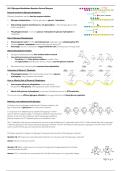
24.1 Glycogen Breakdown Requires Several Enzyme
Enzymes Involved in Glycogen Breakdown:
Glycogen breakdown requires four key enzyme activities:
1. Glycogen phosphorylase → Cleaves glycogen to glucose 1-phosphate.
2. Debranching enzymes (transferase & α-1,6-glucosidase) → Remodel glycogen to allow
further degradation.
3. Phosphoglucomutase → Converts glucose 1-phosphate to glucose 6-phosphate for
metabolism.
Role of Glycogen Phosphorylase:
• Cleaves glucose units from the nonreducing ends of glycogen using orthophosphate (Pi).
• Produces glucose 1-phosphate instead of free glucose, saving ATP.
• Advantage: Glucose 1-phosphate is trapped inside the cell, preventing loss of energy stores.
Debranching Enzyme Function:
• Glycogen phosphorylase stops four residues before a branch.
• Two additional enzymes remove branches:
o Transferase shifts three glucose residues to another chain.
o α-1,6-glucosidase hydrolyzes the branch, releasing one free glucose molecule.
• After debranching, phosphorylase continues linear degradation.
Conversion of Glucose 1-Phosphate:
• Phosphoglucomutase shifts the phosphate group to form glucose
6-phosphate, a key metabolic intermediate.
Liver vs. Muscle: Role of Glucose 6-Phosphatase:
• Liver enzyme glucose 6-phosphatase converts glucose 6-
phosphate to free glucose, allowing glucose export into the blood.
• Muscle lacks glucose 6-phosphatase, so glucose 6-phosphate remains for ATP production.
This process ensures efficient glycogen utilization for energy production and blood glucose regulation.
Reducing / non-reducing end of glycogen:
Consider a part of a glycogen molecule with 7 glucose moieties in the
figure. Notice that in glucose A the C-atoms are numbered.
C1 in glucose is an aldehyde group capable of engaging in a redox
reaction with for example copper, it is therefore called the reducing end of
glucose. In the cyclic form of glucose within the glycogen backbone
polymer, however, the C1 aldehyde group is not capable to react.
The C1 aldehyde of the glucose molecule from a branch is also locked by the 1,6-glycosidic bonds. The C1 of the ultimate start site for glycogen
is linked to glycogenin, the enzyme starting the glycogen molecule. The non-reducing end of the glucose in glycogen is the C4 carbon, it is the
carbon at which further glucose molecules are attached/removed.
This figure represents a fragment of glycogen. R represents the remainder of the glycogen molecule
Question 1A: Which glucose molecule(s) represent(s) the non-reducing ends of the glycogen molecule?
Answer: Glucose molecules A and G.
Question 1B: Which carbon atoms are involved in the glycosidic linkage between the indicated
monosaccharides A and B?
Answer: The C1 of residue A is connected to the C4 of B, thus forming an α-1,4 glycosidic linkage.
1|Page
,This figure represents a fragment of glycogen. R represents the remainder of the glycogen molecule.
Question 1C: How is the linkage between A and B called?
Answer: α-1,6-glycosidic linkage. It is the same type of linkage as in the main chain, only the residue A is
connected with its C1 to the C6 of B.
Question 1D: For which enzyme(s) is this glycogen fragment a direct substrate?
a. Glycogen Phosphorylase b
b. Glycogen Phosphorylase a
c. the branching enzyme
d. α-1,6 Glucosidase
Answer: In this form it can only be hydrolysed α-1,6 glucosidase (which will remove G). The two branches are too short for the other enzymes.
Phosphorylase a stops cleaving four residues away from a branching point.
Glycogen is stored in cells in the form of granules. The nonreducing ends of the glycogen molecule form the surface of the granule.
Question 2: Where is glycogen mainly stored in the body?
a. Blood
b. Muscles
c. Brain
d. Liver
Answer: It is mainly stored in both the liver and the skeletal muscles (mostly in the skeletal muscles). In certain glial cells in the brain, it can be
found, but only in very small amounts.
Question 3: Where is glycogen stored in the cell?
a. In dense granules in the mitochondria
b. In dense granules in the nucleus
c. In dense granules in the Smooth Endoplasmatic Reticulum (SER)
d. In dense granules in the cytoplasm
Answer: These are stored in dense granules in the cytoplasm of the cells specialized in glycogen storage.
Question 4: During starvation, which stores are the first to be depleted?
a. Glycogen reserves
b. Fat reserves
c. Protein reserves
Answer: Glycogen is readily mobilized and is therefore a good source of energy for sudden, strenuous activity. Unlike fatty acids, the released
glucose can provide energy in the absence of oxygen and can thus supply energy for anaerobic activity. In addition, there is a lot less carbon and
energy stored as glycogen than as fat in most humans: starvation for more than one day depletes the body of its glycogen stores.
There are several ways to cleave parts of the glycogen: phosphorolytic and hydrolytic.
Question 5A: What do these reactions produce?
Answer: Phosphorolytic cleavage results in a glucose 1-phosphate; hydrolytic cleavage in a glucose molecule.
Question 5B: What molecule(s) can directly enter the glycolytic pathway?
a. Glucose
b. Glucose 6-phosphate
c. Glucose 1-phosphate
Answer: Glucose and glucose 6-phosphate. The glycolytic pathway starts with glucose, which in the first step is converted into glucose 6-
phosphate. Glucose 1-phosphate can only enter the glycolytic pathway after it is converted into glucose 6-phosphate.
2|Page
, Question 5C: Which cleavage is energetically more advantageous?
a. Phosphorolytic
b. Hydrolytic
Answer: The conversion of glucose 1-phosphate from the phosphorolytic cleavage to glucose 6-phosphate does not require the expenditure of
an ATP. Converting glucose would, so the hydrolytic cleavage increases the ATP investment needed to harvest energy from stored glycogen.
This is a drawing of a glycogen molecule with one side chain. You will
now break it down to the core using three enzymes.
Question 6A: What enzyme do you use first and does this enzyme need another compound?
Answer: Glycogen phosphorylase. It needs an orthophosphate (Pi) to perform.
Question 6B: How many glucose molecules can Glycogen Phosphorylase remove from this end of the chain?
Answer: 8 molecules. Phosphorylase can only remove units from the end of a chain which is over 4 units long.
Question 6C: What enzyme do you use next and does this enzyme need another compound?
Answer: Transferase. It does not need any other compound.
Question 6D: How many glucose molecules can transferase transfer, from where and where are they transferred to?
Answer: It transfers 1 glucose molecule from the side chain to the main chain.
The last enzyme you use is a glucosidase, to remove the side chain of one glucose molecule.
Question 6E: What glucosidic bond does this glucosidase need to break?
Answer: It is α-1,6-glucosidase.
Question 6F: Does α-1,6-Glucosidase need another compound?
Answer: It needs water to donate a proton to the main chain and an OH-group to donate to the glucose on the side chain.
Question 6I: What do these three enzymes release?
Answer:
• Glycogen Phosphorylase: glucose 1-phosphate
• Transferase: remodelled glycogen
• α-1,6-Glucosidase: glucose
Question 6J: Does any of these enzymes require ATP?
a. No
b. Yes, Glycogen Phosphorylase
c. Yes, both Glycogen Phosphorylase and Transferase
d. Yes, all of them
Answer: No. ATP is not required by any of the enzymes, only later in the glycolysis to process some of the released molecules.
Question 6K: Which bonds do these three enzymes cleave?
Answer: Glucose molecules in a chain have α-1,4 glycosidic bonds; side chains are attached with an α-1,6 glycosidic bond.
• Glycogen Phosphorylase: α-1,4-glycosidic bonds
• Transferase: α-1,4-glycosidic bonds
• α-1,6-Glucosidase: α-1,6-glycosidic bonds
3|Page
Enzymes Involved in Glycogen Breakdown:
Glycogen breakdown requires four key enzyme activities:
1. Glycogen phosphorylase → Cleaves glycogen to glucose 1-phosphate.
2. Debranching enzymes (transferase & α-1,6-glucosidase) → Remodel glycogen to allow
further degradation.
3. Phosphoglucomutase → Converts glucose 1-phosphate to glucose 6-phosphate for
metabolism.
Role of Glycogen Phosphorylase:
• Cleaves glucose units from the nonreducing ends of glycogen using orthophosphate (Pi).
• Produces glucose 1-phosphate instead of free glucose, saving ATP.
• Advantage: Glucose 1-phosphate is trapped inside the cell, preventing loss of energy stores.
Debranching Enzyme Function:
• Glycogen phosphorylase stops four residues before a branch.
• Two additional enzymes remove branches:
o Transferase shifts three glucose residues to another chain.
o α-1,6-glucosidase hydrolyzes the branch, releasing one free glucose molecule.
• After debranching, phosphorylase continues linear degradation.
Conversion of Glucose 1-Phosphate:
• Phosphoglucomutase shifts the phosphate group to form glucose
6-phosphate, a key metabolic intermediate.
Liver vs. Muscle: Role of Glucose 6-Phosphatase:
• Liver enzyme glucose 6-phosphatase converts glucose 6-
phosphate to free glucose, allowing glucose export into the blood.
• Muscle lacks glucose 6-phosphatase, so glucose 6-phosphate remains for ATP production.
This process ensures efficient glycogen utilization for energy production and blood glucose regulation.
Reducing / non-reducing end of glycogen:
Consider a part of a glycogen molecule with 7 glucose moieties in the
figure. Notice that in glucose A the C-atoms are numbered.
C1 in glucose is an aldehyde group capable of engaging in a redox
reaction with for example copper, it is therefore called the reducing end of
glucose. In the cyclic form of glucose within the glycogen backbone
polymer, however, the C1 aldehyde group is not capable to react.
The C1 aldehyde of the glucose molecule from a branch is also locked by the 1,6-glycosidic bonds. The C1 of the ultimate start site for glycogen
is linked to glycogenin, the enzyme starting the glycogen molecule. The non-reducing end of the glucose in glycogen is the C4 carbon, it is the
carbon at which further glucose molecules are attached/removed.
This figure represents a fragment of glycogen. R represents the remainder of the glycogen molecule
Question 1A: Which glucose molecule(s) represent(s) the non-reducing ends of the glycogen molecule?
Answer: Glucose molecules A and G.
Question 1B: Which carbon atoms are involved in the glycosidic linkage between the indicated
monosaccharides A and B?
Answer: The C1 of residue A is connected to the C4 of B, thus forming an α-1,4 glycosidic linkage.
1|Page
,This figure represents a fragment of glycogen. R represents the remainder of the glycogen molecule.
Question 1C: How is the linkage between A and B called?
Answer: α-1,6-glycosidic linkage. It is the same type of linkage as in the main chain, only the residue A is
connected with its C1 to the C6 of B.
Question 1D: For which enzyme(s) is this glycogen fragment a direct substrate?
a. Glycogen Phosphorylase b
b. Glycogen Phosphorylase a
c. the branching enzyme
d. α-1,6 Glucosidase
Answer: In this form it can only be hydrolysed α-1,6 glucosidase (which will remove G). The two branches are too short for the other enzymes.
Phosphorylase a stops cleaving four residues away from a branching point.
Glycogen is stored in cells in the form of granules. The nonreducing ends of the glycogen molecule form the surface of the granule.
Question 2: Where is glycogen mainly stored in the body?
a. Blood
b. Muscles
c. Brain
d. Liver
Answer: It is mainly stored in both the liver and the skeletal muscles (mostly in the skeletal muscles). In certain glial cells in the brain, it can be
found, but only in very small amounts.
Question 3: Where is glycogen stored in the cell?
a. In dense granules in the mitochondria
b. In dense granules in the nucleus
c. In dense granules in the Smooth Endoplasmatic Reticulum (SER)
d. In dense granules in the cytoplasm
Answer: These are stored in dense granules in the cytoplasm of the cells specialized in glycogen storage.
Question 4: During starvation, which stores are the first to be depleted?
a. Glycogen reserves
b. Fat reserves
c. Protein reserves
Answer: Glycogen is readily mobilized and is therefore a good source of energy for sudden, strenuous activity. Unlike fatty acids, the released
glucose can provide energy in the absence of oxygen and can thus supply energy for anaerobic activity. In addition, there is a lot less carbon and
energy stored as glycogen than as fat in most humans: starvation for more than one day depletes the body of its glycogen stores.
There are several ways to cleave parts of the glycogen: phosphorolytic and hydrolytic.
Question 5A: What do these reactions produce?
Answer: Phosphorolytic cleavage results in a glucose 1-phosphate; hydrolytic cleavage in a glucose molecule.
Question 5B: What molecule(s) can directly enter the glycolytic pathway?
a. Glucose
b. Glucose 6-phosphate
c. Glucose 1-phosphate
Answer: Glucose and glucose 6-phosphate. The glycolytic pathway starts with glucose, which in the first step is converted into glucose 6-
phosphate. Glucose 1-phosphate can only enter the glycolytic pathway after it is converted into glucose 6-phosphate.
2|Page
, Question 5C: Which cleavage is energetically more advantageous?
a. Phosphorolytic
b. Hydrolytic
Answer: The conversion of glucose 1-phosphate from the phosphorolytic cleavage to glucose 6-phosphate does not require the expenditure of
an ATP. Converting glucose would, so the hydrolytic cleavage increases the ATP investment needed to harvest energy from stored glycogen.
This is a drawing of a glycogen molecule with one side chain. You will
now break it down to the core using three enzymes.
Question 6A: What enzyme do you use first and does this enzyme need another compound?
Answer: Glycogen phosphorylase. It needs an orthophosphate (Pi) to perform.
Question 6B: How many glucose molecules can Glycogen Phosphorylase remove from this end of the chain?
Answer: 8 molecules. Phosphorylase can only remove units from the end of a chain which is over 4 units long.
Question 6C: What enzyme do you use next and does this enzyme need another compound?
Answer: Transferase. It does not need any other compound.
Question 6D: How many glucose molecules can transferase transfer, from where and where are they transferred to?
Answer: It transfers 1 glucose molecule from the side chain to the main chain.
The last enzyme you use is a glucosidase, to remove the side chain of one glucose molecule.
Question 6E: What glucosidic bond does this glucosidase need to break?
Answer: It is α-1,6-glucosidase.
Question 6F: Does α-1,6-Glucosidase need another compound?
Answer: It needs water to donate a proton to the main chain and an OH-group to donate to the glucose on the side chain.
Question 6I: What do these three enzymes release?
Answer:
• Glycogen Phosphorylase: glucose 1-phosphate
• Transferase: remodelled glycogen
• α-1,6-Glucosidase: glucose
Question 6J: Does any of these enzymes require ATP?
a. No
b. Yes, Glycogen Phosphorylase
c. Yes, both Glycogen Phosphorylase and Transferase
d. Yes, all of them
Answer: No. ATP is not required by any of the enzymes, only later in the glycolysis to process some of the released molecules.
Question 6K: Which bonds do these three enzymes cleave?
Answer: Glucose molecules in a chain have α-1,4 glycosidic bonds; side chains are attached with an α-1,6 glycosidic bond.
• Glycogen Phosphorylase: α-1,4-glycosidic bonds
• Transferase: α-1,4-glycosidic bonds
• α-1,6-Glucosidase: α-1,6-glycosidic bonds
3|Page