

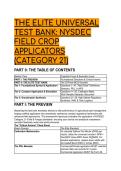
THE ELITE UNIVERSAL
TEST BANK: NYSDEC
FIELD CROP
APPLICATORS
(CATEGORY 21)
PART 0: THE TABLE OF CONTENTS
Section Tiers Cognitive Focus & Execution Level
PART I: THE PREVIEW Foundational Directives & Critical Axioms
PART II: THE ELITE TEST BANK The 30-Point MCQ Gauntlet
Tier 1: Foundational Syntax & Application Questions 1–10: "Hard Deck" Definitions,
Setbacks, PRL, & WPS
Tier 2: Complex Application & Simulation Questions 11–20: Calibration Math,
Multi-Variable Setbacks, Biocontrol
Tier 3: Grandmaster Synthesis Questions 21–30: High-Stakes Regulatory
Synthesis, IWM, & Tank Logistics
PART I: THE PREVIEW
Mastering this test bank translates directly to elite performance in agricultural pest management,
forging certified applicators who seamlessly synthesize complex regulatory frameworks with
advanced field agronomics. This assessment rigorously evaluates the application of NYSDEC
Category 21 (Field & Forage) standards, ensuring your clinical and analytical competence
operates flawlessly under real-world pressures.
The "Critical Axioms" Cheat Sheet
Axiom Domain The Elite Standard
Calibration Mathematics To calculate Gallons Per Minute (GPM) per
nozzle, utilize the universal constant: GPM =
\frac{GPA \times MPH \times W}{5940}. For
banded applications, replace boom width with
the treated Band Width in Inches (BWI).
The PRL Mandate Commercial/Private applicators MUST maintain
granular daily use records for 3 years.
Commercial applicators MUST file Form 26
,Axiom Domain The Elite Standard
annually by Feb 1st, even for zero applications.
Groundwater Setbacks Mixing/loading is prohibited within 50 feet of
any well or intermittent stream unless on an
impervious pad. Application requires a 66-foot
buffer from runoff entry points and 200 feet from
natural lakes.
WPS Decontamination Handlers require 3 gallons of wash water.
Pressurized closed-system mixing demands a
15-minute (0.4 GPM / 6 gallon) eye flush.
Applications requiring eyewear demand 1 pint
of immediately available flush water.
Biological Integration For subterranean pests like the Alfalfa Snout
Beetle (ASB), apply native entomopathogenic
nematodes (S. carpocapsae and S. feltiae) at a
minimum of 50 GPA with all sprayer screens
removed.
PART II: THE ELITE TEST BANK
Tier 1: Foundational Syntax & Application
Q1: A private pesticide applicator managing a 500-acre forage operation in New York State is
approaching the end of their certification cycle. Under NYSDEC regulations, what is the EXACT
requirement to successfully recertify in Category 21 (Field & Forage) without taking a
recertification examination? A) Accumulate 10 category-specific continuing education credits
over a 3-year period. B) Accumulate 8 category-specific continuing education credits over a
5-year period. C) Accumulate 10 category-specific continuing education credits over a 5-year
period, obtained in more than one calendar year. D) Accumulate 12 category-specific continuing
education credits within the final 12 months of the 5-year cycle.
● The Answer: C (Accumulate 10 category-specific continuing education credits over a
5-year period, obtained in more than one calendar year.)
● Distractor Analysis:
○ A is incorrect: Commercial applicators operate on a 3-year cycle, but private
applicators operate on a 5-year certification cycle.
○ B is incorrect: Accumulating 8 credits is the requirement for Category 31
(Agricultural Animal Pest Control) or Category 1A, not Category 21.
○ D is incorrect: Credits must be obtained in more than one calendar year. Private
applicators are explicitly forbidden from earning all their credits in a single year to
prevent last-minute cramming.
The Mentor's Analysis: Private applicators are bound by a 5-year certification cycle, distinct
from the accelerated 3-year commercial cycle. Category 21 explicitly requires 10 credits spread
across multiple years. Professional/Academic Intuition: Never conflate commercial and
private timelines; Private = 5 years / 10 credits (Cat 21), Commercial = 3 years.
Q2: Under the New York State Pesticide Reporting Law (PRL), a commercial applicator utilizes
a general-use herbicide and an EPA-exempt minimum-risk pesticide on a field crop. Which
action MUST the applicator take regarding recordkeeping and reporting? A) Record both
products in the daily use record and report both on the annual Form 26. B) Record both
, products in the daily use record, but exclude the minimum-risk product from the annual Form 26
report. C) Exclude the minimum-risk product entirely from all daily records and annual reports.
D) Report the general-use herbicide on Form 26 and report the minimum-risk product only on
WPS safety data logs.
● The Answer: B (Record both products in the daily use record, but exclude the
minimum-risk product from the annual Form 26 report.)
● Distractor Analysis:
○ A is incorrect: Minimum-risk products do not possess an EPA Registration Number
and must not be included in the annual PRL report submitted to the state.
○ C is incorrect: Title 6 NYCRR Part 325.25 mandates that all pesticide activities,
including minimum-risk products, must be maintained in daily use records for 3
years.
○ D is incorrect: Minimum-risk products require daily use logging under State law,
independent of any federal Worker Protection Standard (WPS) requirements.
The Mentor's Analysis: The PRL creates a strict bifurcation between internal logging and
external reporting. Daily records represent absolute ground truth (every chemical applied), while
annual reports are filtered for registered EPA products to track specific environmental chemical
loads. Professional/Academic Intuition: Daily use records capture everything; Annual
Reports capture only EPA-registered products.
Q3: An applicator plans to use a restricted-use herbicide (e.g., Atrazine) near a rural farm site.
Based on the label restrictions designed to protect groundwater, what is the absolute MINIMUM
setback distance required when mixing or loading this product near an abandoned drainage
well? A) 25 feet B) 50 feet C) 66 feet D) 100 feet
● The Answer: B (50 feet)
● Distractor Analysis:
○ A is incorrect: 25 feet is the Application Exclusion Zone (AEZ) for medium/coarse
sprays applied from a height greater than 12 inches, which is unrelated to structural
well setbacks.
○ C is incorrect: 66 feet is the standard setback for points where surface water runoff
enters perennial or intermittent streams, not for mixing near wells.
○ D is incorrect: While 100 feet is recommended as a best management practice for
private wells, the strict legal baseline for mixing/loading near any well (including
abandoned or drainage wells) is 50 feet unless conducted on a certified impervious
pad.
The Mentor's Analysis: Groundwater protection relies on strict, non-negotiable physical buffers
to mitigate point-source contamination from catastrophic spills or back-siphoning events during
the high-risk mixing phase. Professional/Academic Intuition: The "Hard Deck" for
mixing/loading near any well, sinkhole, or intermittent stream is always 50 feet.
Q4: A handler employer is setting up a decontamination site for early-entry workers and
handlers in accordance with the Worker Protection Standard (WPS). If handlers are mixing a
pesticide that mandates protective eyewear, what is the IMMEDIATE requirement for eye flush
water? A) 1 gallon of water per worker located within 1/4 mile. B) 3 gallons of water per handler
located in a central facility. C) 1 pint of water in a portable container immediately available to
each handler. D) A plumbed system delivering 0.4 gallons per minute for exactly 10 minutes.
● The Answer: C (1 pint of water in a portable container immediately available to each
handler.)
● Distractor Analysis:
○ A is incorrect: 1 gallon per worker is the standard routine washing requirement for
TEST BANK: NYSDEC
FIELD CROP
APPLICATORS
(CATEGORY 21)
PART 0: THE TABLE OF CONTENTS
Section Tiers Cognitive Focus & Execution Level
PART I: THE PREVIEW Foundational Directives & Critical Axioms
PART II: THE ELITE TEST BANK The 30-Point MCQ Gauntlet
Tier 1: Foundational Syntax & Application Questions 1–10: "Hard Deck" Definitions,
Setbacks, PRL, & WPS
Tier 2: Complex Application & Simulation Questions 11–20: Calibration Math,
Multi-Variable Setbacks, Biocontrol
Tier 3: Grandmaster Synthesis Questions 21–30: High-Stakes Regulatory
Synthesis, IWM, & Tank Logistics
PART I: THE PREVIEW
Mastering this test bank translates directly to elite performance in agricultural pest management,
forging certified applicators who seamlessly synthesize complex regulatory frameworks with
advanced field agronomics. This assessment rigorously evaluates the application of NYSDEC
Category 21 (Field & Forage) standards, ensuring your clinical and analytical competence
operates flawlessly under real-world pressures.
The "Critical Axioms" Cheat Sheet
Axiom Domain The Elite Standard
Calibration Mathematics To calculate Gallons Per Minute (GPM) per
nozzle, utilize the universal constant: GPM =
\frac{GPA \times MPH \times W}{5940}. For
banded applications, replace boom width with
the treated Band Width in Inches (BWI).
The PRL Mandate Commercial/Private applicators MUST maintain
granular daily use records for 3 years.
Commercial applicators MUST file Form 26
,Axiom Domain The Elite Standard
annually by Feb 1st, even for zero applications.
Groundwater Setbacks Mixing/loading is prohibited within 50 feet of
any well or intermittent stream unless on an
impervious pad. Application requires a 66-foot
buffer from runoff entry points and 200 feet from
natural lakes.
WPS Decontamination Handlers require 3 gallons of wash water.
Pressurized closed-system mixing demands a
15-minute (0.4 GPM / 6 gallon) eye flush.
Applications requiring eyewear demand 1 pint
of immediately available flush water.
Biological Integration For subterranean pests like the Alfalfa Snout
Beetle (ASB), apply native entomopathogenic
nematodes (S. carpocapsae and S. feltiae) at a
minimum of 50 GPA with all sprayer screens
removed.
PART II: THE ELITE TEST BANK
Tier 1: Foundational Syntax & Application
Q1: A private pesticide applicator managing a 500-acre forage operation in New York State is
approaching the end of their certification cycle. Under NYSDEC regulations, what is the EXACT
requirement to successfully recertify in Category 21 (Field & Forage) without taking a
recertification examination? A) Accumulate 10 category-specific continuing education credits
over a 3-year period. B) Accumulate 8 category-specific continuing education credits over a
5-year period. C) Accumulate 10 category-specific continuing education credits over a 5-year
period, obtained in more than one calendar year. D) Accumulate 12 category-specific continuing
education credits within the final 12 months of the 5-year cycle.
● The Answer: C (Accumulate 10 category-specific continuing education credits over a
5-year period, obtained in more than one calendar year.)
● Distractor Analysis:
○ A is incorrect: Commercial applicators operate on a 3-year cycle, but private
applicators operate on a 5-year certification cycle.
○ B is incorrect: Accumulating 8 credits is the requirement for Category 31
(Agricultural Animal Pest Control) or Category 1A, not Category 21.
○ D is incorrect: Credits must be obtained in more than one calendar year. Private
applicators are explicitly forbidden from earning all their credits in a single year to
prevent last-minute cramming.
The Mentor's Analysis: Private applicators are bound by a 5-year certification cycle, distinct
from the accelerated 3-year commercial cycle. Category 21 explicitly requires 10 credits spread
across multiple years. Professional/Academic Intuition: Never conflate commercial and
private timelines; Private = 5 years / 10 credits (Cat 21), Commercial = 3 years.
Q2: Under the New York State Pesticide Reporting Law (PRL), a commercial applicator utilizes
a general-use herbicide and an EPA-exempt minimum-risk pesticide on a field crop. Which
action MUST the applicator take regarding recordkeeping and reporting? A) Record both
products in the daily use record and report both on the annual Form 26. B) Record both
, products in the daily use record, but exclude the minimum-risk product from the annual Form 26
report. C) Exclude the minimum-risk product entirely from all daily records and annual reports.
D) Report the general-use herbicide on Form 26 and report the minimum-risk product only on
WPS safety data logs.
● The Answer: B (Record both products in the daily use record, but exclude the
minimum-risk product from the annual Form 26 report.)
● Distractor Analysis:
○ A is incorrect: Minimum-risk products do not possess an EPA Registration Number
and must not be included in the annual PRL report submitted to the state.
○ C is incorrect: Title 6 NYCRR Part 325.25 mandates that all pesticide activities,
including minimum-risk products, must be maintained in daily use records for 3
years.
○ D is incorrect: Minimum-risk products require daily use logging under State law,
independent of any federal Worker Protection Standard (WPS) requirements.
The Mentor's Analysis: The PRL creates a strict bifurcation between internal logging and
external reporting. Daily records represent absolute ground truth (every chemical applied), while
annual reports are filtered for registered EPA products to track specific environmental chemical
loads. Professional/Academic Intuition: Daily use records capture everything; Annual
Reports capture only EPA-registered products.
Q3: An applicator plans to use a restricted-use herbicide (e.g., Atrazine) near a rural farm site.
Based on the label restrictions designed to protect groundwater, what is the absolute MINIMUM
setback distance required when mixing or loading this product near an abandoned drainage
well? A) 25 feet B) 50 feet C) 66 feet D) 100 feet
● The Answer: B (50 feet)
● Distractor Analysis:
○ A is incorrect: 25 feet is the Application Exclusion Zone (AEZ) for medium/coarse
sprays applied from a height greater than 12 inches, which is unrelated to structural
well setbacks.
○ C is incorrect: 66 feet is the standard setback for points where surface water runoff
enters perennial or intermittent streams, not for mixing near wells.
○ D is incorrect: While 100 feet is recommended as a best management practice for
private wells, the strict legal baseline for mixing/loading near any well (including
abandoned or drainage wells) is 50 feet unless conducted on a certified impervious
pad.
The Mentor's Analysis: Groundwater protection relies on strict, non-negotiable physical buffers
to mitigate point-source contamination from catastrophic spills or back-siphoning events during
the high-risk mixing phase. Professional/Academic Intuition: The "Hard Deck" for
mixing/loading near any well, sinkhole, or intermittent stream is always 50 feet.
Q4: A handler employer is setting up a decontamination site for early-entry workers and
handlers in accordance with the Worker Protection Standard (WPS). If handlers are mixing a
pesticide that mandates protective eyewear, what is the IMMEDIATE requirement for eye flush
water? A) 1 gallon of water per worker located within 1/4 mile. B) 3 gallons of water per handler
located in a central facility. C) 1 pint of water in a portable container immediately available to
each handler. D) A plumbed system delivering 0.4 gallons per minute for exactly 10 minutes.
● The Answer: C (1 pint of water in a portable container immediately available to each
handler.)
● Distractor Analysis:
○ A is incorrect: 1 gallon per worker is the standard routine washing requirement for


