

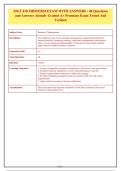
MGT 410 MIDTERM EXAM WITH ANSWERS - 40 Questions
and Answers Already Graded A+ Premium Exam Tested And
Verified
Subject Area Business / Management
Description This midterm exam covers strategic management, organizational behavior,
financial analysis, marketing strategy, operations management, and business
ethics. It tests advanced understanding of theoretical frameworks and their
application to complex business scenarios.
Expected Grade A+
Total Questions 40
Duration 3 hours
Learning Outcomes 1. Analyze competitive dynamics using Porter's Five Forces and game theory
2. Evaluate financial statements to assess firm performance and risk
3. Design organizational structures to align with strategy
4. Develop marketing strategies based on consumer behavior and market
segmentation
5. Apply ethical reasoning to business dilemmas
Accreditation This exam meets the rigorous standards of AACSB-accredited US business
schools at the graduate level.
Page 1
,1. In a market with high exit barriers and low switching costs for buyers, which
competitive force is most likely to intensify, and what is the resulting impact on
industry profitability?
A. Threat of new entrants increases, reducing profitability.
B. Rivalry among existing competitors intensifies, eroding profitability.
C. Bargaining power of suppliers increases, squeezing margins.
D. Threat of substitutes increases, limiting price increases.
Answer: B. Rivalry among existing competitors intensifies, eroding profitability.
High exit barriers force firms to remain in the industry even when profits are low,
increasing rivalry. Low switching costs enable buyers to easily switch, further
intensifying competition. This combination typically depresses industry profitability.
2. A firm's current ratio is 2.5, quick ratio is 1.2, and cash ratio is 0.4. The industry
averages are 2.0, 1.0, and 0.5 respectively. Which conclusion best interprets these
ratios?
A. The firm has excessive inventory relative to its current liabilities.
B. The firm has strong liquidity but may be over-invested in inventory.
C. The firm's cash position is weak, indicating potential insolvency.
D. The firm relies heavily on accounts receivable for liquidity.
Answer: B. The firm has strong liquidity but may be over-invested in inventory.
The current and quick ratios are above industry averages, indicating strong overall
liquidity. However, the cash ratio is below average, suggesting that a significant portion
of current assets is tied up in inventory and receivables, not cash.
3. Which organizational structure is most appropriate for a multinational
corporation pursuing a transnational strategy that requires both global efficiency
and local responsiveness?
A. Global product division structure
B. Matrix structure with geographic and product dimensions
C. International division structure
D. Worldwide functional structure
Answer: B. Matrix structure with geographic and product dimensions
A matrix structure allows simultaneous focus on product (global efficiency) and
geographic regions (local responsiveness), aligning with the dual demands of a
transnational strategy. Other structures prioritize one dimension over the other.
Page 2
, 4. A company uses a differentiation strategy. Which of the following control systems
is most consistent with this strategy?
A. Tight cost controls with standardized operating procedures
B. Flexible, decentralized decision-making with output controls
C. Rigid bureaucratic controls with detailed rules
D. Centralized planning with strict budget adherence
Answer: B. Flexible, decentralized decision-making with output controls
Differentiation requires creativity and flexibility to produce unique products.
Decentralized decision-making and output controls (e.g., innovation metrics) support
this, while tight cost controls and rigid rules stifle innovation.
5. In a repeated prisoners' dilemma game with an indefinite horizon, which strategy
is most likely to sustain cooperation under the condition that players are sufficiently
patient?
A. Always defect
B. Tit-for-tat
C. Grim trigger
D. Randomized mixed strategy
Answer: B. Tit-for-tat
Tit-for-tat (cooperate first, then mimic opponent's last move) is robust in sustaining
cooperation because it is nice, retaliatory, forgiving, and clear. Grim trigger (permanent
defection after one defection) is less forgiving and can lead to breakdown.
6. A firm's stock has a beta of 1.5, the risk-free rate is 3%, and the expected market
return is 10%. If the firm's actual return over the past year was 12%, what is the
abnormal return according to the Capital Asset Pricing Model?
A. -1.5%
B. 0%
C. 1.5%
D. 3%
Answer: A. -1.5%
CAPM expected return = 3% + 1.5*(10%-3%) = 13.5%. Abnormal return = actual -
expected = 12% - 13.5% = -1.5%.
Page 3
and Answers Already Graded A+ Premium Exam Tested And
Verified
Subject Area Business / Management
Description This midterm exam covers strategic management, organizational behavior,
financial analysis, marketing strategy, operations management, and business
ethics. It tests advanced understanding of theoretical frameworks and their
application to complex business scenarios.
Expected Grade A+
Total Questions 40
Duration 3 hours
Learning Outcomes 1. Analyze competitive dynamics using Porter's Five Forces and game theory
2. Evaluate financial statements to assess firm performance and risk
3. Design organizational structures to align with strategy
4. Develop marketing strategies based on consumer behavior and market
segmentation
5. Apply ethical reasoning to business dilemmas
Accreditation This exam meets the rigorous standards of AACSB-accredited US business
schools at the graduate level.
Page 1
,1. In a market with high exit barriers and low switching costs for buyers, which
competitive force is most likely to intensify, and what is the resulting impact on
industry profitability?
A. Threat of new entrants increases, reducing profitability.
B. Rivalry among existing competitors intensifies, eroding profitability.
C. Bargaining power of suppliers increases, squeezing margins.
D. Threat of substitutes increases, limiting price increases.
Answer: B. Rivalry among existing competitors intensifies, eroding profitability.
High exit barriers force firms to remain in the industry even when profits are low,
increasing rivalry. Low switching costs enable buyers to easily switch, further
intensifying competition. This combination typically depresses industry profitability.
2. A firm's current ratio is 2.5, quick ratio is 1.2, and cash ratio is 0.4. The industry
averages are 2.0, 1.0, and 0.5 respectively. Which conclusion best interprets these
ratios?
A. The firm has excessive inventory relative to its current liabilities.
B. The firm has strong liquidity but may be over-invested in inventory.
C. The firm's cash position is weak, indicating potential insolvency.
D. The firm relies heavily on accounts receivable for liquidity.
Answer: B. The firm has strong liquidity but may be over-invested in inventory.
The current and quick ratios are above industry averages, indicating strong overall
liquidity. However, the cash ratio is below average, suggesting that a significant portion
of current assets is tied up in inventory and receivables, not cash.
3. Which organizational structure is most appropriate for a multinational
corporation pursuing a transnational strategy that requires both global efficiency
and local responsiveness?
A. Global product division structure
B. Matrix structure with geographic and product dimensions
C. International division structure
D. Worldwide functional structure
Answer: B. Matrix structure with geographic and product dimensions
A matrix structure allows simultaneous focus on product (global efficiency) and
geographic regions (local responsiveness), aligning with the dual demands of a
transnational strategy. Other structures prioritize one dimension over the other.
Page 2
, 4. A company uses a differentiation strategy. Which of the following control systems
is most consistent with this strategy?
A. Tight cost controls with standardized operating procedures
B. Flexible, decentralized decision-making with output controls
C. Rigid bureaucratic controls with detailed rules
D. Centralized planning with strict budget adherence
Answer: B. Flexible, decentralized decision-making with output controls
Differentiation requires creativity and flexibility to produce unique products.
Decentralized decision-making and output controls (e.g., innovation metrics) support
this, while tight cost controls and rigid rules stifle innovation.
5. In a repeated prisoners' dilemma game with an indefinite horizon, which strategy
is most likely to sustain cooperation under the condition that players are sufficiently
patient?
A. Always defect
B. Tit-for-tat
C. Grim trigger
D. Randomized mixed strategy
Answer: B. Tit-for-tat
Tit-for-tat (cooperate first, then mimic opponent's last move) is robust in sustaining
cooperation because it is nice, retaliatory, forgiving, and clear. Grim trigger (permanent
defection after one defection) is less forgiving and can lead to breakdown.
6. A firm's stock has a beta of 1.5, the risk-free rate is 3%, and the expected market
return is 10%. If the firm's actual return over the past year was 12%, what is the
abnormal return according to the Capital Asset Pricing Model?
A. -1.5%
B. 0%
C. 1.5%
D. 3%
Answer: A. -1.5%
CAPM expected return = 3% + 1.5*(10%-3%) = 13.5%. Abnormal return = actual -
expected = 12% - 13.5% = -1.5%.
Page 3


