

THIS DOCUMENT BELONGS TO
TESTBANKSPROF
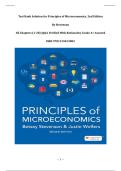
Test Bank Solution for Principles of Microeconomics, 2nd Edition
By Stevenson
All Chapters (1-20) |Q&A Verified With Rationales| Grade A+ Assured
ISBN 9781319433802
~1~
,THIS DOCUMENT BELONGS TO
TESTBANKSPROF
TABLE OF CONTENTS
Chapter 1: The Core Principles of Economics ............................................................... 3
Chapter 2: Demand: Thinking Like a Buyer.................................................................... 19
Chapter 3: Supply: Thinking Like a Seller ................................................................... 59
Chapter 4: Equilibrium: Where Supply Meets Demand Part II: Analyzing Markets.... 79
Chapter 5: Elasticity: Measuring Responsiveness ....................................................... 98
Chapter 6: When Governments Intervene in Markets .............................................. 122
Chapter 7: Welfare and Efficiency ............................................................................. 138
Chapter 8: Gains from Trade ..................................................................................... 164
Chapter 10: Externalities and Public Goods ................................................................. 178
Chapter 9: International Trade ................................................................................. 181
CHAPTER 10: WAGES, WORKERS, AND MANAGEMENT ............................................. 225
CHAPTER 11: INEQUALITY, SOCIAL INSURANCE, AND REDISTRIBUTION ................. 226
Chapter 12: Wages, Workers, and Management ....................................................... 244
Chapter 13: Inequality, Social Insurance, and Redistribution Part IV: Market Structure
and Business Strategy ............................................................................................... 265
Chapter 14: Market Structure and Market Power ..................................................... 291
Chapter 15: Entry, Exit, and Long-Run Profitability .................................................. 306
Chapter 16: Business Strategy) ................................................................................. 327
Chapter 18: Sophisticated Pricing Strategies............................................................ 347
Chapter 19: Decisions Involving Uncertainty............................................................ 369
Chapter 20: Decisions Involving Private Information ............................................... 388
~2~
, THIS DOCUMENT BELONGS TO
TESTBANKSPROF
Each question is accompanied by four options, the correct answer, and a brief explanation.
Chapter 1: The Core Principles of Economics
1. THE CORE PRINCIPLES OF ECONOMICS
Questions 1-50
1. What is the basic economic problem that arises because resources are limited?
o A) Inflation
o B) Scarcity
o C) Unemployment
o D) Trade deficits
CORRECT ANSWER B
Explanation: Scarcity refers to the fundamental economic problem of having seemingly
unlimited human wants in a world of limited resources.
2. Opportunity cost is best defined as:
o A) The monetary cost of an alternative.
o B) The benefit of the next best alternative foregone.
o C) The total cost of all alternatives.
o D) The cost of producing one more unit.
CORRECT ANSWER B
Explanation: Opportunity cost is the value of the next best alternative that is foregone when a
choice is made.
3. Which of the following is NOT considered a factor of production?
o A) Land
o B) Labor
o C) Capital
o D) Money
Explanation: The factors of production include land, labor, capital, and entrepreneurship. Money
is not a factor of production.
~3~
, THIS DOCUMENT BELONGS TO
TESTBANKSPROF
4. Marginal analysis involves comparing:
o A) Total costs to total benefits.
o B) Average costs to average benefits.
o C) The additional benefits of an action to the additional costs.
o D) Fixed costs to variable costs.
CORRECT ANSWER C
Explanation: Marginal analysis examines the additional benefits and additional costs of an
action to determine its worth.
5. Which principle states that people respond to incentives?
o A) Scarcity
o B) Opportunity Cost
o C) Marginal Analysis
o D) Incentives Matter
CORRECT ANSWER D
Explanation: The principle "People Respond to Incentives" highlights that individuals' behavior
changes in response to rewards or penalties.
6. Trade-offs are necessary because:
o A) Resources are unlimited.
o B) Choices have no costs.
o C) Allocating resources to one use means they are not available for another.
o D) Markets are always efficient.
CORRECT ANSWER C
Explanation: Trade-offs arise because resources allocated to one use cannot be used for another,
necessitating choices.
7. The law of diminishing marginal utility states that:
o A) Total utility increases with each additional unit consumed.
~4~
TESTBANKSPROF
Test Bank Solution for Principles of Microeconomics, 2nd Edition
By Stevenson
All Chapters (1-20) |Q&A Verified With Rationales| Grade A+ Assured
ISBN 9781319433802
~1~
,THIS DOCUMENT BELONGS TO
TESTBANKSPROF
TABLE OF CONTENTS
Chapter 1: The Core Principles of Economics ............................................................... 3
Chapter 2: Demand: Thinking Like a Buyer.................................................................... 19
Chapter 3: Supply: Thinking Like a Seller ................................................................... 59
Chapter 4: Equilibrium: Where Supply Meets Demand Part II: Analyzing Markets.... 79
Chapter 5: Elasticity: Measuring Responsiveness ....................................................... 98
Chapter 6: When Governments Intervene in Markets .............................................. 122
Chapter 7: Welfare and Efficiency ............................................................................. 138
Chapter 8: Gains from Trade ..................................................................................... 164
Chapter 10: Externalities and Public Goods ................................................................. 178
Chapter 9: International Trade ................................................................................. 181
CHAPTER 10: WAGES, WORKERS, AND MANAGEMENT ............................................. 225
CHAPTER 11: INEQUALITY, SOCIAL INSURANCE, AND REDISTRIBUTION ................. 226
Chapter 12: Wages, Workers, and Management ....................................................... 244
Chapter 13: Inequality, Social Insurance, and Redistribution Part IV: Market Structure
and Business Strategy ............................................................................................... 265
Chapter 14: Market Structure and Market Power ..................................................... 291
Chapter 15: Entry, Exit, and Long-Run Profitability .................................................. 306
Chapter 16: Business Strategy) ................................................................................. 327
Chapter 18: Sophisticated Pricing Strategies............................................................ 347
Chapter 19: Decisions Involving Uncertainty............................................................ 369
Chapter 20: Decisions Involving Private Information ............................................... 388
~2~
, THIS DOCUMENT BELONGS TO
TESTBANKSPROF
Each question is accompanied by four options, the correct answer, and a brief explanation.
Chapter 1: The Core Principles of Economics
1. THE CORE PRINCIPLES OF ECONOMICS
Questions 1-50
1. What is the basic economic problem that arises because resources are limited?
o A) Inflation
o B) Scarcity
o C) Unemployment
o D) Trade deficits
CORRECT ANSWER B
Explanation: Scarcity refers to the fundamental economic problem of having seemingly
unlimited human wants in a world of limited resources.
2. Opportunity cost is best defined as:
o A) The monetary cost of an alternative.
o B) The benefit of the next best alternative foregone.
o C) The total cost of all alternatives.
o D) The cost of producing one more unit.
CORRECT ANSWER B
Explanation: Opportunity cost is the value of the next best alternative that is foregone when a
choice is made.
3. Which of the following is NOT considered a factor of production?
o A) Land
o B) Labor
o C) Capital
o D) Money
Explanation: The factors of production include land, labor, capital, and entrepreneurship. Money
is not a factor of production.
~3~
, THIS DOCUMENT BELONGS TO
TESTBANKSPROF
4. Marginal analysis involves comparing:
o A) Total costs to total benefits.
o B) Average costs to average benefits.
o C) The additional benefits of an action to the additional costs.
o D) Fixed costs to variable costs.
CORRECT ANSWER C
Explanation: Marginal analysis examines the additional benefits and additional costs of an
action to determine its worth.
5. Which principle states that people respond to incentives?
o A) Scarcity
o B) Opportunity Cost
o C) Marginal Analysis
o D) Incentives Matter
CORRECT ANSWER D
Explanation: The principle "People Respond to Incentives" highlights that individuals' behavior
changes in response to rewards or penalties.
6. Trade-offs are necessary because:
o A) Resources are unlimited.
o B) Choices have no costs.
o C) Allocating resources to one use means they are not available for another.
o D) Markets are always efficient.
CORRECT ANSWER C
Explanation: Trade-offs arise because resources allocated to one use cannot be used for another,
necessitating choices.
7. The law of diminishing marginal utility states that:
o A) Total utility increases with each additional unit consumed.
~4~


