

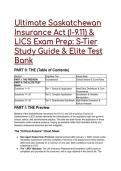
Ultimate Saskatchewan
Insurance Act (I-9.11) &
LICS Exam Prep: S-Tier
Study Guide & Elite Test
Bank
PART 0: THE (Table of Contents)
Section Cognitive Tier Focus Area
PART I: THE PREVIEW Foundational Critical Axioms & Core Rules
PART II: THE ELITE TEST
BANK
Questions 1–10 Tier 1: Syntax & Application Hard Deck Definitions & Core
Frameworks
Questions 11–20 Tier 2: Complex Application Simulations & Variable
Manipulation
Questions 21–30 Tier 3: Grandmaster Synthesis High-Stakes Scenarios &
Failure Aversion
PART I: THE Preview
Mastery of the Saskatchewan Insurance Act (I-9.11) and Life Insurance Council of
Saskatchewan (LICS) bylaws demands the internalization of the regulatory logic that governs
clinical, ethical, and administrative practice. This elite test bank forces the application of these
frameworks under extreme pressure, forging an analytical reflex that translates directly into
flawless professional execution and risk mitigation.
The "Critical Axioms" Cheat Sheet
● New Agent Supervision Protocol: Agents licensed after January 1, 2020, remain under
mandatory supervision until they complete a minimum of 50 placed and in-force policies
AND have been licensed for a minimum of one year. Both conditions must be met and
evidenced to LICS.
● The "LIRD" Mandate: The Life Insurance Replacement Declaration (LIRD) must be
completed and provided to the consumer, with a copy retained in the client's file. The
, legacy requirement to provide this document to the existing or new insurer is obsolete.
● Insurable Interest Timing: In life insurance, an insurable interest must exist at the exact
moment the contract takes effect. It is not required at the time of claim, nor is it required of
the beneficiary.
● The MAID Axiom: Medical Assistance in Dying (MAID) is legally deemed a death
resulting from the underlying illness. Contractual undertakings to pay upon MAID are
strictly lawful and fully enforceable under the Act.
● Errors & Omissions (E&O) Baseline: Licensees must maintain E&O coverage with a
minimum of $1,000,000 per occurrence, a $1,000,000 aggregate, and $1,000,000
extended coverage for fraudulent or dishonest acts. Lapses demand immediate LICS
notification and trigger an automatic suspension.
PART II: THE ELITE TEST BANK
Tier 1 - Foundational Syntax & Application
Q1: A newly licensed agent in Saskatchewan is securing the required Errors & Omissions
(E&O) insurance. Based on the principles of LICS Bylaws and the Saskatchewan Insurance Act,
which action is the MOST ACCURATE regarding the E&O policy requirements? A) The policy
must provide a minimum of $500,000 per occurrence and a $1,000,000 aggregate limit,
provided the agent is sponsored by a Managing General Agent (MGA). B) The policy must
provide $1,000,000 in coverage per occurrence and $1,000,000 in aggregate, but it exempts
fraudulent acts if the agent acts independently. C) The policy must provide a minimum of
$1,000,000 per occurrence, a $1,000,000 aggregate, and $1,000,000 extended coverage for
fraudulent or dishonest acts. D) The policy must be underwritten by an insurer based globally,
provided the limits meet the $2,000,000 combined threshold.
● The Answer: C (The policy must provide a minimum of $1,000,000 per occurrence, a
$1,000,000 aggregate, and $1,000,000 extended coverage for fraudulent or dishonest
acts.)
● Distractor Analysis:
○ A is incorrect: These represent outdated limits or legacy property/casualty
thresholds; LICS strictly requires $1,000,000 across all fundamental life and
accident/sickness thresholds.
○ B is incorrect: Fraudulent or dishonest act coverage ($1,000,000) is explicitly
mandatory for all individual agents and cannot be waived.
○ D is incorrect: The insurer providing the E&O coverage must be licensed to do
business specifically in Canada, not merely operating globally.
The Mentor's Analysis: Regulatory baseline metrics are non-negotiable parameters. Without
valid, compliant E&O coverage, an agent presents an existential risk to the public and
immediately forfeits the right to transact business. By utilizing exact threshold compliance, the
practitioner bypasses the common trap of under-insuring against fraudulent acts.
Professional/Academic Intuition: Never assume global standards supersede local
mandates; E&O must strictly hit the $1M/$1M/$1M Canadian-underwritten threshold.
Q2: An individual licensed for life insurance after January 1, 2020, seeks to operate
independently. Based on the principles of LICS New Agent Supervision, which conclusion is the
MOST ACCURATE regarding when the supervisory period concludes? A) Immediately upon
successfully passing the LLQP examination and securing a sponsor. B) After the agent places
, exactly 50 policies, regardless of the time elapsed since licensing. C) When the agent
completes a minimum of 50 placed and in-force policies, has been licensed for at least one
year, and provides evidence to LICS. D) After two consecutive years of holding an active
license, regardless of the production volume achieved.
● The Answer: C (When the agent completes a minimum of 50 placed and in-force
policies, has been licensed for at least one year, and provides evidence to LICS.)
● Distractor Analysis:
○ A is incorrect: Passing the LLQP is merely the entry point for licensing, not the
termination of the mandated supervision period.
○ B is incorrect: Volume alone is insufficient; the regulations mandate a temporal
component ensuring a minimum of one year of industry exposure.
○ D is incorrect: This is the legacy rule applicable only to agents licensed before
January 1, 2020. Post-2020 agents have strict dual requirements.
The Mentor's Analysis: The regulator restructured supervision to ensure both practical
experience (50 policies) and sustained industry exposure (one year) exist simultaneously. When
facing New Agent Supervision, the immediate priority is dual-metric fulfillment. By utilizing
documented volume and tenure, the practitioner bypasses the common trap of legacy
assumptions. Professional/Academic Intuition: Supervision release is never automatic; it
is an earned, dual-metric status that must be actively evidenced to the Council.
Q3: A client applies for a life insurance policy on a business partner to fund a buy-sell
agreement. The business dissolves a year later, but the policy remains active. Based on the
principles of the Saskatchewan Insurance Act (I-9.11) regarding insurable interest, which
conclusion is the MOST ACCURATE if the insured partner dies five years later? A) The policy is
void because the insurable interest ceased to exist upon the legal dissolution of the partnership.
B) The policy is valid, but the death benefit must be pro-rated based on the actual financial loss
at the time of death. C) The policy is valid because an insurable interest only needs to exist at
the time the contract takes effect. D) The policy is voidable at the insurer's discretion due to a
material change in risk resulting from the business closure.
● The Answer: C (The policy is valid because an insurable interest only needs to exist at
the time the contract takes effect.)
● Distractor Analysis:
○ A is incorrect: In life insurance, unlike property insurance, the insurable interest
does not need to be maintained throughout the life of the policy.
○ B is incorrect: Life insurance is not a contract of strict indemnity; it pays the face
value regardless of the quantifiable financial loss at the time of death.
○ D is incorrect: The dissolution of a business partnership does not constitute a
material change in risk affecting the mortality of the insured.
The Mentor's Analysis: Life insurance distinguishes itself from indemnity insurance by isolating
the necessity of insurable interest strictly to contract inception. When facing ownership changes
or relationship dissolutions, the immediate priority is validating inception status. By utilizing
Section 8-80(1), the practitioner bypasses the common trap of applying property/casualty
indemnity logic to life contracts. Professional/Academic Intuition: In life insurance,
insurable interest is a snapshot taken at inception, not a continuous video feed.
Q4: A client suffering from a terminal illness is approved for Medical Assistance in Dying
(MAID). The client holds a life insurance policy issued two years prior. Based on the principles of
the Saskatchewan Insurance Act (I-9.11), which action by the insurer is the MOST
ACCURATE? A) The insurer must deny the claim under the standard two-year suicide exclusion
clause. B) The insurer must return all premiums paid but is exempt from paying the death
Insurance Act (I-9.11) &
LICS Exam Prep: S-Tier
Study Guide & Elite Test
Bank
PART 0: THE (Table of Contents)
Section Cognitive Tier Focus Area
PART I: THE PREVIEW Foundational Critical Axioms & Core Rules
PART II: THE ELITE TEST
BANK
Questions 1–10 Tier 1: Syntax & Application Hard Deck Definitions & Core
Frameworks
Questions 11–20 Tier 2: Complex Application Simulations & Variable
Manipulation
Questions 21–30 Tier 3: Grandmaster Synthesis High-Stakes Scenarios &
Failure Aversion
PART I: THE Preview
Mastery of the Saskatchewan Insurance Act (I-9.11) and Life Insurance Council of
Saskatchewan (LICS) bylaws demands the internalization of the regulatory logic that governs
clinical, ethical, and administrative practice. This elite test bank forces the application of these
frameworks under extreme pressure, forging an analytical reflex that translates directly into
flawless professional execution and risk mitigation.
The "Critical Axioms" Cheat Sheet
● New Agent Supervision Protocol: Agents licensed after January 1, 2020, remain under
mandatory supervision until they complete a minimum of 50 placed and in-force policies
AND have been licensed for a minimum of one year. Both conditions must be met and
evidenced to LICS.
● The "LIRD" Mandate: The Life Insurance Replacement Declaration (LIRD) must be
completed and provided to the consumer, with a copy retained in the client's file. The
, legacy requirement to provide this document to the existing or new insurer is obsolete.
● Insurable Interest Timing: In life insurance, an insurable interest must exist at the exact
moment the contract takes effect. It is not required at the time of claim, nor is it required of
the beneficiary.
● The MAID Axiom: Medical Assistance in Dying (MAID) is legally deemed a death
resulting from the underlying illness. Contractual undertakings to pay upon MAID are
strictly lawful and fully enforceable under the Act.
● Errors & Omissions (E&O) Baseline: Licensees must maintain E&O coverage with a
minimum of $1,000,000 per occurrence, a $1,000,000 aggregate, and $1,000,000
extended coverage for fraudulent or dishonest acts. Lapses demand immediate LICS
notification and trigger an automatic suspension.
PART II: THE ELITE TEST BANK
Tier 1 - Foundational Syntax & Application
Q1: A newly licensed agent in Saskatchewan is securing the required Errors & Omissions
(E&O) insurance. Based on the principles of LICS Bylaws and the Saskatchewan Insurance Act,
which action is the MOST ACCURATE regarding the E&O policy requirements? A) The policy
must provide a minimum of $500,000 per occurrence and a $1,000,000 aggregate limit,
provided the agent is sponsored by a Managing General Agent (MGA). B) The policy must
provide $1,000,000 in coverage per occurrence and $1,000,000 in aggregate, but it exempts
fraudulent acts if the agent acts independently. C) The policy must provide a minimum of
$1,000,000 per occurrence, a $1,000,000 aggregate, and $1,000,000 extended coverage for
fraudulent or dishonest acts. D) The policy must be underwritten by an insurer based globally,
provided the limits meet the $2,000,000 combined threshold.
● The Answer: C (The policy must provide a minimum of $1,000,000 per occurrence, a
$1,000,000 aggregate, and $1,000,000 extended coverage for fraudulent or dishonest
acts.)
● Distractor Analysis:
○ A is incorrect: These represent outdated limits or legacy property/casualty
thresholds; LICS strictly requires $1,000,000 across all fundamental life and
accident/sickness thresholds.
○ B is incorrect: Fraudulent or dishonest act coverage ($1,000,000) is explicitly
mandatory for all individual agents and cannot be waived.
○ D is incorrect: The insurer providing the E&O coverage must be licensed to do
business specifically in Canada, not merely operating globally.
The Mentor's Analysis: Regulatory baseline metrics are non-negotiable parameters. Without
valid, compliant E&O coverage, an agent presents an existential risk to the public and
immediately forfeits the right to transact business. By utilizing exact threshold compliance, the
practitioner bypasses the common trap of under-insuring against fraudulent acts.
Professional/Academic Intuition: Never assume global standards supersede local
mandates; E&O must strictly hit the $1M/$1M/$1M Canadian-underwritten threshold.
Q2: An individual licensed for life insurance after January 1, 2020, seeks to operate
independently. Based on the principles of LICS New Agent Supervision, which conclusion is the
MOST ACCURATE regarding when the supervisory period concludes? A) Immediately upon
successfully passing the LLQP examination and securing a sponsor. B) After the agent places
, exactly 50 policies, regardless of the time elapsed since licensing. C) When the agent
completes a minimum of 50 placed and in-force policies, has been licensed for at least one
year, and provides evidence to LICS. D) After two consecutive years of holding an active
license, regardless of the production volume achieved.
● The Answer: C (When the agent completes a minimum of 50 placed and in-force
policies, has been licensed for at least one year, and provides evidence to LICS.)
● Distractor Analysis:
○ A is incorrect: Passing the LLQP is merely the entry point for licensing, not the
termination of the mandated supervision period.
○ B is incorrect: Volume alone is insufficient; the regulations mandate a temporal
component ensuring a minimum of one year of industry exposure.
○ D is incorrect: This is the legacy rule applicable only to agents licensed before
January 1, 2020. Post-2020 agents have strict dual requirements.
The Mentor's Analysis: The regulator restructured supervision to ensure both practical
experience (50 policies) and sustained industry exposure (one year) exist simultaneously. When
facing New Agent Supervision, the immediate priority is dual-metric fulfillment. By utilizing
documented volume and tenure, the practitioner bypasses the common trap of legacy
assumptions. Professional/Academic Intuition: Supervision release is never automatic; it
is an earned, dual-metric status that must be actively evidenced to the Council.
Q3: A client applies for a life insurance policy on a business partner to fund a buy-sell
agreement. The business dissolves a year later, but the policy remains active. Based on the
principles of the Saskatchewan Insurance Act (I-9.11) regarding insurable interest, which
conclusion is the MOST ACCURATE if the insured partner dies five years later? A) The policy is
void because the insurable interest ceased to exist upon the legal dissolution of the partnership.
B) The policy is valid, but the death benefit must be pro-rated based on the actual financial loss
at the time of death. C) The policy is valid because an insurable interest only needs to exist at
the time the contract takes effect. D) The policy is voidable at the insurer's discretion due to a
material change in risk resulting from the business closure.
● The Answer: C (The policy is valid because an insurable interest only needs to exist at
the time the contract takes effect.)
● Distractor Analysis:
○ A is incorrect: In life insurance, unlike property insurance, the insurable interest
does not need to be maintained throughout the life of the policy.
○ B is incorrect: Life insurance is not a contract of strict indemnity; it pays the face
value regardless of the quantifiable financial loss at the time of death.
○ D is incorrect: The dissolution of a business partnership does not constitute a
material change in risk affecting the mortality of the insured.
The Mentor's Analysis: Life insurance distinguishes itself from indemnity insurance by isolating
the necessity of insurable interest strictly to contract inception. When facing ownership changes
or relationship dissolutions, the immediate priority is validating inception status. By utilizing
Section 8-80(1), the practitioner bypasses the common trap of applying property/casualty
indemnity logic to life contracts. Professional/Academic Intuition: In life insurance,
insurable interest is a snapshot taken at inception, not a continuous video feed.
Q4: A client suffering from a terminal illness is approved for Medical Assistance in Dying
(MAID). The client holds a life insurance policy issued two years prior. Based on the principles of
the Saskatchewan Insurance Act (I-9.11), which action by the insurer is the MOST
ACCURATE? A) The insurer must deny the claim under the standard two-year suicide exclusion
clause. B) The insurer must return all premiums paid but is exempt from paying the death


