

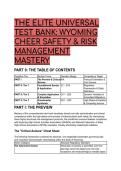
THE ELITE UNIVERSAL
TEST BANK: WYOMING
CHEER SAFETY & RISK
MANAGEMENT
MASTERY
PART 0: THE TABLE OF CONTENTS
Cognitive Tier Section Focus Question Range Competency Target
PART I The Preview & Critical N/A Protocol Orientation &
Axioms Core Axioms
PART II: Tier 1 Foundational Syntax Q1 – Q10 Regulatory
& Application Frameworks & Static
Definitions
PART II: Tier 2 Complex Application Q11 – Q20 Dynamic Variables &
& Simulation Immediate Mitigations
PART II: Tier 3 Grandmaster Q21 – Q30 High-Stakes Escalation
Synthesis & Competing Axioms
PART I: THE PREVIEW
Mastery of this comprehensive test bank translates directly into elite administrative and clinical
competence within the high-stakes environment of interscholastic spirit safety. By internalizing
these highly structured risk-management protocols, the practitioner ensures flawless compliance
with Wyoming High School Activities Association (WHSAA) and National Federation of State
High School Associations (NFHS) mandates, thereby eliminating catastrophic liabilities.
The "Critical Axioms" Cheat Sheet
The following frameworks constitute the absolute, non-negotiable parameters governing safe
and compliant interscholastic cheerleading within the State of Wyoming.
Axiom Category Absolute Regulatory Standard
The Adornment Axiom Absolutely no jewelry is permitted, and new
piercings cannot be taped over; the sole
exceptions are medical/religious medals taped
,Axiom Category Absolute Regulatory Standard
securely to the body. Rhinestones are legal
strictly on the uniform, never on the skin or
woven into the hair.
The Inversion & Release Law During braced flips, if the connection is strictly
hand-to-foot, the top person is universally
prohibited from twisting, the bracer must
maintain a double-based prep with a spotter,
and original bases must catch.
The Game Day Hard Deck For WHSAA Game Day events, the routine
strictly follows Band Dance, Crowd Leading,
and Fight Song (maximum 3:00 minutes). Skill
ceilings are absolute: zero basket tosses, zero
inversions, zero running tumbling, and exactly
one standing tumbling skill.
The Brain Trauma Mandate Any suspected concussion demands immediate
removal, zero same-day return (minimum
24-hour observation), and a rigorously
documented 5-phase return-to-play protocol
managed by authorized medical professionals.
The Dual-Participation Ban WHSAA eligibility rules strictly prohibit a
student from participating on an outside
independent team in the same sport during the
same season.
PART II: THE ELITE TEST BANK
Tier 1: Foundational Syntax & Application
Q1: A spirit team enters the performance mat for the WHSAA State Spirit Competition. The
official safety judge notices that two athletes have freshly pierced cartilage covered by athletic
tape, and one athlete has rhinestones glued directly to her cheekbones. Based on the principles
of the NFHS Spirit Rules Book, which conclusion is the MOST ACCURATE? A) The team is
compliant because taping over new piercings neutralizes the safety hazard of the jewelry,
aligning with standard risk minimization. B) The team is non-compliant solely due to the
rhinestones, as facial adornments are strictly prohibited, but taped piercings are allowed during
competition. C) The team is entirely non-compliant, as taping over jewelry (other than
medical/religious medals) is illegal, and rhinestones on the skin are classified as illegal
adornments. D) The team is compliant because rhinestones are classified as stage makeup,
and tape is an acceptable modification for fresh, unhealed cartilage piercings.
● Answer: C (The team is entirely non-compliant, as taping over jewelry (other than
medical/religious medals) is illegal, and rhinestones on the skin are classified as illegal
adornments.)
● Distractor Analysis:
○ A is incorrect: A common novice misconception dictates that taping over new
piercings bypasses the jewelry rule. NFHS rules universally prohibit taping over
jewelry, except for authenticated medical or religious medals, because the
underlying metal still poses a severe laceration and avulsion risk during
, high-velocity collisions.
○ B is incorrect: While rhinestones on the skin are indeed illegal, the assertion that
taped piercings are acceptable is factually incorrect under current safety guidelines.
The historical practice of taping piercings was outlawed precisely because tape fails
to mitigate the structural rigidity of the jewelry.
○ D is incorrect: Rhinestones adhered to the skin are explicitly defined by the NFHS
as illegal jewelry, not stage makeup. To remain compliant, rhinestones must be
securely sewn, punched, or glued directly to the uniform fabric, never the biological
anatomy.
The Mentor's Analysis: The absolute prohibition of jewelry is non-negotiable and supersedes
any aesthetic or temporary modification attempts. When facing compliance checks, the
immediate priority is enforcing the definition of "jewelry" as any personal adornment worn on the
body. By utilizing strict literal interpretation of the adornment rule, the official bypasses the
common trap of allowing aesthetic concessions that ultimately lead to catastrophic lacerations.
Professional/Academic Intuition: If an adornment is not part of the biological anatomy or
a taped medical/religious necessity, it is a universal safety violation.
Q2: A first-year head cheer coach in Wyoming is actively preparing for the upcoming
competitive season. According to WHSAA Coach Employment Requirements, which
combination of administrative actions is the MOST ACCURATE prerequisite before the coach
can legally supervise the first official contest? A) Acquiring a PTSB coaching permit, completing
CPR/First Aid training, and attending the WHSAA rules clinic in person. B) Completing CPR
training, securing a PTSB permit, and passing the NFHS open-book Spirit Rules Test with a
score of 70% or higher. C) Holding a valid PTSB coaching endorsement, maintaining current
CPR/First Aid certification, and passing the NFHS open-book Spirit Rules Test with an 80% or
higher. D) Attending the USA Cheer safety certification, obtaining a CPR card, and passing the
WHSAA general rules exam with a 75%.
● Answer: C (Holding a valid PTSB coaching endorsement, maintaining current CPR/First
Aid certification, and passing the NFHS open-book Spirit Rules Test with an 80% or
higher.)
● Distractor Analysis:
○ A is incorrect: This option dangerously omits the mandatory NFHS open-book Spirit
Rules Test. Attendance at a clinic does not replace the requirement to pass the
formal written assessment, which serves as the legal baseline for liability protection.
○ B is incorrect: The WHSAA explicitly mandates an 80% or higher passing grade on
the NFHS test. Accepting a 70% threshold is technically inaccurate and leaves the
administration legally vulnerable to negligence claims in the event of an injury.
○ D is incorrect: This distractor relies on an outdated or adjacent metric. While USA
Cheer certification is an esteemed industry standard for skill progression, the
statutory WHSAA requirement specifically demands the PTSB permit and an 80%
on the NFHS Spirit Rules Test.
The Mentor's Analysis: Administrative compliance forms the fundamental layer of all athletic
risk management. When facing season preparation, the immediate priority is verifying statutory
credentials to shield the institution from liability. By utilizing proactive compliance verification, the
athletic director bypasses the common trap of allowing uncertified personnel to assume
catastrophic liability risks on the performance surface. Professional/Academic Intuition:
Administrative oversight requires zero-tolerance enforcement; a score of 79% on the
rules exam renders a coach legally uncertified and uninsured for the performance
surface.
TEST BANK: WYOMING
CHEER SAFETY & RISK
MANAGEMENT
MASTERY
PART 0: THE TABLE OF CONTENTS
Cognitive Tier Section Focus Question Range Competency Target
PART I The Preview & Critical N/A Protocol Orientation &
Axioms Core Axioms
PART II: Tier 1 Foundational Syntax Q1 – Q10 Regulatory
& Application Frameworks & Static
Definitions
PART II: Tier 2 Complex Application Q11 – Q20 Dynamic Variables &
& Simulation Immediate Mitigations
PART II: Tier 3 Grandmaster Q21 – Q30 High-Stakes Escalation
Synthesis & Competing Axioms
PART I: THE PREVIEW
Mastery of this comprehensive test bank translates directly into elite administrative and clinical
competence within the high-stakes environment of interscholastic spirit safety. By internalizing
these highly structured risk-management protocols, the practitioner ensures flawless compliance
with Wyoming High School Activities Association (WHSAA) and National Federation of State
High School Associations (NFHS) mandates, thereby eliminating catastrophic liabilities.
The "Critical Axioms" Cheat Sheet
The following frameworks constitute the absolute, non-negotiable parameters governing safe
and compliant interscholastic cheerleading within the State of Wyoming.
Axiom Category Absolute Regulatory Standard
The Adornment Axiom Absolutely no jewelry is permitted, and new
piercings cannot be taped over; the sole
exceptions are medical/religious medals taped
,Axiom Category Absolute Regulatory Standard
securely to the body. Rhinestones are legal
strictly on the uniform, never on the skin or
woven into the hair.
The Inversion & Release Law During braced flips, if the connection is strictly
hand-to-foot, the top person is universally
prohibited from twisting, the bracer must
maintain a double-based prep with a spotter,
and original bases must catch.
The Game Day Hard Deck For WHSAA Game Day events, the routine
strictly follows Band Dance, Crowd Leading,
and Fight Song (maximum 3:00 minutes). Skill
ceilings are absolute: zero basket tosses, zero
inversions, zero running tumbling, and exactly
one standing tumbling skill.
The Brain Trauma Mandate Any suspected concussion demands immediate
removal, zero same-day return (minimum
24-hour observation), and a rigorously
documented 5-phase return-to-play protocol
managed by authorized medical professionals.
The Dual-Participation Ban WHSAA eligibility rules strictly prohibit a
student from participating on an outside
independent team in the same sport during the
same season.
PART II: THE ELITE TEST BANK
Tier 1: Foundational Syntax & Application
Q1: A spirit team enters the performance mat for the WHSAA State Spirit Competition. The
official safety judge notices that two athletes have freshly pierced cartilage covered by athletic
tape, and one athlete has rhinestones glued directly to her cheekbones. Based on the principles
of the NFHS Spirit Rules Book, which conclusion is the MOST ACCURATE? A) The team is
compliant because taping over new piercings neutralizes the safety hazard of the jewelry,
aligning with standard risk minimization. B) The team is non-compliant solely due to the
rhinestones, as facial adornments are strictly prohibited, but taped piercings are allowed during
competition. C) The team is entirely non-compliant, as taping over jewelry (other than
medical/religious medals) is illegal, and rhinestones on the skin are classified as illegal
adornments. D) The team is compliant because rhinestones are classified as stage makeup,
and tape is an acceptable modification for fresh, unhealed cartilage piercings.
● Answer: C (The team is entirely non-compliant, as taping over jewelry (other than
medical/religious medals) is illegal, and rhinestones on the skin are classified as illegal
adornments.)
● Distractor Analysis:
○ A is incorrect: A common novice misconception dictates that taping over new
piercings bypasses the jewelry rule. NFHS rules universally prohibit taping over
jewelry, except for authenticated medical or religious medals, because the
underlying metal still poses a severe laceration and avulsion risk during
, high-velocity collisions.
○ B is incorrect: While rhinestones on the skin are indeed illegal, the assertion that
taped piercings are acceptable is factually incorrect under current safety guidelines.
The historical practice of taping piercings was outlawed precisely because tape fails
to mitigate the structural rigidity of the jewelry.
○ D is incorrect: Rhinestones adhered to the skin are explicitly defined by the NFHS
as illegal jewelry, not stage makeup. To remain compliant, rhinestones must be
securely sewn, punched, or glued directly to the uniform fabric, never the biological
anatomy.
The Mentor's Analysis: The absolute prohibition of jewelry is non-negotiable and supersedes
any aesthetic or temporary modification attempts. When facing compliance checks, the
immediate priority is enforcing the definition of "jewelry" as any personal adornment worn on the
body. By utilizing strict literal interpretation of the adornment rule, the official bypasses the
common trap of allowing aesthetic concessions that ultimately lead to catastrophic lacerations.
Professional/Academic Intuition: If an adornment is not part of the biological anatomy or
a taped medical/religious necessity, it is a universal safety violation.
Q2: A first-year head cheer coach in Wyoming is actively preparing for the upcoming
competitive season. According to WHSAA Coach Employment Requirements, which
combination of administrative actions is the MOST ACCURATE prerequisite before the coach
can legally supervise the first official contest? A) Acquiring a PTSB coaching permit, completing
CPR/First Aid training, and attending the WHSAA rules clinic in person. B) Completing CPR
training, securing a PTSB permit, and passing the NFHS open-book Spirit Rules Test with a
score of 70% or higher. C) Holding a valid PTSB coaching endorsement, maintaining current
CPR/First Aid certification, and passing the NFHS open-book Spirit Rules Test with an 80% or
higher. D) Attending the USA Cheer safety certification, obtaining a CPR card, and passing the
WHSAA general rules exam with a 75%.
● Answer: C (Holding a valid PTSB coaching endorsement, maintaining current CPR/First
Aid certification, and passing the NFHS open-book Spirit Rules Test with an 80% or
higher.)
● Distractor Analysis:
○ A is incorrect: This option dangerously omits the mandatory NFHS open-book Spirit
Rules Test. Attendance at a clinic does not replace the requirement to pass the
formal written assessment, which serves as the legal baseline for liability protection.
○ B is incorrect: The WHSAA explicitly mandates an 80% or higher passing grade on
the NFHS test. Accepting a 70% threshold is technically inaccurate and leaves the
administration legally vulnerable to negligence claims in the event of an injury.
○ D is incorrect: This distractor relies on an outdated or adjacent metric. While USA
Cheer certification is an esteemed industry standard for skill progression, the
statutory WHSAA requirement specifically demands the PTSB permit and an 80%
on the NFHS Spirit Rules Test.
The Mentor's Analysis: Administrative compliance forms the fundamental layer of all athletic
risk management. When facing season preparation, the immediate priority is verifying statutory
credentials to shield the institution from liability. By utilizing proactive compliance verification, the
athletic director bypasses the common trap of allowing uncertified personnel to assume
catastrophic liability risks on the performance surface. Professional/Academic Intuition:
Administrative oversight requires zero-tolerance enforcement; a score of 79% on the
rules exam renders a coach legally uncertified and uninsured for the performance
surface.


