

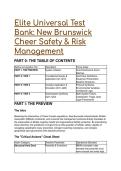
Elite Universal Test
Bank: New Brunswick
Cheer Safety & Risk
Management
PART 0: THE TABLE OF CONTENTS
Section & Cognitive Tier Description Focus Areas
PART I: THE PREVIEW System Initiation Core Directives & Axiom
Matrices
PART II: TIER 1 Foundational Syntax & Hard Deck Definitions,
Application (Q1–Q10) Equipment Parameters,
Baseline Directives
PART II: TIER 2 Complex Application & Protocol Synthesis,
Simulation (Q11–Q20) Environmental Variables,
Conditional Logic
PART II: TIER 3 Grandmaster Synthesis Multi-System Failure,
(Q21–Q30) Catastrophic Triage, Apex
Legal Frameworks
PART I: THE PREVIEW
The Intro
Mastering the intersection of Cheer Canada regulations, New Brunswick Interscholastic Athletic
Association (NBIAA) constraints, and universal risk management protocols directly translates to
the preservation of athlete cognitive health and organizational liability protection. By internalizing
these doctrines, the practitioner is forged into an elite guardian of athletic safety, capable of
navigating catastrophic injury prevention, stringent coaching compliance, and complex
geopolitical sport governance with absolute precision.
The "Critical Axioms" Cheat Sheet
Axiom Category Directive Parameter Operational Standard
Structural Hard Deck Pyramids & Inversions NBIAA scholastic rules
mandate that pyramids must
never exceed two levels high,
,Axiom Category Directive Parameter Operational Standard
and inversions originating
directly from the performance
surface are strictly prohibited.
Concussion Redline Suspected Traumatic Brain Any athlete displaying visual
Injury (TBI) signs or reporting symptoms of
a concussion must be
immediately removed from
play; progression to Stage 1 of
the Return-to-Sport protocol
begins only after 24 hours of
being entirely symptom-free.
The Rule of Two Safe Sport Supervision All training environments
(physical and virtual) must
remain open, observable, and
justifiable, requiring a minimum
of two responsible, screened
adults to prevent instances of
maltreatment.
Apparatus Modifications Orthopaedic Devices Unaltered soft braces require
no padding, but altered soft
braces require closed-cell,
slow-recovery foam padding no
less than 1.27 cm (1/2 inch)
thick; hard casts unequivocally
disqualify an athlete from
stunting, pyramids, tosses, or
tumbling.
Policy 701 & 709 Provincial Scholastic Mandates Policy 701 strictly dictates the
protection of pupils from
non-professional conduct and
abuse, while Policy 709
enforces absolute physical
activity safety standards,
including the complete ban of
trampolines and mini-tramps in
scholastic settings.
PART II: THE ELITE TEST BANK
Tier 1: Foundational Syntax & Application (Questions 1–10)
Q1: During a pre-competition equipment check at a Cheer New Brunswick sanctioned event, an
athlete is found wearing a clear plastic belly-button ring and a medical ID bracelet. Based on the
principles of Cheer Canada General Safety Rules, which action is the MOST ACCURATE? A)
Both items may remain in place provided they are securely taped over with athletic tape. B) The
clear plastic jewelry must be removed, but the medical ID bracelet may remain provided it is
securely taped to the body. C) Both items must be entirely removed before the athlete is
, permitted to step onto the performance surface. D) The athlete may keep both items without
modification because clear plastic is non-abrasive and medical IDs are exempt from safety
checks.
● Answer/Respuesta/Réponse: B (The clear plastic jewelry must be removed, but the
medical ID bracelet may remain provided it is securely taped to the body.)
● Distractor Analysis:
○ A is incorrect: Taping over standard jewelry, including clear plastic piercings, is
explicitly forbidden under Cheer Canada safety regulations to prevent laceration
and avulsion injuries during dynamic skill execution.
○ C is incorrect: Medical ID bracelets are a strict exception to the no-jewelry rule and
must not be removed, as doing so endangers the athlete's physiological safety in a
medical emergency.
○ D is incorrect: Clear plastic jewelry is explicitly listed as a prohibited item that must
be removed entirely, as it still presents a rigid structural hazard during contact.
The Mentor's Analysis: The absolute prohibition of jewelry prevents severe avulsion injuries
during complex acrobatics, but life-saving medical information supersedes standard uniform
codes. When facing equipment infractions, the immediate priority is eliminating superficial
hazards while securing critical health identifiers. By utilizing approved athletic taping for medical
IDs, you bypass the common trap of compromising emergency response data for the sake of
aesthetic uniformity. Professional/Academic Intuition: Never tape over cosmetic jewelry;
medical identification is the sole exception and must be secured flush to the athlete's
body.
Q2: A scholastic athlete arrives at an NBIAA practice wearing a fiberglass walking boot for a
recovering ankle sprain. Based on the principles of the Cheer Canada and NBIAA Scholastic
Rules, which conclusion is the MOST ACCURATE? A) The athlete may participate in partner
stunts as a base if the boot is padded with closed-cell foam no less than 1.27 cm thick. B) The
athlete may participate in tumbling but must not be involved in any partner stunts or pyramids.
C) The athlete must not be involved in stunts, pyramids, tosses, or tumbling under any
circumstances. D) The athlete may participate fully provided a physician's note is presented
approving the use of the boot during athletic competition.
● Answer/Respuesta/Réponse: C (The athlete must not be involved in stunts, pyramids,
tosses, or tumbling under any circumstances.)
● Distractor Analysis:
○ A is incorrect: Closed-cell foam padding rules apply strictly to altered soft casts and
braces, not to hard fiberglass casts or walking boots, which present unmitigated
blunt-force hazards.
○ B is incorrect: Tumbling requires complex lower-extremity impact absorption and
kinematic chaining; athletes in walking boots are structurally prohibited from
tumbling.
○ D is incorrect: A physician's note does not override the absolute Cheer Canada
mandate prohibiting hard casts and walking boots in elevated or high-impact skills,
as the hazard affects the surrounding athletes as well as the injured individual.
The Mentor's Analysis: Rigid apparatuses introduce unyielding, high-density hazards into an
environment that relies on soft-tissue impact absorption and dynamic movement. When facing
athletes with rigid orthopaedic devices, the immediate priority is protecting both the recovering
athlete and their teammates from blunt-force trauma. By utilizing the absolute hard-cast ban,
you bypass the novice trap of assuming localized joint protection makes an athlete safe to lift or
tumble. Professional/Academic Intuition: Hard casts and walking boots represent
Bank: New Brunswick
Cheer Safety & Risk
Management
PART 0: THE TABLE OF CONTENTS
Section & Cognitive Tier Description Focus Areas
PART I: THE PREVIEW System Initiation Core Directives & Axiom
Matrices
PART II: TIER 1 Foundational Syntax & Hard Deck Definitions,
Application (Q1–Q10) Equipment Parameters,
Baseline Directives
PART II: TIER 2 Complex Application & Protocol Synthesis,
Simulation (Q11–Q20) Environmental Variables,
Conditional Logic
PART II: TIER 3 Grandmaster Synthesis Multi-System Failure,
(Q21–Q30) Catastrophic Triage, Apex
Legal Frameworks
PART I: THE PREVIEW
The Intro
Mastering the intersection of Cheer Canada regulations, New Brunswick Interscholastic Athletic
Association (NBIAA) constraints, and universal risk management protocols directly translates to
the preservation of athlete cognitive health and organizational liability protection. By internalizing
these doctrines, the practitioner is forged into an elite guardian of athletic safety, capable of
navigating catastrophic injury prevention, stringent coaching compliance, and complex
geopolitical sport governance with absolute precision.
The "Critical Axioms" Cheat Sheet
Axiom Category Directive Parameter Operational Standard
Structural Hard Deck Pyramids & Inversions NBIAA scholastic rules
mandate that pyramids must
never exceed two levels high,
,Axiom Category Directive Parameter Operational Standard
and inversions originating
directly from the performance
surface are strictly prohibited.
Concussion Redline Suspected Traumatic Brain Any athlete displaying visual
Injury (TBI) signs or reporting symptoms of
a concussion must be
immediately removed from
play; progression to Stage 1 of
the Return-to-Sport protocol
begins only after 24 hours of
being entirely symptom-free.
The Rule of Two Safe Sport Supervision All training environments
(physical and virtual) must
remain open, observable, and
justifiable, requiring a minimum
of two responsible, screened
adults to prevent instances of
maltreatment.
Apparatus Modifications Orthopaedic Devices Unaltered soft braces require
no padding, but altered soft
braces require closed-cell,
slow-recovery foam padding no
less than 1.27 cm (1/2 inch)
thick; hard casts unequivocally
disqualify an athlete from
stunting, pyramids, tosses, or
tumbling.
Policy 701 & 709 Provincial Scholastic Mandates Policy 701 strictly dictates the
protection of pupils from
non-professional conduct and
abuse, while Policy 709
enforces absolute physical
activity safety standards,
including the complete ban of
trampolines and mini-tramps in
scholastic settings.
PART II: THE ELITE TEST BANK
Tier 1: Foundational Syntax & Application (Questions 1–10)
Q1: During a pre-competition equipment check at a Cheer New Brunswick sanctioned event, an
athlete is found wearing a clear plastic belly-button ring and a medical ID bracelet. Based on the
principles of Cheer Canada General Safety Rules, which action is the MOST ACCURATE? A)
Both items may remain in place provided they are securely taped over with athletic tape. B) The
clear plastic jewelry must be removed, but the medical ID bracelet may remain provided it is
securely taped to the body. C) Both items must be entirely removed before the athlete is
, permitted to step onto the performance surface. D) The athlete may keep both items without
modification because clear plastic is non-abrasive and medical IDs are exempt from safety
checks.
● Answer/Respuesta/Réponse: B (The clear plastic jewelry must be removed, but the
medical ID bracelet may remain provided it is securely taped to the body.)
● Distractor Analysis:
○ A is incorrect: Taping over standard jewelry, including clear plastic piercings, is
explicitly forbidden under Cheer Canada safety regulations to prevent laceration
and avulsion injuries during dynamic skill execution.
○ C is incorrect: Medical ID bracelets are a strict exception to the no-jewelry rule and
must not be removed, as doing so endangers the athlete's physiological safety in a
medical emergency.
○ D is incorrect: Clear plastic jewelry is explicitly listed as a prohibited item that must
be removed entirely, as it still presents a rigid structural hazard during contact.
The Mentor's Analysis: The absolute prohibition of jewelry prevents severe avulsion injuries
during complex acrobatics, but life-saving medical information supersedes standard uniform
codes. When facing equipment infractions, the immediate priority is eliminating superficial
hazards while securing critical health identifiers. By utilizing approved athletic taping for medical
IDs, you bypass the common trap of compromising emergency response data for the sake of
aesthetic uniformity. Professional/Academic Intuition: Never tape over cosmetic jewelry;
medical identification is the sole exception and must be secured flush to the athlete's
body.
Q2: A scholastic athlete arrives at an NBIAA practice wearing a fiberglass walking boot for a
recovering ankle sprain. Based on the principles of the Cheer Canada and NBIAA Scholastic
Rules, which conclusion is the MOST ACCURATE? A) The athlete may participate in partner
stunts as a base if the boot is padded with closed-cell foam no less than 1.27 cm thick. B) The
athlete may participate in tumbling but must not be involved in any partner stunts or pyramids.
C) The athlete must not be involved in stunts, pyramids, tosses, or tumbling under any
circumstances. D) The athlete may participate fully provided a physician's note is presented
approving the use of the boot during athletic competition.
● Answer/Respuesta/Réponse: C (The athlete must not be involved in stunts, pyramids,
tosses, or tumbling under any circumstances.)
● Distractor Analysis:
○ A is incorrect: Closed-cell foam padding rules apply strictly to altered soft casts and
braces, not to hard fiberglass casts or walking boots, which present unmitigated
blunt-force hazards.
○ B is incorrect: Tumbling requires complex lower-extremity impact absorption and
kinematic chaining; athletes in walking boots are structurally prohibited from
tumbling.
○ D is incorrect: A physician's note does not override the absolute Cheer Canada
mandate prohibiting hard casts and walking boots in elevated or high-impact skills,
as the hazard affects the surrounding athletes as well as the injured individual.
The Mentor's Analysis: Rigid apparatuses introduce unyielding, high-density hazards into an
environment that relies on soft-tissue impact absorption and dynamic movement. When facing
athletes with rigid orthopaedic devices, the immediate priority is protecting both the recovering
athlete and their teammates from blunt-force trauma. By utilizing the absolute hard-cast ban,
you bypass the novice trap of assuming localized joint protection makes an athlete safe to lift or
tumble. Professional/Academic Intuition: Hard casts and walking boots represent


