

Written by students who passed Immediately available after payment Read online or as PDF Wrong document? Swap it for free 4.6 TrustPilot
logo-home
Document preview thumbnail
Preview 2 out of 13 pages
Exam (elaborations)

NUR 661 Exam 3 2026 | 150+ Practice Questions & Verified Answers | Key Topics: Person-Centered Therapy, Gestalt Therapy, CBT, DBT, Motivational Interviewing, REBT & Solution-Focused Therapy | Maryville University

Document preview thumbnail
Preview 2 out of 13 pages

Prepare for Maryville University NUR 661 Exam 3 with this comprehensive 2026 study guide featuring 150+ expertly verified practice questions and detailed answers covering the major psychotherapy theories and evidence-based counseling approaches taught in advanced psychiatric-mental health nursing. This exam preparation resource provides an in-depth review of person-centered therapy, Gestalt therapy, cognitive behavioral therapies, dialectical behavior therapy (DBT), mindfulness-based interventions, motivational interviewing, rational emotive behavior therapy (REBT), reality therapy, solution-focused counseling, and therapeutic communication. The structured question-and-answer format is designed to strengthen clinical reasoning, reinforce graduate-level psychiatric nursing concepts, and improve examination performance through realistic, exam-focused practice. This study guide comprehensively reviews the major concepts assessed in NUR 661 Exam 3, including Carl Rogers' Person-Centered Therapy, congruence, genuineness, unconditional positive regard, empathy, self-actualization, Gestalt Therapy, awareness, here-and-now interventions, Gestalt experiments, projections, cognitive restructuring, reframing, stress inoculation training, behavioral alignment, Transtheoretical Model of Change (Stages of Change), motivational interviewing (MI Spirit and ambivalence), Rational Emotive Behavior Therapy (REBT), irrational beliefs, emotive techniques, unconditional acceptance, Solution-Focused Brief Therapy (SFBT), solution-focused counseling, Choice Theory, Contemporary Reality Therapy, Dialectical Behavior Therapy (DBT), mindfulness-based cognitive therapy (MBCT), mindfulness-based stress reduction (MBSR), relapse prevention, graded task assignments, paradoxical theory of change, peer reinforcement systems, sponsor systems, dyadic support systems, buddy systems, behavioral rehearsal, and evidence-based therapeutic interventions for depression, anxiety, trauma, substance use disorders, and personality disorders. The practice questions emphasize application of psychotherapy models to advanced psychiatric nursing scenarios commonly encountered in graduate nursing education and clinical practice. The content aligns with current psychiatric-mental health nursing education and incorporates evidence-based concepts from the American Psychiatric Association (APA), the Diagnostic and Statistical Manual of Mental Disorders (DSM-5-TR), the American Nurses Association (ANA), the American Psychiatric Nurses Association (APNA), and foundational works by Carl Rogers, Fritz Perls, William Glasser, Albert Ellis, Marsha Linehan, William R. Miller, and Stephen Rollnick. Core concepts reflect nationally recognized standards in psychotherapy, therapeutic communication, motivational interviewing, cognitive behavioral therapies, mindfulness-based interventions, solution-focused counseling, and advanced psychiatric nursing practice. This study guide is an excellent resource for Maryville University NUR 661 students, Psychiatric-Mental Health Nurse Practitioner (PMHNP) students, graduate nursing students, and healthcare professionals preparing for advanced psychiatric nursing examinations and clinical practice. Relevant for Students: Maryville University NUR 661 students Psychiatric-Mental Health Nurse Practitioner (PMHNP) students Master of Science in Nursing (MSN) students Doctor of Nursing Practice (DNP) students Advanced Practice Registered Nurse (APRN) students Graduate Psychiatric Nursing students Mental Health Nursing students Behavioral Health students Psychotherapy students Counseling students Graduate Healthcare students Psychiatric nursing professionals preparing for examinations and clinical practice References: American Psychiatric Association. (2022). Diagnostic and Statistical Manual of Mental Disorders (DSM-5-TR). American Psychiatric Publishing. American Nurses Association. (2022). Psychiatric-Mental Health Nursing: Scope and Standards of Practice (3rd ed.). Rogers, C. R. (1961). On Becoming a Person. Houghton Mifflin. Perls, F. S., Hefferline, R. F., & Goodman, P. (1951). Gestalt Therapy: Excitement and Growth in the Human Personality. Julian Press. Ellis, A., & Dryden, W. (2007). The Practice of Rational Emotive Behavior Therapy (2nd ed.). Springer. Linehan, M. M. (2015). DBT Skills Training Manual (2nd ed.). Guilford Press. Miller, W. R., & Rollnick, S. (2023). Motivational Interviewing: Helping People Change (4th ed.). Guilford Press. Glasser, W. (1998). Choice Theory: A New Psychology of Personal Freedom. HarperCollins. Keywords: NUR 661, NUR 661 Exam 3, Maryville University, psychiatric mental health nursing, PMHNP, person centered therapy, Carl Rogers, self actualization, congruence, empathy, unconditional positive regard, Gestalt therapy, Fritz Perls, awareness, Gestalt experiments, here and now, projections, cognitive restructuring, reframing, stress inoculation training, behavioral alignment, transtheoretical model of change, stages of change, motivational interviewing, MI Spirit, ambivalence, REBT, Rational Emotive Behavior Therapy, Albert Ellis, irrational beliefs, emotive techniques, solution focused brief therapy, SFBT, solution focused counseling, choice theory, William Glasser, reality therapy, dialectical behavior therapy, DBT, mindfulness based cognitive therapy, MBCT, mindfulness based stress reduction, MBSR, relapse prevention, graded task assignment, paradoxical theory of change, psychiatric nursing, graduate nursing, psychotherapy, behavioral health, practice questions

Content preview

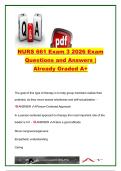
NURS 661 Exam 3 2026 Exam
Questions and Answers |
Already Graded A+


The goal of this type of therapy is to help group members realize their

potential, as they move toward wholeness and self-actualization. -

ANSWER ✔✔Person-Centered Approach


In a person-centered approach to therapy the most important role of the

leader is to? - ANSWER ✔✔Have a good attitude


Show congruence/genuine

Empathetic understanding

Caring

, The basic assumption of this therapy is that people are essentially

trustworthy, that they have a vast potential for understanding themselves

and resolving their own problems without direct intervention on the

therapist part and that they are capable of self directed growth. -

ANSWER ✔✔Patient-centered approach


In patient-centered therapy who is the facilitator? - ANSWER ✔✔The

group leader

What does person-centered therapy rely on to validate it's concepts? -

ANSWER ✔✔Research


What is the most noted helpful aspect for patient in patient-centered

therapy? - ANSWER ✔✔Being understood


This type of therapy is most concerned with decreasing human suffering,

with cross cultural awareness, and conflict resolution on a large scale. -

ANSWER ✔✔Person-centered therapy


What does congruence of a group leader imply? - ANSWER

✔✔Genuineness


Empathy

Caring

A belief that core conditions work together and not independently.

Document information

Uploaded on
July 17, 2026
Number of pages
13
Written in
2025/2026
Type
Exam (elaborations)
Contains
Questions & answers
$18.99

Wrong document? Swap it for free Within 14 days of purchase and before downloading, you can choose a different document. You can simply spend the amount again.
Written by students who passed
Immediately available after payment
Read online or as PDF

Seller avatar
Reputation scores are based on the amount of documents a seller has sold for a fee and the reviews they have received for those documents. There are three levels: Bronze, Silver and Gold. The better the reputation, the more your can rely on the quality of the sellers work.
PROFFKERRYMARTIN
3.4
(53)
Sold
267
Followers
9
Items
10856
Last sold
1 day ago


Why students choose Stuvia

Created by fellow students, verified by reviews

Quality you can trust: written by students who passed their tests and reviewed by others who've used these notes.

Didn't get what you expected? Choose another document

No worries! You can instantly pick a different document that better fits what you're looking for.

Pay as you like, start learning right away

No subscription, no commitments. Pay the way you're used to via credit card and download your PDF document instantly.

Student with book image

“Bought, downloaded, and aced it. It really can be that simple.”

Alisha Student

Working on your references?

Create accurate citations in APA, MLA and Harvard with our free citation generator.

Working on your references?

Frequently asked questions

