

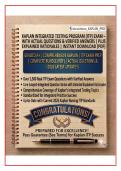
,KAPLAN INTEGRATED TESTING PROGRAM (ITP) EXAM
Complete Practice Examination with Correct Answers &
Detailed Rationales
Exam Type: Comprehensive Nursing Assessment
Total Questions: 250
Domain: Kaplan Integrated Testing Program (ITP) — Fundamentals & Core Nursing
Format: Multiple Choice, Select All That Apply, Ordered Response, Case Studies
Target: Kaplan Integrated Testing Program, NCLEX-RN®, & Nursing School Final Exam
Preparation
INSTRUCTIONS TO CANDIDATE
The Kaplan Integrated Testing Program (ITP) is a comprehensive assessment that
measures competency across core nursing domains including clinical judgment, patient
safety, infection control, nutrition, mobility, pain management, pharmacology, and
therapeutic communication. The exam typically consists of 60–180 questions and is a
secured, proctored assessment.
Read each question carefully. Select the single best answer unless otherwise indicated.
For questions marked (Select All That Apply) , select all correct options. Each question
is followed by a detailed, expert-verified rationale explaining the underlying nursing
principles, clinical judgment, and the rationale for excluding distractors.
SECTION 1: SAFE & EFFECTIVE CARE ENVIRONMENT
(Questions 1–50)
,Question 1
A nurse is preparing to administer medications to a group of clients. Which action best
demonstrates the "right dose" of the five rights of medication administration?
A. Checking the client's identification band before giving the medication
B. Comparing the medication label with the medication administration record (MAR)
three times
C. Calculating the correct dose based on the client's weight and comparing it to the
ordered dose
D. Documenting the medication administration immediately after giving it
Correct Answer: C. Calculating the correct dose based on the client's weight and
comparing it to the ordered dose
Rationale: The right dose requires verifying that the dose ordered is appropriate for
the client, including weight-based calculations for pediatric and critical care populations.
Option A describes the right client; Option B describes the right medication; Option D
describes documentation. Safe medication administration requires all five rights: right
client, right drug, right dose, right route, and right time.
Question 2
A nurse is caring for a client on fall precautions. Which intervention is most important to
include in the client's plan of care?
A. Keep the bed in the lowest position with the brakes locked
B. Place the call light within the client's reach
C. Ensure the client wears non-skid footwear when ambulating
D. All of the above
, Correct Answer: D. All of the above
Rationale: Fall prevention requires a multifactorial approach. Keeping the bed in the
lowest position with brakes locked prevents injury from falls out of bed; placing the call
light within reach allows the client to call for assistance; and non-skid footwear reduces
the risk of slipping. All interventions are essential components of a comprehensive fall
prevention plan.
Question 3
A nurse is preparing to delegate tasks to unlicensed assistive personnel (UAP). Which
task is appropriate to delegate?
A. Administering oral medications to a stable client
B. Performing a sterile dressing change
C. Assisting a client with feeding
D. Assessing a client's lung sounds
Correct Answer: C. Assisting a client with feeding
Rationale: UAP can assist with activities of daily living (ADLs) including feeding,
bathing, ambulation, and toileting. Medication administration (A), sterile procedures (B),
and assessments (D) are outside the scope of UAP and must be performed by licensed
nurses. The five rights of delegation include: right task, right circumstance, right person,
right direction/communication, and right supervision/evaluation.
Question 4
A nurse is caring for a client who is on contact precautions. Which personal protective
equipment (PPE) is required when entering the client's room?
A. Gloves only
B. Gloves and gown
Complete Practice Examination with Correct Answers &
Detailed Rationales
Exam Type: Comprehensive Nursing Assessment
Total Questions: 250
Domain: Kaplan Integrated Testing Program (ITP) — Fundamentals & Core Nursing
Format: Multiple Choice, Select All That Apply, Ordered Response, Case Studies
Target: Kaplan Integrated Testing Program, NCLEX-RN®, & Nursing School Final Exam
Preparation
INSTRUCTIONS TO CANDIDATE
The Kaplan Integrated Testing Program (ITP) is a comprehensive assessment that
measures competency across core nursing domains including clinical judgment, patient
safety, infection control, nutrition, mobility, pain management, pharmacology, and
therapeutic communication. The exam typically consists of 60–180 questions and is a
secured, proctored assessment.
Read each question carefully. Select the single best answer unless otherwise indicated.
For questions marked (Select All That Apply) , select all correct options. Each question
is followed by a detailed, expert-verified rationale explaining the underlying nursing
principles, clinical judgment, and the rationale for excluding distractors.
SECTION 1: SAFE & EFFECTIVE CARE ENVIRONMENT
(Questions 1–50)
,Question 1
A nurse is preparing to administer medications to a group of clients. Which action best
demonstrates the "right dose" of the five rights of medication administration?
A. Checking the client's identification band before giving the medication
B. Comparing the medication label with the medication administration record (MAR)
three times
C. Calculating the correct dose based on the client's weight and comparing it to the
ordered dose
D. Documenting the medication administration immediately after giving it
Correct Answer: C. Calculating the correct dose based on the client's weight and
comparing it to the ordered dose
Rationale: The right dose requires verifying that the dose ordered is appropriate for
the client, including weight-based calculations for pediatric and critical care populations.
Option A describes the right client; Option B describes the right medication; Option D
describes documentation. Safe medication administration requires all five rights: right
client, right drug, right dose, right route, and right time.
Question 2
A nurse is caring for a client on fall precautions. Which intervention is most important to
include in the client's plan of care?
A. Keep the bed in the lowest position with the brakes locked
B. Place the call light within the client's reach
C. Ensure the client wears non-skid footwear when ambulating
D. All of the above
, Correct Answer: D. All of the above
Rationale: Fall prevention requires a multifactorial approach. Keeping the bed in the
lowest position with brakes locked prevents injury from falls out of bed; placing the call
light within reach allows the client to call for assistance; and non-skid footwear reduces
the risk of slipping. All interventions are essential components of a comprehensive fall
prevention plan.
Question 3
A nurse is preparing to delegate tasks to unlicensed assistive personnel (UAP). Which
task is appropriate to delegate?
A. Administering oral medications to a stable client
B. Performing a sterile dressing change
C. Assisting a client with feeding
D. Assessing a client's lung sounds
Correct Answer: C. Assisting a client with feeding
Rationale: UAP can assist with activities of daily living (ADLs) including feeding,
bathing, ambulation, and toileting. Medication administration (A), sterile procedures (B),
and assessments (D) are outside the scope of UAP and must be performed by licensed
nurses. The five rights of delegation include: right task, right circumstance, right person,
right direction/communication, and right supervision/evaluation.
Question 4
A nurse is caring for a client who is on contact precautions. Which personal protective
equipment (PPE) is required when entering the client's room?
A. Gloves only
B. Gloves and gown


