The Elite Universal Test
Bank: Principles of Real
Estate I (Texas Mastery)
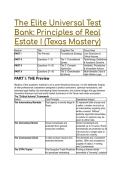
Section Title Cognitive Tier Focus Area
PART I The Preview Foundational Strategy Core Directives &
Critical Axioms
PART II Questions 1–10 Tier 1: Foundational Terminology, Definitions
Syntax & Academic Doctrine
PART II Questions 11–20 Tier 2: Complex Variables, Procedures
Application & Immediate Actions
PART II Questions 21–30 Tier 3: Grandmaster Multi-Variable Crisis &
Synthesis High-Stakes Logic
PART I: THE Preview
Mastery of this academic material is not a mere theoretical exercise; it is the deliberate forging
of elite professional competence designed to protect consumers, optimize transactions, and
eliminate legal liability. By internalizing these frameworks, the scholar bridges the gap between
theoretical licensure and real-world market dominance in the Texas real estate ecosystem.
The "Critical Axioms" Framework
Axiom Core Principle Operational Impact
The Intermediary Mandate Dual agency is strictly illegal in To represent both a buyer and
Texas. a seller, a broker must act as
an Intermediary requiring prior
written consent. Without
explicitly appointed associates,
no advice or opinions may be
given to either side.
The Homestead Shield Texas homesteads are Urban homesteads are
protected from general protected up to 10 acres. Rural
unsecured creditors. homesteads are protected up to
100 acres for a single adult or
200 acres for a family.
The Contractual COLIC A valid contract requires five The elements are: Competent
essential elements. parties, Offer and acceptance,
Legality of object, In writing,
and Consideration.
The DTPA Triplier The Deceptive Trade Practices Proving a license holder
Act penalizes misleading committed a "knowing" violation
, Axiom Core Principle Operational Impact
business acts. allows courts to award up to
three times the actual economic
damages.
Economic Paradigms Land possesses four distinct The characteristics are
economic characteristics. Scarcity, Modification, Fixity,
and Situs (location preference).
PART II: THE ELITE TEST BANK
Tier 1: Foundational Syntax & Application
Q1: A new regional freeway has made commuting to a distant suburban neighborhood
significantly faster, resulting in a sudden, sharp increase in new home sales in the area. Based
on the principles of real estate economics, this specific increase in sales and value is an
example of which characteristic? A) Scarcity B) Fixity C) Situs D) Modification
● The Answer: D (Modification)
● Distractor Analysis:
○ A is incorrect: Scarcity refers to the naturally limited supply of land globally, not
localized demand shifts driven by infrastructure.
○ B is incorrect: Fixity refers to the long-term, illiquid nature of real estate capital
investments, not external environmental changes.
○ C is incorrect: Situs is the economic preference for a location, but the specific act of
man-made infrastructure directly changing surrounding land value is technically
defined as modification.
The Mentor's Analysis: Economic characteristics dictate how human interaction drives
property value. When offsite improvements, such as infrastructure, positively or negatively alter
local property utility, the market responds to the modification of the environment.
Professional/Academic Intuition: Human-driven changes to surrounding infrastructure
impact value via the principle of Modification.
Q2: An agricultural tenant's lease expires before their current crop of corn is fully matured.
Under property law, the tenant returns later to harvest the crop. The crop is considered the
personal property of the tenant under which specific doctrine? A) Trade Fixtures B) Fixtures C)
Severances D) Emblements
● The Answer: D (Emblements)
● Distractor Analysis:
○ A is incorrect: Trade fixtures are items attached to a property by a commercial
tenant for business operations, not agricultural crops.
○ B is incorrect: Fixtures are permanently attached personal property that become
real property.
○ C is incorrect: Severance is the act of turning real property into personal property
(e.g., cutting down a tree), not the legal protection of a crop.
The Mentor's Analysis: Annual, cultivated crops produced by human labor are distinct from the
land itself. The doctrine of emblements protects the agricultural tenant's right to harvest the
fruits of their labor even if the tenancy has expired. Professional/Academic Intuition: Annual,
cultivated crops are legally classified as personal property known as Emblements.
Q3: A lawsuit was tried on a real estate matter in Texas. The presiding judge ruled in the case
by citing a decision rendered by another judge in a highly similar case tried ten years ago. This
Bank: Principles of Real
Estate I (Texas Mastery)
Section Title Cognitive Tier Focus Area
PART I The Preview Foundational Strategy Core Directives &
Critical Axioms
PART II Questions 1–10 Tier 1: Foundational Terminology, Definitions
Syntax & Academic Doctrine
PART II Questions 11–20 Tier 2: Complex Variables, Procedures
Application & Immediate Actions
PART II Questions 21–30 Tier 3: Grandmaster Multi-Variable Crisis &
Synthesis High-Stakes Logic
PART I: THE Preview
Mastery of this academic material is not a mere theoretical exercise; it is the deliberate forging
of elite professional competence designed to protect consumers, optimize transactions, and
eliminate legal liability. By internalizing these frameworks, the scholar bridges the gap between
theoretical licensure and real-world market dominance in the Texas real estate ecosystem.
The "Critical Axioms" Framework
Axiom Core Principle Operational Impact
The Intermediary Mandate Dual agency is strictly illegal in To represent both a buyer and
Texas. a seller, a broker must act as
an Intermediary requiring prior
written consent. Without
explicitly appointed associates,
no advice or opinions may be
given to either side.
The Homestead Shield Texas homesteads are Urban homesteads are
protected from general protected up to 10 acres. Rural
unsecured creditors. homesteads are protected up to
100 acres for a single adult or
200 acres for a family.
The Contractual COLIC A valid contract requires five The elements are: Competent
essential elements. parties, Offer and acceptance,
Legality of object, In writing,
and Consideration.
The DTPA Triplier The Deceptive Trade Practices Proving a license holder
Act penalizes misleading committed a "knowing" violation
, Axiom Core Principle Operational Impact
business acts. allows courts to award up to
three times the actual economic
damages.
Economic Paradigms Land possesses four distinct The characteristics are
economic characteristics. Scarcity, Modification, Fixity,
and Situs (location preference).
PART II: THE ELITE TEST BANK
Tier 1: Foundational Syntax & Application
Q1: A new regional freeway has made commuting to a distant suburban neighborhood
significantly faster, resulting in a sudden, sharp increase in new home sales in the area. Based
on the principles of real estate economics, this specific increase in sales and value is an
example of which characteristic? A) Scarcity B) Fixity C) Situs D) Modification
● The Answer: D (Modification)
● Distractor Analysis:
○ A is incorrect: Scarcity refers to the naturally limited supply of land globally, not
localized demand shifts driven by infrastructure.
○ B is incorrect: Fixity refers to the long-term, illiquid nature of real estate capital
investments, not external environmental changes.
○ C is incorrect: Situs is the economic preference for a location, but the specific act of
man-made infrastructure directly changing surrounding land value is technically
defined as modification.
The Mentor's Analysis: Economic characteristics dictate how human interaction drives
property value. When offsite improvements, such as infrastructure, positively or negatively alter
local property utility, the market responds to the modification of the environment.
Professional/Academic Intuition: Human-driven changes to surrounding infrastructure
impact value via the principle of Modification.
Q2: An agricultural tenant's lease expires before their current crop of corn is fully matured.
Under property law, the tenant returns later to harvest the crop. The crop is considered the
personal property of the tenant under which specific doctrine? A) Trade Fixtures B) Fixtures C)
Severances D) Emblements
● The Answer: D (Emblements)
● Distractor Analysis:
○ A is incorrect: Trade fixtures are items attached to a property by a commercial
tenant for business operations, not agricultural crops.
○ B is incorrect: Fixtures are permanently attached personal property that become
real property.
○ C is incorrect: Severance is the act of turning real property into personal property
(e.g., cutting down a tree), not the legal protection of a crop.
The Mentor's Analysis: Annual, cultivated crops produced by human labor are distinct from the
land itself. The doctrine of emblements protects the agricultural tenant's right to harvest the
fruits of their labor even if the tenancy has expired. Professional/Academic Intuition: Annual,
cultivated crops are legally classified as personal property known as Emblements.
Q3: A lawsuit was tried on a real estate matter in Texas. The presiding judge ruled in the case
by citing a decision rendered by another judge in a highly similar case tried ten years ago. This