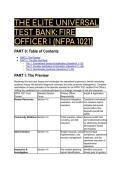
THE ELITE UNIVERSAL
TEST BANK: FIRE
OFFICER I (NFPA 1021)
PART 0: Table of Contents
● PART I: The Preview
● PART II: The Elite Test Bank
○ Tier 1: Foundational Syntax & Application (Questions 1–10)
○ Tier 2: Complex Application & Simulation (Questions 11–20)
○ Tier 3: Grandmaster Synthesis (Questions 21–30)
PART I: The Preview
Mastering this test bank forges raw knowledge into operational supremacy, directly translating
academic theory into decisive fireground command and elite personnel management. Complete
assimilation of these principles is the absolute standard for an NFPA 1021-certified Fire Officer I,
shifting the candidate from a tactical participant to a strategic manager of risk and resources.
NFPA 1021 Core Standard Section Primary Officer Insight & Application
Domain Focus Responsibility
Human Resources Section 4.2 Personnel delegation, Transforms individuals
evaluation, and conflict into cohesive teams;
resolution. mitigates behavioral
issues before they
degrade operational
safety.
Community Relations Section 4.3 Public inquiries, citizen Secures public trust
concerns, and risk and institutional funding
reduction. by addressing localized
demographic needs
and hazards.
Administration Section 4.4 Budget requests, policy Ensures legal
implementation, and compliance, operational
records management. readiness, and the
seamless execution of
departmental
objectives.
Inspection & Section 4.5 Pre-incident planning, Identifies structural
Investigation hazard identification, threats prior to ignition;
,NFPA 1021 Core Standard Section Primary Officer Insight & Application
Domain Focus Responsibility
and scene security. protects the legal chain
of custody for origin
and cause
determination.
Emergency Delivery Section 4.6 Initial action plans, The core of the
size-up, and tactical profession; requires
deployment. rapid synthesis of fire
dynamics, construction,
and resource capability
under extreme duress.
Health & Safety Section 4.7 Mishap investigation, Guarantees responder
exposure reporting, and survival; strictly
risk management. enforces OSHA/NFPA
respiratory and
occupational safety
mandates.
Critical Axioms:
● The Command Triad: Life Safety is always FIRST, followed strictly by Incident
Stabilization, and then Property Conservation.
● Span & Unity: Span of control unequivocally dictates 3 to 7 personnel per supervisor, with
5 being the optimal operational standard to prevent cognitive overload. Unity of command
mandates that every individual reports to only one supervisor to eliminate the catastrophe
of conflicting orders.
● Progressive Discipline: Corrective action escalates surgically to correct behavior, not to
punish. The sequence must follow informal counseling, formal verbal reprimand, written
reprimand, suspension, and termination.
● The RECEO-VS Framework: Rescue, Exposures, Confinement, Extinguishment,
Overhaul, Ventilation, Salvage. This is the definitive, sequential tactical operating system
for structural fire suppression.
● Safety Absolutes: Freelancing is strictly prohibited. The incident commander must
continuously evaluate the dynamic risk-to-benefit ratio to ensure responder survival in
decaying structural environments.
PART II: The Elite Test Bank
Tier 1: Foundational Syntax & Application (Questions 1–10)
Q1: A first-arriving Fire Officer I establishes command at a rapidly escalating commercial
structure fire. As additional mutual aid units arrive, the Incident Commander attempts to direct
the tactical maneuvers of nine distinct suppression crews simultaneously. Based on the
principles of the Incident Command System (ICS), which structural failure is occurring, and what
is the MOST APPROPRIATE immediate corrective action? A) Violation of the division of labor;
the Incident Commander must assign all crews to perform the exact same task until it is
completed. B) Breakdown of the unity of command doctrine; the Incident Commander must
order the crews to report to each other to foster teamwork. C) Expansion beyond the optimal
, span of control; the Incident Commander must establish distinct operational Divisions or Groups
and delegate command. D) Failure to establish a unified command matrix; the Incident
Commander must immediately transfer command to a law enforcement officer.
● The Answer: C (Expansion beyond the optimal span of control; the Incident Commander
must establish distinct operational Divisions or Groups and delegate command)
● Distractor Analysis:
○ A is incorrect: The division of labor refers to breaking complex, overarching
objectives into smaller, manageable assignments to prevent duplication of effort, not
forcing all units into a singular tactical bottleneck.
○ B is incorrect: Unity of command requires that each firefighter reports to exactly one
supervisor to prevent conflicting directives. Having crews report to each other
destroys accountability and chain of command.
○ D is incorrect: Unified command is a strategic management tool utilized when an
incident crosses multiple jurisdictions or statutory authorities. It is completely
inappropriate to hand tactical fire control to law enforcement.
The Mentor's Analysis: The fundamental limit of human cognitive processing under the
extreme stress of a hazard zone dictates that a single supervisor cannot effectively manage
more than 3 to 7 subordinates. When the span of control is exceeded, communication
bottlenecks occur, critical safety indicators are missed, and personnel are endangered. By
delegating authority into geographic Divisions or functional Groups, the Incident Commander
restores the administrative hierarchy necessary for survival. Professional/Academic Intuition:
Delegate immediately when direct reports exceed five to maintain tactical superiority; an
overwhelmed commander is a blind commander.
Q2: While attempting to improve station productivity and morale, a newly promoted Fire Officer I
reviews Douglas McGregor's management paradigms. If the officer fundamentally assumes that
the crew inherently dislikes work, avoids responsibility, and must be closely monitored or
coerced to perform adequately, which specific framework is the officer operating under? A)
Theory Y B) Theory Z C) Theory X D) The Hazard Mitigation Model
● The Answer: C (Theory X)
● Distractor Analysis:
○ A is incorrect: Theory Y posits the exact opposite paradigm. It asserts that workers
naturally seek responsibility, are inherently self-motivated, and will excel if given the
proper environment and leadership support.
○ B is incorrect: Theory Z, derived from Japanese management models, focuses on
autonomous performance, extreme trust, life-long employee loyalty, and a close
relationship between work and social life.
○ D is incorrect: The Hazard Mitigation Model is a physical risk management
framework used by Incident Safety Officers to categorize and reduce fireground
hazards, completely unrelated to human resource motivational theories.
The Mentor's Analysis: Management paradigms silently dictate supervisory behavior and
organizational culture. A Theory X approach often results in single-issue, autocratic leadership
focused heavily on raw production while entirely neglecting the human element. Historically
rooted in early industrial-era labor models, this approach often causes catastrophic morale
failures in modern, high-reliability organizations like the fire service. Professional/Academic
Intuition: Leadership styles must adapt to the intellectual capability of the personnel;
rigid adherence to Theory X stifles initiative and breeds resentment.
Q3: A Fire Officer I is conducting a training seminar for probationary firefighters on the
differences between departmental governance documents. Which definition distinguishing
TEST BANK: FIRE
OFFICER I (NFPA 1021)
PART 0: Table of Contents
● PART I: The Preview
● PART II: The Elite Test Bank
○ Tier 1: Foundational Syntax & Application (Questions 1–10)
○ Tier 2: Complex Application & Simulation (Questions 11–20)
○ Tier 3: Grandmaster Synthesis (Questions 21–30)
PART I: The Preview
Mastering this test bank forges raw knowledge into operational supremacy, directly translating
academic theory into decisive fireground command and elite personnel management. Complete
assimilation of these principles is the absolute standard for an NFPA 1021-certified Fire Officer I,
shifting the candidate from a tactical participant to a strategic manager of risk and resources.
NFPA 1021 Core Standard Section Primary Officer Insight & Application
Domain Focus Responsibility
Human Resources Section 4.2 Personnel delegation, Transforms individuals
evaluation, and conflict into cohesive teams;
resolution. mitigates behavioral
issues before they
degrade operational
safety.
Community Relations Section 4.3 Public inquiries, citizen Secures public trust
concerns, and risk and institutional funding
reduction. by addressing localized
demographic needs
and hazards.
Administration Section 4.4 Budget requests, policy Ensures legal
implementation, and compliance, operational
records management. readiness, and the
seamless execution of
departmental
objectives.
Inspection & Section 4.5 Pre-incident planning, Identifies structural
Investigation hazard identification, threats prior to ignition;
,NFPA 1021 Core Standard Section Primary Officer Insight & Application
Domain Focus Responsibility
and scene security. protects the legal chain
of custody for origin
and cause
determination.
Emergency Delivery Section 4.6 Initial action plans, The core of the
size-up, and tactical profession; requires
deployment. rapid synthesis of fire
dynamics, construction,
and resource capability
under extreme duress.
Health & Safety Section 4.7 Mishap investigation, Guarantees responder
exposure reporting, and survival; strictly
risk management. enforces OSHA/NFPA
respiratory and
occupational safety
mandates.
Critical Axioms:
● The Command Triad: Life Safety is always FIRST, followed strictly by Incident
Stabilization, and then Property Conservation.
● Span & Unity: Span of control unequivocally dictates 3 to 7 personnel per supervisor, with
5 being the optimal operational standard to prevent cognitive overload. Unity of command
mandates that every individual reports to only one supervisor to eliminate the catastrophe
of conflicting orders.
● Progressive Discipline: Corrective action escalates surgically to correct behavior, not to
punish. The sequence must follow informal counseling, formal verbal reprimand, written
reprimand, suspension, and termination.
● The RECEO-VS Framework: Rescue, Exposures, Confinement, Extinguishment,
Overhaul, Ventilation, Salvage. This is the definitive, sequential tactical operating system
for structural fire suppression.
● Safety Absolutes: Freelancing is strictly prohibited. The incident commander must
continuously evaluate the dynamic risk-to-benefit ratio to ensure responder survival in
decaying structural environments.
PART II: The Elite Test Bank
Tier 1: Foundational Syntax & Application (Questions 1–10)
Q1: A first-arriving Fire Officer I establishes command at a rapidly escalating commercial
structure fire. As additional mutual aid units arrive, the Incident Commander attempts to direct
the tactical maneuvers of nine distinct suppression crews simultaneously. Based on the
principles of the Incident Command System (ICS), which structural failure is occurring, and what
is the MOST APPROPRIATE immediate corrective action? A) Violation of the division of labor;
the Incident Commander must assign all crews to perform the exact same task until it is
completed. B) Breakdown of the unity of command doctrine; the Incident Commander must
order the crews to report to each other to foster teamwork. C) Expansion beyond the optimal
, span of control; the Incident Commander must establish distinct operational Divisions or Groups
and delegate command. D) Failure to establish a unified command matrix; the Incident
Commander must immediately transfer command to a law enforcement officer.
● The Answer: C (Expansion beyond the optimal span of control; the Incident Commander
must establish distinct operational Divisions or Groups and delegate command)
● Distractor Analysis:
○ A is incorrect: The division of labor refers to breaking complex, overarching
objectives into smaller, manageable assignments to prevent duplication of effort, not
forcing all units into a singular tactical bottleneck.
○ B is incorrect: Unity of command requires that each firefighter reports to exactly one
supervisor to prevent conflicting directives. Having crews report to each other
destroys accountability and chain of command.
○ D is incorrect: Unified command is a strategic management tool utilized when an
incident crosses multiple jurisdictions or statutory authorities. It is completely
inappropriate to hand tactical fire control to law enforcement.
The Mentor's Analysis: The fundamental limit of human cognitive processing under the
extreme stress of a hazard zone dictates that a single supervisor cannot effectively manage
more than 3 to 7 subordinates. When the span of control is exceeded, communication
bottlenecks occur, critical safety indicators are missed, and personnel are endangered. By
delegating authority into geographic Divisions or functional Groups, the Incident Commander
restores the administrative hierarchy necessary for survival. Professional/Academic Intuition:
Delegate immediately when direct reports exceed five to maintain tactical superiority; an
overwhelmed commander is a blind commander.
Q2: While attempting to improve station productivity and morale, a newly promoted Fire Officer I
reviews Douglas McGregor's management paradigms. If the officer fundamentally assumes that
the crew inherently dislikes work, avoids responsibility, and must be closely monitored or
coerced to perform adequately, which specific framework is the officer operating under? A)
Theory Y B) Theory Z C) Theory X D) The Hazard Mitigation Model
● The Answer: C (Theory X)
● Distractor Analysis:
○ A is incorrect: Theory Y posits the exact opposite paradigm. It asserts that workers
naturally seek responsibility, are inherently self-motivated, and will excel if given the
proper environment and leadership support.
○ B is incorrect: Theory Z, derived from Japanese management models, focuses on
autonomous performance, extreme trust, life-long employee loyalty, and a close
relationship between work and social life.
○ D is incorrect: The Hazard Mitigation Model is a physical risk management
framework used by Incident Safety Officers to categorize and reduce fireground
hazards, completely unrelated to human resource motivational theories.
The Mentor's Analysis: Management paradigms silently dictate supervisory behavior and
organizational culture. A Theory X approach often results in single-issue, autocratic leadership
focused heavily on raw production while entirely neglecting the human element. Historically
rooted in early industrial-era labor models, this approach often causes catastrophic morale
failures in modern, high-reliability organizations like the fire service. Professional/Academic
Intuition: Leadership styles must adapt to the intellectual capability of the personnel;
rigid adherence to Theory X stifles initiative and breeds resentment.
Q3: A Fire Officer I is conducting a training seminar for probationary firefighters on the
differences between departmental governance documents. Which definition distinguishing