

Written by students who passed Immediately available after payment Read online or as PDF Wrong document? Swap it for free 4.6 TrustPilot
logo-home
Document preview thumbnail
Preview 3 out of 21 pages
Exam (elaborations)

WND 580 Wound Care Exam (2026) | 90+ Expert-Verified Exam Questions & Answers | Wound Healing, Pressure Injuries, Vascular Assessment, NPWT, Debridement & Advanced Wound Management

Document preview thumbnail
Preview 3 out of 21 pages

This comprehensive WND 580 Wound Care Exam (2026) study guide contains 90+ expert-verified exam questions with detailed answers covering the essential principles of advanced wound healing, pressure injury prevention and management, vascular assessment, wound bed preparation, debridement techniques, advanced dressings, negative pressure wound therapy (NPWT), and evidence-based wound care taught in WND 580. Presented in a structured question-and-answer format, this resource thoroughly reviews foundational wound healing physiology alongside complex clinical scenarios involving arterial, venous, neuropathic, surgical, and pressure-related wounds. It is designed to strengthen clinical reasoning, reinforce evidence-based nursing interventions, and prepare students for final examinations, WOC certification, and advanced wound care practice. This study guide comprehensively reviews hemostasis, inflammation, proliferation, maturation, fibroblasts, collagen synthesis, elastin production, platelet activation, granulation tissue, epithelialization, scar formation, necrotic tissue, eschar, slough, maceration, excoriation, hypergranulation, physiologic wound environment, TIME and TIMERS wound bed preparation frameworks, moisture balance, pH regulation, wound temperature, bioburden control, wound infection assessment, biofilm, matrix metalloproteinases (MMPs), oxygen perfusion, protein-energy malnutrition, zinc deficiency, pressure injury staging, Braden Scale risk assessment, deep tissue pressure injuries, pressure redistribution surfaces, low-air-loss mattresses, air-fluidized therapy, wheelchair pressure redistribution, support surface selection, shear and friction injuries, pressure injury prevention strategies, conservative sharp wound debridement (CSWD), autolytic debridement, wound cleansing and irrigation, hydrocolloid dressings, hydrogel dressings, foam dressings, calcium alginate, silver alginate rope, antimicrobial hydrofiber, transparent films, non-adherent dressings, Negative Pressure Wound Therapy (NPWT), electrical stimulation therapy, ultrasonic mist therapy, arterial insufficiency ulcers, venous leg ulcers (VLUs), diabetic foot ulcers (DFUs), neuropathic ulcers, mixed arterial-venous ulcers, ankle-brachial index (ABI), transcutaneous oxygen pressure (TcPO₂), duplex ultrasound, graduated compression therapy, inelastic compression bandages, total contact casting (TCC), Charcot foot, lipodermatosclerosis, venous dermatitis, lymphedema, Stemmer sign, burn rehabilitation, radiation dermatitis, necrotizing fasciitis, toxic epidermal necrolysis (TEN), pyoderma gangrenosum, surgical wound dehiscence, surgical site infection (SSI) prevention, hyperglycemia management, obesity-related wound complications, neonatal skin care, monofilament sensory testing, tertiary wound closure, and evidence-based wound management guidelines. The extensive question bank reinforces high-yield examination concepts while promoting clinical decision-making across acute care, long-term care, outpatient wound centers, rehabilitation, and home healthcare settings. This study guide aligns with the learning outcomes of WND 580, Advanced Wound Care, Wound, Ostomy and Continence (WOC) Nursing, Pressure Injury Prevention and Management, Medical-Surgical Nursing, Advanced Clinical Assessment, Evidence-Based Nursing Practice, Vascular Wound Management, Diabetic Foot Management, Burn Care, and Skin and Wound Management courses. It serves as a comprehensive revision resource for mastering wound assessment, selecting appropriate wound therapies, interpreting vascular findings, applying evidence-based interventions, improving patient outcomes, and preparing for university examinations, specialty certification, graduate nursing coursework, and advanced clinical wound care practice. This resource is particularly valuable for WND 580 students, Wound Ostomy Continence Nursing (WOCN) students, WOC certification candidates, Bachelor of Science in Nursing (BSN) students, Master of Science in Nursing (MSN) students, Doctor of Nursing Practice (DNP) students, Registered Nurses (RNs), Advanced Practice Registered Nurses (APRNs), Nurse Practitioners (NPs), Clinical Nurse Specialists (CNSs), Medical-Surgical Nursing students, Adult Health Nursing students, Critical Care Nurses, Wound Care Specialists, Diabetes Care Nurses, Burn Care Nurses, Long-Term Acute Care (LTAC) clinicians, Rehabilitation Nurses, Home Health Nurses, Clinical Nurse Educators, and healthcare professionals preparing for advanced wound care examinations, WOC certification, or expert clinical practice in wound, ostomy, and continence management. Academic References Baranoski, S., & Ayello, E. A. (2023). Wound Care Essentials: Practice Principles (5th ed.). Wolters Kluwer. Bryant, R. A., & Nix, D. P. (2023). Acute and Chronic Wounds: Current Management Concepts (6th ed.). Elsevier. Wound, Ostomy and Continence Nurses Society (WOCN). (2024). WOCN Society Clinical Practice Guidelines. WOCN Society. European Pressure Ulcer Advisory Panel (EPUAP), National Pressure Injury Advisory Panel (NPIAP), & Pan Pacific Pressure Injury Alliance (PPPIA). (2019). Prevention and Treatment of Pressure Ulcers/Injuries: Clinical Practice Guideline. International Working Group on the Diabetic Foot (IWGDF). (2023). IWGDF Guidelines on the Prevention and Management of Diabetes-Related Foot Disease. Keywords WND 580, WND 580 Wound Care Exam, WND 580 Final Exam, advanced wound care, wound healing, wound assessment, wound management, wound care nursing, fibroblasts, collagen synthesis, wound healing phases, hemostasis, inflammation, proliferation, maturation, granulation tissue, epithelialization, scar formation, pressure injury, pressure ulcer, deep tissue pressure injury, Braden Scale, pressure redistribution, low air loss mattress, air fluidized bed, NPWT, negative pressure wound therapy, wound debridement, autolytic debridement, conservative sharp wound debridement, CSWD, wound cleansing, wound irrigation, TIME framework, TIMERS framework, biofilm, matrix metalloproteinases, MMPs, wound infection, necrotic tissue, eschar, maceration, arterial ulcer, venous ulcer, diabetic foot ulcer, neuropathic ulcer, ankle brachial index, ABI, TcPO2, duplex ultrasound, compression therapy, Charcot foot, lymphedema, lipodermatosclerosis, venous dermatitis, hydrocolloid dressing, hydrogel dressing, calcium alginate, foam dressing, antimicrobial hydrofiber, silver alginate rope, burn care, radiation dermatitis, necrotizing fasciitis, toxic epidermal necrolysis, TEN, pyoderma gangrenosum, surgical wound dehiscence, surgical site infection, SSI, hyperglycemia, obesity, neonatal skin care, monofilament testing, WOC nursing, WOCN certification, nursing exam questions, practice questions, complete study guide

Content preview

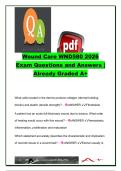
Wound Care WND580 2026
Exam Questions and Answers |
Already Graded A+


What cells located in the dermis produce collagen (dermal building

blocks) and elastin (tensile strength)? - ANSWER ✔✔Fibroblasts


A patient has an acute full-thickness wound due to trauma. What order

of healing would occur with this wound? - ANSWER ✔✔hemostasis,

inflammation, proliferation and maturation

Which statement accurately describes the characteristic and implication

of necrotic tissue in a wound bed? - ANSWER ✔✔Eschar usually is

,black, brown, or gray and associated with deeper tissue damage. It is

usually firmly attached to the wound base.

What is the primary reason for taking the time to perform a

comprehensive assessment to identify protein energy malnutrition as

opposed to ordering a simple blood draw to formulate a diagnosis? -

ANSWER ✔✔Blood tests do not provide a stand alone assessment.


This wound will heal with a scar formation. - ANSWER ✔✔full

thickness wound

When the skin around a wound develops a whitish appearance, it can be

described as? - ANSWER ✔✔maceration.


As you setup a skin care program, you identify the elderly to be at risk

for skin tears due to the effects of aging on the: - ANSWER ✔✔rete

ridges

As wound healing progresses, collagen deposition and remodeling occur

and has which of the following effects? - ANSWER ✔✔increased

tensile strength

You are aware that age itself is not a risk factor for failure to heal

wounds. Problems in wound healing for the elderly are most likely

associated with: - ANSWER ✔✔Multiple co-morbidities

, An intubated pt. with HOB elevated to 45 degrees. Has a stage 3

pressure ulcer on her coccyx with undermining. Which of the following

risk factors is most responsible for undermining in the pressure injuries?

- ANSWER ✔✔Shear from having the HOB elevated to 45 Degrees.


Arterial disease, hypotension, vasopressors and severe anemia can be

deleterious to wound healing because they decrease the amount of: -

ANSWER ✔✔Oxygen in the tissue


What cell plays a central role in initiating the wound repair process? -

ANSWER ✔✔Platelets


90 Year old female in the nursing home has a partial thickness wound

with a fully approximated epidermal flap on her left forearm. What type of

skin damage is present - ANSWER ✔✔Skin tear, type 1


Which treatment would be most appropriate for the management of a

partial thickness wound with a fully approximated epidermal flap? -

ANSWER ✔✔Re-approximate edges and apply a non-adherent

dressing

When changing a wound dressing over a full thickness wound, you

notice the wound bed is shiny, moist, red and has a cobblestone


3
COPYRIGHT©JOSHCLAY 2025/2026. YEAR PUBLISHED 2026. COMPANY REGISTRATION NUMBER: 619652435. TERMS OF USE. PRIVACY
STATEMENT. ALL RIGHTS RESERVED


Document information

Uploaded on
July 17, 2026
Number of pages
21
Written in
2025/2026
Type
Exam (elaborations)
Contains
Questions & answers
$18.99

Wrong document? Swap it for free Within 14 days of purchase and before downloading, you can choose a different document. You can simply spend the amount again.
Written by students who passed
Immediately available after payment
Read online or as PDF

Seller avatar
Reputation scores are based on the amount of documents a seller has sold for a fee and the reviews they have received for those documents. There are three levels: Bronze, Silver and Gold. The better the reputation, the more your can rely on the quality of the sellers work.
JOSHCLAY
3.5
(82)
Sold
379
Followers
16
Items
20253
Last sold
1 day ago


Why students choose Stuvia

Created by fellow students, verified by reviews

Quality you can trust: written by students who passed their tests and reviewed by others who've used these notes.

Didn't get what you expected? Choose another document

No worries! You can instantly pick a different document that better fits what you're looking for.

Pay as you like, start learning right away

No subscription, no commitments. Pay the way you're used to via credit card and download your PDF document instantly.

Student with book image

“Bought, downloaded, and aced it. It really can be that simple.”

Alisha Student

Working on your references?

Create accurate citations in APA, MLA and Harvard with our free citation generator.

Working on your references?

Frequently asked questions
