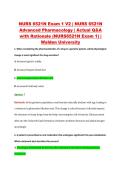
NURS 6521N Exam 1 V2 | NURS 6521N
Advanced Pharmacology | Actual Q&A
with Rationale (NURS6521N Exam 1) |
Walden University
1. When considering the pharmacokinetics of a drug in a geriatric patient, which physiological
change is most significant for drug excretion?
A. Increased gastric acidity
B. Increased hepatic blood flow
C. Decreased glomerular filtration rate
D. Increased total body water
Answer: C
Rationale: In the geriatric population, renal function naturally declines with age, leading to
a reduction in glomerular filtration rate. This change is critical because it directly impacts
the clearance of many drugs from the body, increasing the risk of toxicity. Clinicians must
often use the Cockcroft-Gault formula to estimate creatinine clearance and adjust dosages
accordingly.
2. A patient is prescribed an oral medication that undergoes significant first-pass metabolism.
Which statement best describes this process?
A. The drug is metabolized by the liver after absorption but before reaching systemic
circulation.
,B. The drug is excreted by the kidneys before reaching the liver.
C. The drug bypasses the liver via the lymphatic system.
D. The drug is deactivated by gastric acid in the stomach.
Answer: A
Rationale: First-pass metabolism occurs when an orally administered drug is absorbed
from the gastrointestinal tract into the portal venous system. The drug then travels to the
liver, where enzymes may metabolize a large portion of it before it ever reaches the
systemic circulation. This phenomenon explains why the oral dose of certain medications is
significantly higher than the intravenous dose.
3. Which pregnancy category is assigned to drugs where the risk to the fetus clearly
outweighs any possible maternal benefit?
A. Category A
B. Category X
C. Category C
D. Category B
Answer: B
Rationale: Category X signifies that studies in animals or humans have demonstrated fetal
abnormalities or there is evidence of fetal risk based on human experience. The risks
, involved in the use of the drug in pregnant women clearly outweigh any potential benefits.
These drugs are strictly contraindicated in women who are or may become pregnant.
4. In pediatric patients, why is the risk of drug toxicity increased for drugs that are primarily
distributed in body water?
A. Pediatric patients have more adipose tissue than adults.
B. Pediatric patients have lower gastric pH levels.
C. Children have increased plasma protein binding sites.
D. Neonates and infants have a higher percentage of total body water than adults.
Answer: D
Rationale: Neonates and infants possess a significantly higher percentage of total body
water compared to adults, reaching up to 80 percent. This affects the volume of
distribution for water-soluble drugs, requiring careful dosage calculations to reach
therapeutic levels. Consequently, as the water content shifts during growth, the
concentration of the drug in the blood can change rapidly, necessitating close monitoring.
5. A drug is considered an ‘agonist’ if it performs which of the following actions?
A. Blocks the receptor site to prevent activation.
B. Increases the rate of drug excretion.
C. Binds to a receptor and triggers a biological response.
D. Inhibits the cytochrome P450 enzyme system.
Advanced Pharmacology | Actual Q&A
with Rationale (NURS6521N Exam 1) |
Walden University
1. When considering the pharmacokinetics of a drug in a geriatric patient, which physiological
change is most significant for drug excretion?
A. Increased gastric acidity
B. Increased hepatic blood flow
C. Decreased glomerular filtration rate
D. Increased total body water
Answer: C
Rationale: In the geriatric population, renal function naturally declines with age, leading to
a reduction in glomerular filtration rate. This change is critical because it directly impacts
the clearance of many drugs from the body, increasing the risk of toxicity. Clinicians must
often use the Cockcroft-Gault formula to estimate creatinine clearance and adjust dosages
accordingly.
2. A patient is prescribed an oral medication that undergoes significant first-pass metabolism.
Which statement best describes this process?
A. The drug is metabolized by the liver after absorption but before reaching systemic
circulation.
,B. The drug is excreted by the kidneys before reaching the liver.
C. The drug bypasses the liver via the lymphatic system.
D. The drug is deactivated by gastric acid in the stomach.
Answer: A
Rationale: First-pass metabolism occurs when an orally administered drug is absorbed
from the gastrointestinal tract into the portal venous system. The drug then travels to the
liver, where enzymes may metabolize a large portion of it before it ever reaches the
systemic circulation. This phenomenon explains why the oral dose of certain medications is
significantly higher than the intravenous dose.
3. Which pregnancy category is assigned to drugs where the risk to the fetus clearly
outweighs any possible maternal benefit?
A. Category A
B. Category X
C. Category C
D. Category B
Answer: B
Rationale: Category X signifies that studies in animals or humans have demonstrated fetal
abnormalities or there is evidence of fetal risk based on human experience. The risks
, involved in the use of the drug in pregnant women clearly outweigh any potential benefits.
These drugs are strictly contraindicated in women who are or may become pregnant.
4. In pediatric patients, why is the risk of drug toxicity increased for drugs that are primarily
distributed in body water?
A. Pediatric patients have more adipose tissue than adults.
B. Pediatric patients have lower gastric pH levels.
C. Children have increased plasma protein binding sites.
D. Neonates and infants have a higher percentage of total body water than adults.
Answer: D
Rationale: Neonates and infants possess a significantly higher percentage of total body
water compared to adults, reaching up to 80 percent. This affects the volume of
distribution for water-soluble drugs, requiring careful dosage calculations to reach
therapeutic levels. Consequently, as the water content shifts during growth, the
concentration of the drug in the blood can change rapidly, necessitating close monitoring.
5. A drug is considered an ‘agonist’ if it performs which of the following actions?
A. Blocks the receptor site to prevent activation.
B. Increases the rate of drug excretion.
C. Binds to a receptor and triggers a biological response.
D. Inhibits the cytochrome P450 enzyme system.