

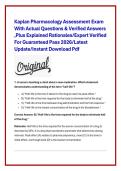
Kaplan Pharmacology Assessment Exam
With Actual Questions & Verified Answers
,Plus Explained Rationales/Expert Verified
For Guaranteed Pass 2026/Latest
Update/Instant Download Pdf
1. A nurse is teaching a client about a new medication. Which statement
demonstrates understanding of the term "half-life"?
• A) "Half-life is the time it takes for the drug to reach its peak effect."
• B) "Half-life is the time required for the body to eliminate half of the drug."
• C) "Half-life is the time between drug administration and the first response."
• D) "Half-life is the lowest concentration of the drug in the bloodstream."
Correct Answer: B) "Half-life is the time required for the body to eliminate half
of the drug."
Rationale: Half-life is the time required for the serum concentration of a drug to
decrease by 50%. It is a key pharmacokinetic parameter that determines dosing
intervals. Peak effect (A) relates to pharmacodynamics, onset (C) is the time to
initial effect, and trough level (D) is the lowest concentration.
,2. A drug with a narrow therapeutic index requires which nursing action?
• A) Administration with food to enhance absorption
• B) Frequent monitoring of serum drug levels
• C) Administration of a loading dose
• D) Use of a topical route to minimize systemic effects
Correct Answer: B) Frequent monitoring of serum drug levels
Rationale: Drugs with a narrow therapeutic index (e.g., digoxin, lithium, warfarin,
phenytoin) have a small margin between therapeutic and toxic doses. Serum drug
levels must be monitored frequently to avoid toxicity while ensuring therapeutic
efficacy.
3. A nurse is administering a medication that is highly protein-bound. Which
condition could increase the risk of drug toxicity?
• A) Decreased liver function
• B) Hypoalbuminemia
• C) Increased renal excretion
• D) Decreased gastric pH
Correct Answer: B) Hypoalbuminemia
Rationale: Highly protein-bound drugs rely on albumin for transport. In
hypoalbuminemia (low serum albumin), more free (unbound) drug is available,
increasing the risk of toxicity. Liver function affects metabolism, renal excretion
affects elimination, and gastric pH affects absorption.
,4. Which route of medication administration has the fastest onset of action?
• A) Oral
• B) Subcutaneous
• C) Intramuscular
• D) Intravenous
Correct Answer: D) Intravenous
Rationale: Intravenous (IV) administration delivers the drug directly into the
bloodstream, providing the fastest onset of action. Oral medications must undergo
absorption and first-pass metabolism, while subcutaneous and intramuscular
routes require absorption from the injection site.
5. A client is prescribed a medication that undergoes significant first-pass
metabolism. Which route would the nurse expect to be ordered to bypass this
effect?
• A) Oral
• B) Sublingual
• C) Rectal
• D) Intramuscular
Correct Answer: B) Sublingual
Rationale: Sublingual administration allows the drug to be absorbed directly into
the systemic circulation through the oral mucosa, bypassing first-pass metabolism
in the liver. Oral and rectal routes are subject to first-pass metabolism, and
intramuscular administration partially bypasses it but not completely.
, 6. The nurse is reviewing a medication order. Which component is essential for
a complete medication order?
• A) Client's diagnosis
• B) Client's age
• C) Route of administration
• D) Client's weight
Correct Answer: C) Route of administration
Rationale: A complete medication order must include the client's name, date,
medication name, dose, route, frequency, and signature of the prescriber.
Diagnosis, age, and weight are important but not required components of a
complete order.
7. A nurse is preparing to administer an enteric-coated tablet. Which action is
correct?
• A) Crush the tablet and mix with applesauce
• B) Administer the tablet whole without crushing
• C) Dissolve the tablet in water before administration
• D) Split the tablet for a smaller dose
Correct Answer: B) Administer the tablet whole without crushing
Rationale: Enteric-coated tablets are designed to resist dissolution in the stomach
and dissolve in the intestines to protect the drug from gastric acid or to protect the
stomach from the drug. Crushing, splitting, or dissolving destroys the enteric
coating.
With Actual Questions & Verified Answers
,Plus Explained Rationales/Expert Verified
For Guaranteed Pass 2026/Latest
Update/Instant Download Pdf
1. A nurse is teaching a client about a new medication. Which statement
demonstrates understanding of the term "half-life"?
• A) "Half-life is the time it takes for the drug to reach its peak effect."
• B) "Half-life is the time required for the body to eliminate half of the drug."
• C) "Half-life is the time between drug administration and the first response."
• D) "Half-life is the lowest concentration of the drug in the bloodstream."
Correct Answer: B) "Half-life is the time required for the body to eliminate half
of the drug."
Rationale: Half-life is the time required for the serum concentration of a drug to
decrease by 50%. It is a key pharmacokinetic parameter that determines dosing
intervals. Peak effect (A) relates to pharmacodynamics, onset (C) is the time to
initial effect, and trough level (D) is the lowest concentration.
,2. A drug with a narrow therapeutic index requires which nursing action?
• A) Administration with food to enhance absorption
• B) Frequent monitoring of serum drug levels
• C) Administration of a loading dose
• D) Use of a topical route to minimize systemic effects
Correct Answer: B) Frequent monitoring of serum drug levels
Rationale: Drugs with a narrow therapeutic index (e.g., digoxin, lithium, warfarin,
phenytoin) have a small margin between therapeutic and toxic doses. Serum drug
levels must be monitored frequently to avoid toxicity while ensuring therapeutic
efficacy.
3. A nurse is administering a medication that is highly protein-bound. Which
condition could increase the risk of drug toxicity?
• A) Decreased liver function
• B) Hypoalbuminemia
• C) Increased renal excretion
• D) Decreased gastric pH
Correct Answer: B) Hypoalbuminemia
Rationale: Highly protein-bound drugs rely on albumin for transport. In
hypoalbuminemia (low serum albumin), more free (unbound) drug is available,
increasing the risk of toxicity. Liver function affects metabolism, renal excretion
affects elimination, and gastric pH affects absorption.
,4. Which route of medication administration has the fastest onset of action?
• A) Oral
• B) Subcutaneous
• C) Intramuscular
• D) Intravenous
Correct Answer: D) Intravenous
Rationale: Intravenous (IV) administration delivers the drug directly into the
bloodstream, providing the fastest onset of action. Oral medications must undergo
absorption and first-pass metabolism, while subcutaneous and intramuscular
routes require absorption from the injection site.
5. A client is prescribed a medication that undergoes significant first-pass
metabolism. Which route would the nurse expect to be ordered to bypass this
effect?
• A) Oral
• B) Sublingual
• C) Rectal
• D) Intramuscular
Correct Answer: B) Sublingual
Rationale: Sublingual administration allows the drug to be absorbed directly into
the systemic circulation through the oral mucosa, bypassing first-pass metabolism
in the liver. Oral and rectal routes are subject to first-pass metabolism, and
intramuscular administration partially bypasses it but not completely.
, 6. The nurse is reviewing a medication order. Which component is essential for
a complete medication order?
• A) Client's diagnosis
• B) Client's age
• C) Route of administration
• D) Client's weight
Correct Answer: C) Route of administration
Rationale: A complete medication order must include the client's name, date,
medication name, dose, route, frequency, and signature of the prescriber.
Diagnosis, age, and weight are important but not required components of a
complete order.
7. A nurse is preparing to administer an enteric-coated tablet. Which action is
correct?
• A) Crush the tablet and mix with applesauce
• B) Administer the tablet whole without crushing
• C) Dissolve the tablet in water before administration
• D) Split the tablet for a smaller dose
Correct Answer: B) Administer the tablet whole without crushing
Rationale: Enteric-coated tablets are designed to resist dissolution in the stomach
and dissolve in the intestines to protect the drug from gastric acid or to protect the
stomach from the drug. Crushing, splitting, or dissolving destroys the enteric
coating.


