

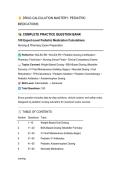
DRUG CALCULATION MASTERY: PEDIATRIC
MEDICATIONS
COMPLETE PRACTICE QUESTION BANK
100 Expert-Level Pediatric Medication Calculations
Nursing & Pharmacy Exam Preparation
Perfect for: NCLEX-RN • NCLEX-PN • Pediatric Nursing Certification •
Pharmacy Technician • Nursing School Finals • Clinical Competency Exams
Topics Covered: Weight-Based Dosing • BSA-Based Dosing (Mosteller
Formula) • IV Fluid Maintenance (Holliday-Segar) • Neonatal Dosing • Oral
Rehydration • TPN Calculations • Pediatric Sedation • Pediatric Chemotherapy •
Pediatric Antibiotics • Acetaminophen Dosing
Skill Level: Intermediate → Advanced
Total Questions: 100
Every question includes step-by-step solutions, clinical context, and safety notes.
Designed by pediatric nursing educators for maximum exam success.
TABLE OF CONTENTS
Section Questions Topic
1 1–10 Weight-Based Oral Dosing
2 11–20 BSA-Based Dosing (Mosteller Formula)
3 21–30 IV Fluid Maintenance (Holliday-Segar)
4 31–40 Pediatric IV Antibiotics
5 41–50 Pediatric Acetaminophen Dosing
6 51–60 Neonatal Medications
nursing
,Section Questions Topic
7 61–70 Oral Rehydration
8 71–80 TPN Calculations
9 81–90 Pediatric Sedation
10 91–100 Pediatric Chemotherapy
HOW TO USE THIS DOCUMENT
1. Attempt each question independently before checking the answer.
2. Show all your work — examiners award partial credit for correct
methodology.
3. Review the safety notes — pediatric dosing errors can be fatal.
4. Time yourself — aim for 3–4 minutes per question on exam day.
5. Flag difficult questions for later review.
CLINICAL SAFETY REMINDERS
• Always double-check the weight — pediatric doses are entirely weight-
dependent.
• Verify the child’s age — some medications are contraindicated in certain
age groups.
• Use pediatric-specific formulations when available.
• Calculate BSA carefully — chemotherapy dosing errors are catastrophic.
• Monitor fluid balance closely — children are vulnerable to fluid overload
and dehydration.
• Use oral syringes for liquid medications — never household spoons.
• Check maximum daily doses — especially for acetaminophen and
ibuprofen.
• When in doubt, ask — patient safety is everyone’s responsibility.
nursing
,Question 1: Pediatric Medication – Body Surface Area (BSA)
Dosing
Patient: Daniel, 6 years old, height 120 cm, weight 18 kg
Order: Methotrexate 15 mg/m² PO weekly
Available: Methotrexate 2.5 mg tablets
Question: a) Calculate the patient’s BSA using the Mosteller formula. b) How
many tablets will you administer?
Answer
Part a – Calculate BSA:
Step 1: Apply the Mosteller formula. - BSA (m²) = √[(Height (cm) × Weight (kg)) /
3600] - BSA = √[(120 × 18) / 3600] - BSA = √[] - BSA = √0.6 - BSA ≈
0.77 m²
Part b – Calculate tablets:
Step 1: Calculate the dose. - Dose = 15 mg/m² × 0.77 m² = 11.55 mg
Step 2: Calculate tablets. - Tablets = 11.55 mg / 2.5 mg per tablet = 4.62 tablets
Step 3: Round appropriately. - Depending on protocol, this may be rounded per
institutional chemotherapy dosing policy.
Answer: a) 0.77 m² | b) 4.62 tablets (round per protocol)
Question 2: Pediatric Medication – IV Fluid Maintenance
Patient: Lucas, 9 years old, weight 8 kg
Order: D5W IV at maintenance rate
Question: At what rate (mL/hr) will you set the infusion pump?
Answer
Step 1: Apply the pediatric maintenance fluid formula (Holliday-Segar method). -
For first 10 kg: 100 mL/kg/day - For next 10 kg: 50 mL/kg/day - For each kg
above 20 kg: 20 mL/kg/day
Step 2: Calculate daily fluid requirement. - 8 kg × 100 = 800 mL
nursing
, Step 3: Convert to hourly rate. - Rate = 800 mL / 24 hr = 33.3 mL/hr
Answer: 33.3 mL/hr
Question 3: Pediatric Medication – Chemotherapy
Patient: Zoe, 8 years old, height 90 cm, weight 15 kg
Order: Topotecan 2 mg/m² IV weekly
Available: Topotecan 4 mg/mL in a 2 mL vial
Question: a) Calculate BSA using the Mosteller formula. b) How many mL will
you administer?
Answer
Part a – Calculate BSA:
Step 1: Apply the Mosteller formula. - BSA (m²) = √[(Height (cm) × Weight (kg)) /
3600] - BSA = √[(90 × 15) / 3600] - BSA = √[] - BSA = √0.375 - BSA ≈
0.61 m²
Part b – Calculate volume:
Step 1: Calculate the dose. - Dose = 2 mg/m² × 0.61 m² = 1.22 mg
Step 2: Calculate volume. - Volume = 1.22 mg / 4 mg/mL = 0.3 mL
Note: Topotecan is a vesicant. Administer ONLY via IV into a running IV of NS or
D5W. Use a 1 mL tuberculin syringe for accuracy.
Answer: a) 0.61 m² | b) 0.3 mL
Question 4: Pediatric Medication – IV Antibiotic
Patient: Mia, 4 years old, weight 8 kg
Order: Doxycycline 2 mg/kg IV q24h
Available: Doxycycline 10 mL vial (reconstitutes to 16 mg); dilute in 50 mL NS
and infuse over 60 minutes
Question: a) What is the dose per administration? b) How many mL of
reconstituted Doxycycline will you administer? c) At what rate (mL/hr) will you set
the pump?
nursing
MEDICATIONS
COMPLETE PRACTICE QUESTION BANK
100 Expert-Level Pediatric Medication Calculations
Nursing & Pharmacy Exam Preparation
Perfect for: NCLEX-RN • NCLEX-PN • Pediatric Nursing Certification •
Pharmacy Technician • Nursing School Finals • Clinical Competency Exams
Topics Covered: Weight-Based Dosing • BSA-Based Dosing (Mosteller
Formula) • IV Fluid Maintenance (Holliday-Segar) • Neonatal Dosing • Oral
Rehydration • TPN Calculations • Pediatric Sedation • Pediatric Chemotherapy •
Pediatric Antibiotics • Acetaminophen Dosing
Skill Level: Intermediate → Advanced
Total Questions: 100
Every question includes step-by-step solutions, clinical context, and safety notes.
Designed by pediatric nursing educators for maximum exam success.
TABLE OF CONTENTS
Section Questions Topic
1 1–10 Weight-Based Oral Dosing
2 11–20 BSA-Based Dosing (Mosteller Formula)
3 21–30 IV Fluid Maintenance (Holliday-Segar)
4 31–40 Pediatric IV Antibiotics
5 41–50 Pediatric Acetaminophen Dosing
6 51–60 Neonatal Medications
nursing
,Section Questions Topic
7 61–70 Oral Rehydration
8 71–80 TPN Calculations
9 81–90 Pediatric Sedation
10 91–100 Pediatric Chemotherapy
HOW TO USE THIS DOCUMENT
1. Attempt each question independently before checking the answer.
2. Show all your work — examiners award partial credit for correct
methodology.
3. Review the safety notes — pediatric dosing errors can be fatal.
4. Time yourself — aim for 3–4 minutes per question on exam day.
5. Flag difficult questions for later review.
CLINICAL SAFETY REMINDERS
• Always double-check the weight — pediatric doses are entirely weight-
dependent.
• Verify the child’s age — some medications are contraindicated in certain
age groups.
• Use pediatric-specific formulations when available.
• Calculate BSA carefully — chemotherapy dosing errors are catastrophic.
• Monitor fluid balance closely — children are vulnerable to fluid overload
and dehydration.
• Use oral syringes for liquid medications — never household spoons.
• Check maximum daily doses — especially for acetaminophen and
ibuprofen.
• When in doubt, ask — patient safety is everyone’s responsibility.
nursing
,Question 1: Pediatric Medication – Body Surface Area (BSA)
Dosing
Patient: Daniel, 6 years old, height 120 cm, weight 18 kg
Order: Methotrexate 15 mg/m² PO weekly
Available: Methotrexate 2.5 mg tablets
Question: a) Calculate the patient’s BSA using the Mosteller formula. b) How
many tablets will you administer?
Answer
Part a – Calculate BSA:
Step 1: Apply the Mosteller formula. - BSA (m²) = √[(Height (cm) × Weight (kg)) /
3600] - BSA = √[(120 × 18) / 3600] - BSA = √[] - BSA = √0.6 - BSA ≈
0.77 m²
Part b – Calculate tablets:
Step 1: Calculate the dose. - Dose = 15 mg/m² × 0.77 m² = 11.55 mg
Step 2: Calculate tablets. - Tablets = 11.55 mg / 2.5 mg per tablet = 4.62 tablets
Step 3: Round appropriately. - Depending on protocol, this may be rounded per
institutional chemotherapy dosing policy.
Answer: a) 0.77 m² | b) 4.62 tablets (round per protocol)
Question 2: Pediatric Medication – IV Fluid Maintenance
Patient: Lucas, 9 years old, weight 8 kg
Order: D5W IV at maintenance rate
Question: At what rate (mL/hr) will you set the infusion pump?
Answer
Step 1: Apply the pediatric maintenance fluid formula (Holliday-Segar method). -
For first 10 kg: 100 mL/kg/day - For next 10 kg: 50 mL/kg/day - For each kg
above 20 kg: 20 mL/kg/day
Step 2: Calculate daily fluid requirement. - 8 kg × 100 = 800 mL
nursing
, Step 3: Convert to hourly rate. - Rate = 800 mL / 24 hr = 33.3 mL/hr
Answer: 33.3 mL/hr
Question 3: Pediatric Medication – Chemotherapy
Patient: Zoe, 8 years old, height 90 cm, weight 15 kg
Order: Topotecan 2 mg/m² IV weekly
Available: Topotecan 4 mg/mL in a 2 mL vial
Question: a) Calculate BSA using the Mosteller formula. b) How many mL will
you administer?
Answer
Part a – Calculate BSA:
Step 1: Apply the Mosteller formula. - BSA (m²) = √[(Height (cm) × Weight (kg)) /
3600] - BSA = √[(90 × 15) / 3600] - BSA = √[] - BSA = √0.375 - BSA ≈
0.61 m²
Part b – Calculate volume:
Step 1: Calculate the dose. - Dose = 2 mg/m² × 0.61 m² = 1.22 mg
Step 2: Calculate volume. - Volume = 1.22 mg / 4 mg/mL = 0.3 mL
Note: Topotecan is a vesicant. Administer ONLY via IV into a running IV of NS or
D5W. Use a 1 mL tuberculin syringe for accuracy.
Answer: a) 0.61 m² | b) 0.3 mL
Question 4: Pediatric Medication – IV Antibiotic
Patient: Mia, 4 years old, weight 8 kg
Order: Doxycycline 2 mg/kg IV q24h
Available: Doxycycline 10 mL vial (reconstitutes to 16 mg); dilute in 50 mL NS
and infuse over 60 minutes
Question: a) What is the dose per administration? b) How many mL of
reconstituted Doxycycline will you administer? c) At what rate (mL/hr) will you set
the pump?
nursing


